





Every summer, the same pattern plays out across Monroe County. A line of thunderstorms rolls off Lake Ontario on a humid July afternoon, the wind gusts hard for ten minutes, and by dinner time our phone is ringing — a silver maple on a garage in Webster, half an ash across a driveway in Penfield, a big limb hanging over a swing set in Greece.
Here's the thing most homeowners don't realize: the trees that fail in summer storms almost never fail at random. In the vast majority of the storm calls we run, the tree was showing warning signs weeks or months earlier — signs you can spot yourself from the ground. This guide walks you through the 15-minute yard check we'd do on your property, what each red flag means, and what's actually worth fixing before the next microburst.
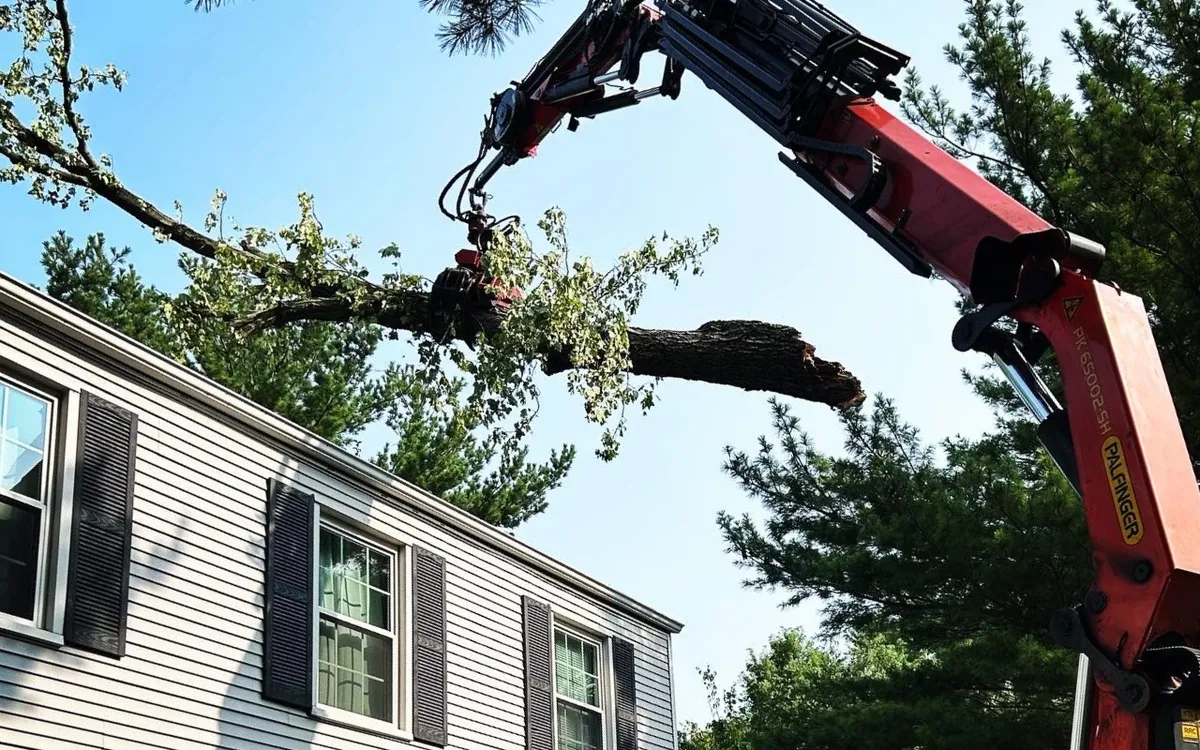
Why Summer Storms Hit Rochester Trees So Hard
Rochester's summer storms are a different animal than winter wind. Three things make July and August the peak season for tree failure here:
- Full canopy = full sail. A mature maple in leaf catches enormously more wind than the same tree bare in January. All that surface area turns a 60 mph gust into thousands of pounds of lateral load.
- Saturated ground. A heavy downpour ahead of the wind softens the root zone. Wet soil holds roots the way wet sand holds a beach umbrella.
- Microbursts. The lake-effect geography that gives us snow in January gives us localized downburst winds in July — short, violent, and concentrated on a few streets at a time. That's why one block in Irondequoit gets shredded while the next block is untouched.
The 15-Minute Yard Check
Walk your property line with a coffee and look for these, in order of urgency:
1. Dead wood in a green canopy
Bare, leafless branches standing out against an otherwise leafed-out tree are the single most common thing we remove after storms — because they're the first thing the wind takes. Dead limbs over a driveway, roof, or play area shouldn't wait for a convenient season.
2. Cracks and splits where branches meet the trunk
Look at the big unions — the spots where major limbs fork off. A visible crack, a seam of dark staining, or bark pushing out of the joint (what arborists call included bark) means the union is already failing. Silver maples and Bradford pears are notorious for this.
3. A new lean, or lifted soil at the base
Trees rarely straighten themselves. If a tree is leaning further than it did last summer — or you can see the soil cracked or mounded on the side away from the lean — the root plate is moving. That's the failure mode that puts whole trees on houses, and it deserves a professional look this week, not this fall.
4. Mushrooms and conks on the trunk or roots
Fungal fruiting bodies at the base of a tree usually mean decay inside the wood where you can't see it. A tree can look perfectly healthy up top while the trunk is hollowing out below.
5. Overextended limbs above your roof
Long horizontal limbs reaching over the house carry the most leverage and do the most expensive damage when they go. They're also the most fixable item on this list — often a weight-reduction trim, not a removal.
What's Actually Worth Doing About It
Not every red flag means taking a tree down. Roughly in order of cost:
- Crown cleaning — removing dead wood so the storm has nothing loose to throw. The highest-value, lowest-cost storm prep there is. See our tree trimming & pruning service.
- Weight reduction — shortening and thinning overextended limbs over structures to cut the wind load they carry.
- An arborist assessment — if you're not sure whether a lean, crack, or fungus is serious, a professional assessment settles it before you spend money either way.
- Removal — for trees with root-plate movement, major trunk decay, or failing unions over targets. A planned tree removal on dry ground, on your schedule, consistently costs a fraction of the same tree removed off your roof at night in the rain.
We say it all storm season: the cheapest tree work is the work you do before the storm. Emergency rates, tarped roofs, insurance deductibles, and landscaping repairs all disappear from the equation when the problem limb comes down on a sunny Tuesday instead.
If a Storm Beats You to It
Sometimes the storm wins the race. If you end up with a tree on a structure, a hanging limb, or anything tangled in service lines: stay away from it (especially anything touching a wire), and call us any hour at — our emergency tree service runs 24/7 all storm season. We also wrote a step-by-step guide on what to do first after storm damage, including how to start the insurance conversation.
Get Ahead of It This Month
July and August are when the radar map decides for you. Do the 15-minute walk this week, and if anything on the list above shows up — or if a tree has simply worried you since the last big blow — request a free estimate or call . We provide free, no-pressure estimates across the Greater Rochester area, we're fully insured, and we'll tell you honestly when a tree is fine and needs nothing.