




Best overall: white spruce. Best for a broad windbreak: Norway spruce. Best for dry sites: eastern redcedar. For Rochester homeowners choosing evergreens in 2026, the right tree starts with drainage, available space, and exposure—not the fastest growth claim on a nursery tag.
- For best windbreak trees Rochester NY searches, start with white spruce where sunlight, drainage, and mature space fit.
- Norway spruce suits broad boundaries; eastern redcedar suits sunny, dry ground.
- Eastern white pine needs room and separation from road salt; arborvitae needs protection where deer browse.
- Spartantreeny provides tree planting and removal for Rochester homeowners planning a replacement windbreak.
Why this matters
A windbreak is not just a privacy hedge. It needs branches near ground level, enough room to mature, and a planting position that intercepts troublesome wind without crowding your house or driveway.
In Rochester, Webster, and eastern Monroe County, assess each property separately. An exposed lakeside boundary and a sheltered backyard call for different planting plans. Winter hardiness alone does not settle the choice.
Spartantreeny offers tree planting, removal, trimming, and stump grinding. If an aging row needs replacement, consider the removal work, access, and new planting together rather than treating them as unrelated jobs.
What makes the best evergreen windbreak trees?
Use these criteria before choosing a species for your 2026 planting plan:
- Winter foliage: Evergreen needles or scales provide winter screening when deciduous trees are bare.
- Low branches: A tree with a bare lower trunk leaves an opening where you need protection.
- Mature room: Match the full-grown crown to the boundary, not the size of the nursery container.
- Soil fit: Check drainage before choosing between spruce, pine, cedar, and arborvitae.
- Exposure tolerance: Consider road salt, drying wind, deer browsing, and overhead shade separately.
- Maintenance fit: Choose a tree you can accommodate without repeatedly cutting it back to force a fit.
A suitable tree in the wrong location is still the wrong windbreak. Keep that rule ahead of growth rate.
Evergreen windbreak trees at a glance
| Tree | Best for | Standout feature | Key limitation |
|---|---|---|---|
| White spruce | A general-purpose evergreen windbreak | Dense, conical growth with persistent needles | Needs room and drainage; unsuitable for standing water |
| Norway spruce | Broad property boundaries | Large evergreen crown and spreading lower branches | Too wide for many narrow residential strips |
| Eastern redcedar | Sunny, dry planting sites | Tolerance of dry soil once established | An alternate host for cedar-apple rust |
| Eastern white pine | Spacious boundaries away from road salt | Long, soft needles and a large crown | Salt sensitivity and substantial mature size |
| Eastern arborvitae | Narrower screening sites with deer protection | Dense foliage and upright forms | Deer browsing can strip lower growth |
These are site-based recommendations, not a promise that every specimen will succeed. Species, nursery condition, planting depth, and aftercare all matter.
1. White spruce: best windbreak tree for a general-purpose row
White spruce, Picea glauca, is the starting point for a sunny Rochester boundary with adequate drainage. Its conical shape and dense evergreen branches suit a windbreak that needs foliage through winter.
Published botanical references, including the Missouri Botanical Garden Plant Finder, commonly describe white spruce at about 40–60 feet tall in landscape settings. That is a substantial tree, not a shrub to squeeze beside a fence.
White spruce pros:
- Evergreen branches provide winter screening.
- Its conical form suits a continuous planting row.
- It tolerates cold conditions.
- Persistent lower branches are useful where the tree has sufficient light.
White spruce cons:
- Standing water and poorly drained soil are poor matches.
- Mature trees need more space than nursery specimens suggest.
- Crowding and shade work against a full lower crown.
Best for: Homeowners who have a sunny boundary and room for a full-size evergreen without repeated size reduction.
For a 2026 replacement project, check whether old trees, fences, or neighboring vegetation will shade the new row. Planting small spruce beneath an existing dense canopy does not give them an open-site start.
Verdict: Buy for a sunny, adequately drained site with mature room.
2. Norway spruce: best windbreak tree for a broad boundary
Norway spruce, Picea abies, fits properties where width is an asset rather than a problem. Its broad evergreen crown and spreading branches make it a candidate for a substantial boundary planting.
The Missouri Botanical Garden lists a typical landscape spread of 25–30 feet. Use that as a warning against narrow siting, not a universal spacing prescription. Individual trees and growing conditions vary.
Norway spruce pros:
- A broad crown provides substantial screening.
- Evergreen branches retain winter cover.
- Its natural shape suits open boundaries without formal shearing.
Norway spruce cons:
- Lower branches can occupy lawn, driveway, and fence space.
- Mature size makes it unsuitable for many small yards.
- Deep shade and wet ground undermine a suitable planting location.
Best for: Homeowners with a broad property edge where spreading branches can remain intact.
Do not plant Norway spruce where you already expect to remove the lower limbs for vehicle clearance. Those limbs are part of the reason to choose it for wind protection.
Verdict: Buy for broad boundaries; skip for narrow side yards.
3. Eastern redcedar: best windbreak tree for sunny, dry ground
Eastern redcedar, Juniperus virginiana, is a juniper despite its common name. It suits sunny sites with well-drained soil, including locations where established drought tolerance matters.
That does not make a newly planted redcedar maintenance-free. New roots still need moisture while they establish, and a dry planting site does not excuse leaving the root ball unchecked.
Eastern redcedar pros:
- Established trees tolerate dry soil.
- Evergreen foliage supplies winter cover.
- It suits open, sunny locations.
- Its fruit provides food for birds.
Eastern redcedar cons:
- It is an alternate host for cedar-apple rust, relevant near susceptible apples and crabapples.
- Shade is a poor fit.
- Natural shape varies; it is not automatically a uniform formal hedge.
Best for: Homeowners with sunny, drier ground who want an informal evergreen boundary.
Before choosing eastern redcedar, identify nearby fruit trees and ornamental crabapples. Disease relationships belong in the planting decision, especially when preserving those trees is part of your landscape plan.
Verdict: Buy for sunny, dry ground after checking nearby apple-family plantings.
4. Eastern white pine: best windbreak tree for spacious inland sites
Eastern white pine, Pinus strobus, provides a softer-textured evergreen screen with long needles. It belongs on a spacious site where its crown can develop without crowding buildings or utilities.
Road salt is a meaningful limitation. Keep eastern white pine out of locations exposed to salt spray or salty runoff, and do not assume a tree suitable for a back boundary also suits the roadside.
Eastern white pine pros:
- Evergreen needles provide winter cover.
- Long needles create a softer visual screen than spruce.
- Large trees suit spacious, informal landscapes.
Eastern white pine cons:
- Road salt can damage foliage and roots.
- Mature size rules out confined planting strips.
- Shaded lower branches can die back, reducing low screening.
Best for: Homeowners with a large, sunny boundary away from salted roads and confined spaces.
For a 2026 planting decision, distinguish privacy at upper-window height from wind protection near the ground. A large pine with an open lower trunk does not perform the same job as a tree with dense low branches.
Verdict: Buy where space and salt separation are clear; skip beside salted pavement.
5. Eastern arborvitae: best windbreak option for narrower screens
Eastern arborvitae, Thuja occidentalis, deserves consideration where a broad spruce would overrun the available space. Nursery forms differ substantially, so the exact selection matters as much as the species name.
Some arborvitae remain relatively narrow; others become sizable trees. Read the mature dimensions for the actual selection rather than treating every arborvitae as a compact hedge.
Eastern arborvitae pros:
- Dense evergreen foliage provides low screening.
- Upright forms offer options for narrower planting areas.
- It suits a more formal boundary than white pine.
Eastern arborvitae cons:
- Deer browsing can remove the lower foliage you need.
- Drought stress and drying winter exposure require attention.
- Narrow forms still need adequate root space and moisture.
Best for: Homeowners who need a narrower evergreen screen and can address deer pressure and watering.
Verdict: Buy only when the specific selection fits and deer protection is realistic.
How the trees were ranked
White spruce takes the default position because its dense, conical evergreen form suits the basic windbreak job. The remaining choices each solve a different site problem: broad space, dry ground, a large informal boundary, or a narrower screen.
These rankings compare established species characteristics, not measured performance on your property. They are not results from a local field trial, and they do not rank nursery cultivars as interchangeable.
Put the row in the right place
Before ordering trees in 2026, walk the proposed boundary and mark these features:
- Wind exposure: Identify the winter wind you actually want to interrupt.
- Mature space: Allow for branches, neighboring property, buildings, and overhead utilities.
- Water movement: Look for low spots, downspout discharge, and persistent wet ground.
- Working access: Keep a route for planting equipment and future tree care.
Watch the site during wet weather rather than judging drainage from a dry lawn. A windbreak plan should work with the property, not depend on every tree tolerating the same wet corner.
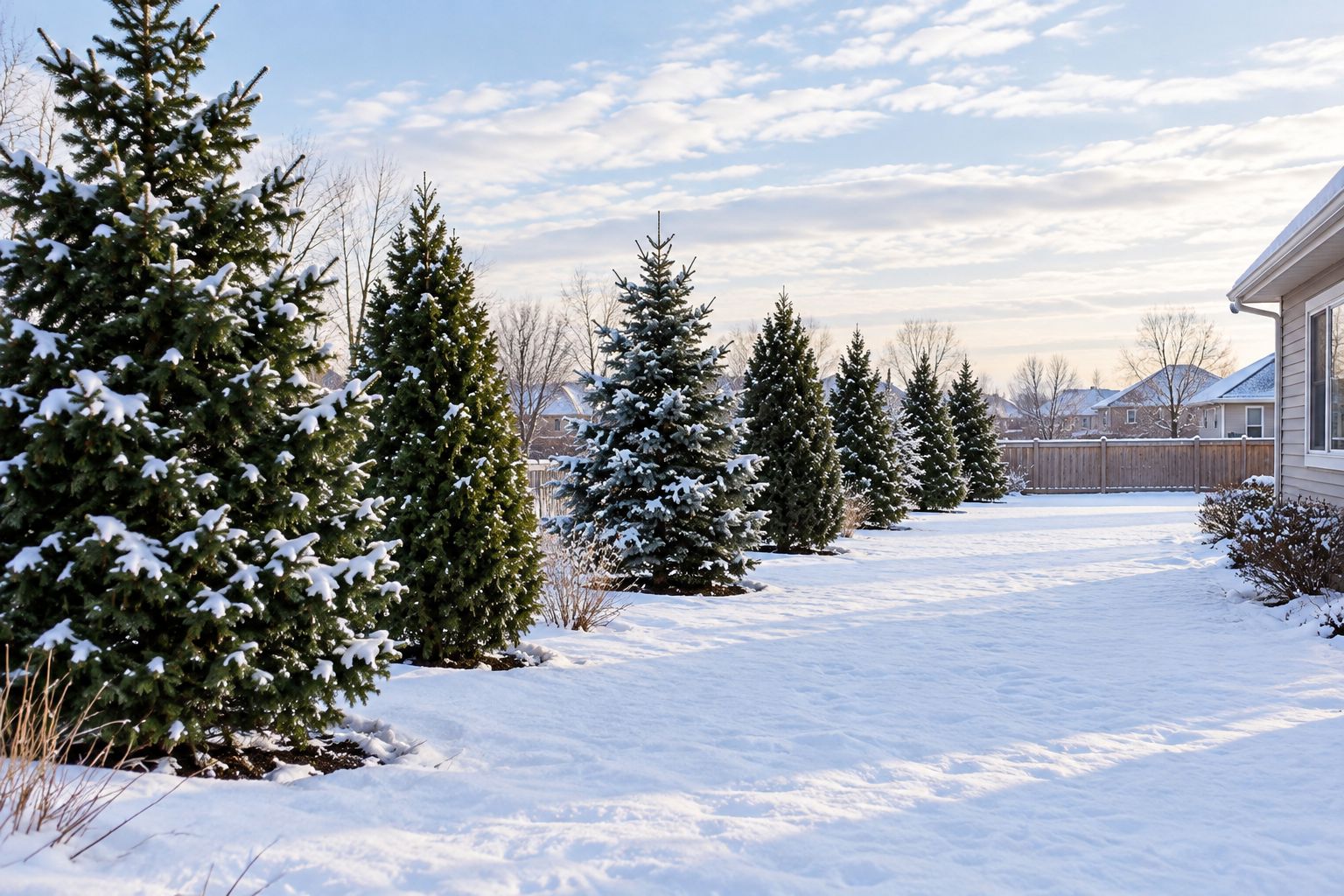
Do not turn a recommended spacing from an unrelated planting into a rule for your yard. A single row, staggered planting, and mixed-species boundary use space differently. The chosen species and mature dimensions should set the layout.
Replacing an old windbreak? Set the scope first
If existing trees need removal, settle the work before positioning replacements. Identify which trees remain, whether stumps need grinding, where equipment can travel, and what material leaves the property.
Spartantreeny is a fit for Rochester homeowners who need tree removal and planting considered together. Discuss careful removal, cleanup expectations, and access directly with the crew rather than leaving those details implied.
Request an individual estimate through the contact page. Tree size, nearby structures, access, and cleanup scope affect the work; a planting list alone cannot establish the job.
For the new trees, water according to soil moisture and root-ball conditions. A mulch layer about 2–3 inches deep, kept away from the trunk, helps moderate soil moisture without burying the trunk flare. Do not pile mulch against the bark.
Which windbreak tree should you choose?
Choose white spruce first for a sunny, adequately drained Rochester site with room for a full-size evergreen. Move to another option only when a specific property condition supports it.
Use Norway spruce for a broad boundary, eastern redcedar for sunny dry ground, eastern white pine for spacious sites away from salt, and arborvitae for narrower screening with deer protection. For 2026 projects, mark the mature footprint before deciding how many trees to request.
A mixed planting spreads dependence across species, but every tree still needs a suitable location. Variety does not fix poor drainage or insufficient space.
FAQ
What's the best evergreen windbreak tree for Rochester, NY?
White spruce is the default choice for a sunny Rochester site with adequate drainage and room for a full-size evergreen. Norway spruce, eastern redcedar, eastern white pine, and arborvitae suit different space and exposure conditions.
Is Norway spruce better than arborvitae for a windbreak?
Norway spruce suits broad boundaries, while suitable arborvitae selections fit narrower screening sites. Norway spruce needs substantial mature width; arborvitae needs particular attention to deer browsing.
What evergreen should I consider for dry ground in Webster?
Eastern redcedar is a candidate for sunny, well-drained sites where established drought tolerance matters. Check nearby apples and crabapples because eastern redcedar is an alternate host for cedar-apple rust.
How far apart should I plant windbreak trees?
Set spacing from the species, exact nursery selection, mature width, and planting layout. There is no single spacing that fits spruce, pine, cedar, and arborvitae equally well.
Can I plant eastern white pine beside a salted road?
Eastern white pine is a poor choice where road salt spray or runoff reaches the planting. Choose a location away from that exposure rather than relying on extra watering to correct the mismatch.
How much does a Rochester windbreak planting project cost?
An individual estimate is needed for your planting project. Tree size, planting quantity, access, existing-tree removal, stump work, and cleanup scope determine what the job includes.
Can Spartantreeny remove an old row and plant replacements?
Spartantreeny offers tree removal, stump grinding, and planting in the Rochester area. Request an estimate that identifies the removal work, stump treatment, cleanup, and replacement planting separately.
One last thing
Preserve the lower branches. A tree that must be limbed up to clear a driveway is poorly positioned for a windbreak meant to shelter the yard near ground level.
Before planting, picture where the lowest mature branches will reach. If they cross a route you need to keep open, move the planting line now—not after the trees establish.