




Yes—planting a tree where one was removed is possible, but a nearby spot with undisturbed soil is usually a better choice than the exact stump location. If you reuse the same spot, remove obstructing stump material, replace concentrated grindings with suitable soil, and address drainage and the reason the original tree died before planting.
- Planting a tree where one was removed works best away from the old stump and concentrated wood chips.
- Stump grinding does not remove every root or automatically create a suitable planting bed.
- Spartan Tree and Landscape serves Rochester homeowners planning tree removal, stump grinding, and replacement planting.
- Choose the replacement tree for its mature size, drainage needs, and available growing space.
Can you plant a new tree where one was removed?
Yes, but a ground stump is not a finished planting site. The replacement tree needs room for its root ball, suitable soil around it, and a stable base beneath it. Old wood, buried debris, and a settling stump cavity can interfere with all three.
Before removal, include your replanting plans in the conversation about the work. The tree removal estimate checklist explains why the written scope matters: cutting down the tree, grinding the stump, hauling grindings, and preparing a planting site are different tasks.
| Replanting approach | Best for | Main advantage | Main drawback |
|---|---|---|---|
| Plant nearby in suitable soil | Homeowners with room to shift the location | Avoids the most disturbed part of the old stump site | Changes the landscape layout and still requires checking for roots |
| Reuse the exact location | Properties where placement is constrained | Preserves the intended planting position | Requires more site preparation and careful assessment of the remaining wood |
| Delay planting | Sites needing drainage work or a diagnosis | Gives you time to correct the underlying problem | Leaves the replacement canopy for a later planting season |
Choose the planting location before deciding how much stump work to request. That keeps the removal scope tied to what you want the yard to become.
Why this matters for Rochester homeowners
A tree removed from a Rochester, Webster, or eastern Monroe County yard leaves more than an empty space. It changes shade, exposes the ground to different conditions, and leaves roots beneath the lawn. The replacement tree will inherit that site, including any problems that contributed to the first tree's decline.
If you are planning removal in 2026, decide whether you want another tree before the crew starts. You can then discuss access, protection of the future planting area, and whether chips should stay or leave. Sorting that out afterward creates separate decisions about the same patch of ground.
A new tree also needs room at maturity. Replacing a large tree with another large-growing tree beside the same foundation or overhead wires repeats a placement problem rather than fixing it.
Planting nearby: the practical first choice
Best for: homeowners who can adjust the planting position. Moving away from the old stump often avoids the deepest concentration of wood and disturbed soil. It also gives you a chance to improve spacing from the house, driveway, neighboring trees, and utility lines.
There is no universal distance that makes every former tree site suitable. A large stump and broad root system create different constraints than a small ornamental tree. Inspect the proposed planting hole rather than assuming a short move solves everything.
Look for these conditions:
- Enough unobstructed space for the full root ball.
- Soil that drains without remaining waterlogged.
- A firm base that will support the tree at the correct depth.
- Adequate room for the replacement tree's mature crown and roots.
- A location clear of underground utilities and conflicting overhead lines.
The trade-off is layout. Your new tree might not provide shade in exactly the same place, so consider the house, patio, and afternoon sun before settling on a location.
Reusing the exact spot: preparation comes first
Best for: homeowners whose planting location cannot reasonably move. Reusing the stump location is possible when the remaining wood, planting depth, soil condition, and drainage allow it. It is not the default recommendation simply because the space looks open.
Stump grinding breaks up stump wood below the surface, but it does not remove the entire underground root system. The resulting cavity can contain a mixture of chips, soil, and remaining roots. That mixture is not equivalent to an undisturbed planting bed.
Concentrated buried wood decomposes and loses volume, allowing the ground to settle. Microorganisms breaking down wood can also temporarily tie up nitrogen in the surrounding soil. Neither issue makes every former stump site unusable, but both argue against setting a root ball directly into fresh grindings.
Ask the crew to assess what must be removed to create a proper planting space. Do not assume a standard stump-grinding scope includes excavation for a replacement tree or delivery of planting soil.
Why replanting success varies
The right approach depends on the site, not a fixed waiting period. These factors explain why neighboring properties can need different preparation:
- Remaining wood: Large roots and stump sections can block the planting hole or leave unstable material beneath it.
- Soil condition: Equipment traffic and construction history can leave compacted soil that restricts root growth.
- Drainage: Persistent wetness can remain after removal and affect the replacement tree.
- Cause of decline: Root disease, unsuitable soil, and pest damage require different replacement decisions.
- Growing space: Foundations, paving, utility lines, and neighboring trees limit suitable mature size.
- Cleanup scope: Leaving chips, removing grindings, and preparing soil produce different starting conditions.
For your 2026 planting plan, treat these as inspection points rather than reasons to buy amendments automatically. Adding fertilizer or bagged soil does not correct every site problem.
How do you prepare the site for a replacement tree?
Start with the location and work toward planting. Digging first and choosing a tree afterward makes it harder to match the plant to the available space.
- Identify the old problem. Establish why the original tree came out. If the cause was uncertain decline, get a qualified assessment before choosing a replacement.
- Confirm utilities. Arrange utility marking before stump excavation or digging the new planting hole. Account for private underground lines as well.
- Clear the planting space. Remove obstructing wood and concentrated grindings from the area needed for the root ball and surrounding soil.
- Check the base. The root ball needs firm support. Avoid placing it over a loosely filled cavity that will settle beneath the tree.
- Set the depth. Locate the root flare, where the trunk widens into its main roots, and position it at the surrounding soil surface or slightly above it.
- Backfill and water. Return suitable soil around the root ball, water it in, and check that the tree remains at the intended depth.
A common planting guideline is a hole 2–3 times as wide as the root ball, but no deeper than necessary to position the root flare correctly. Width creates room around the roots; extra depth creates a settling risk. A former stump cavity still needs individual assessment rather than blind application of that guideline.
If replacement planting is part of your 2026 project, Spartan Tree and Landscape is a fit for Rochester homeowners coordinating tree removal, stump grinding, and planting. Discuss careful removal, cleanup, and the intended planting spot directly with the crew; the practical limitation is that the work needs an individual site assessment, not an assumed planting-ready result after grinding.
Use the contact page to describe the existing tree, access to the yard, and whether you want the replacement in the same location. Ask for the agreed preparation and cleanup scope in writing.
Mulch helps the new tree; buried grindings are different
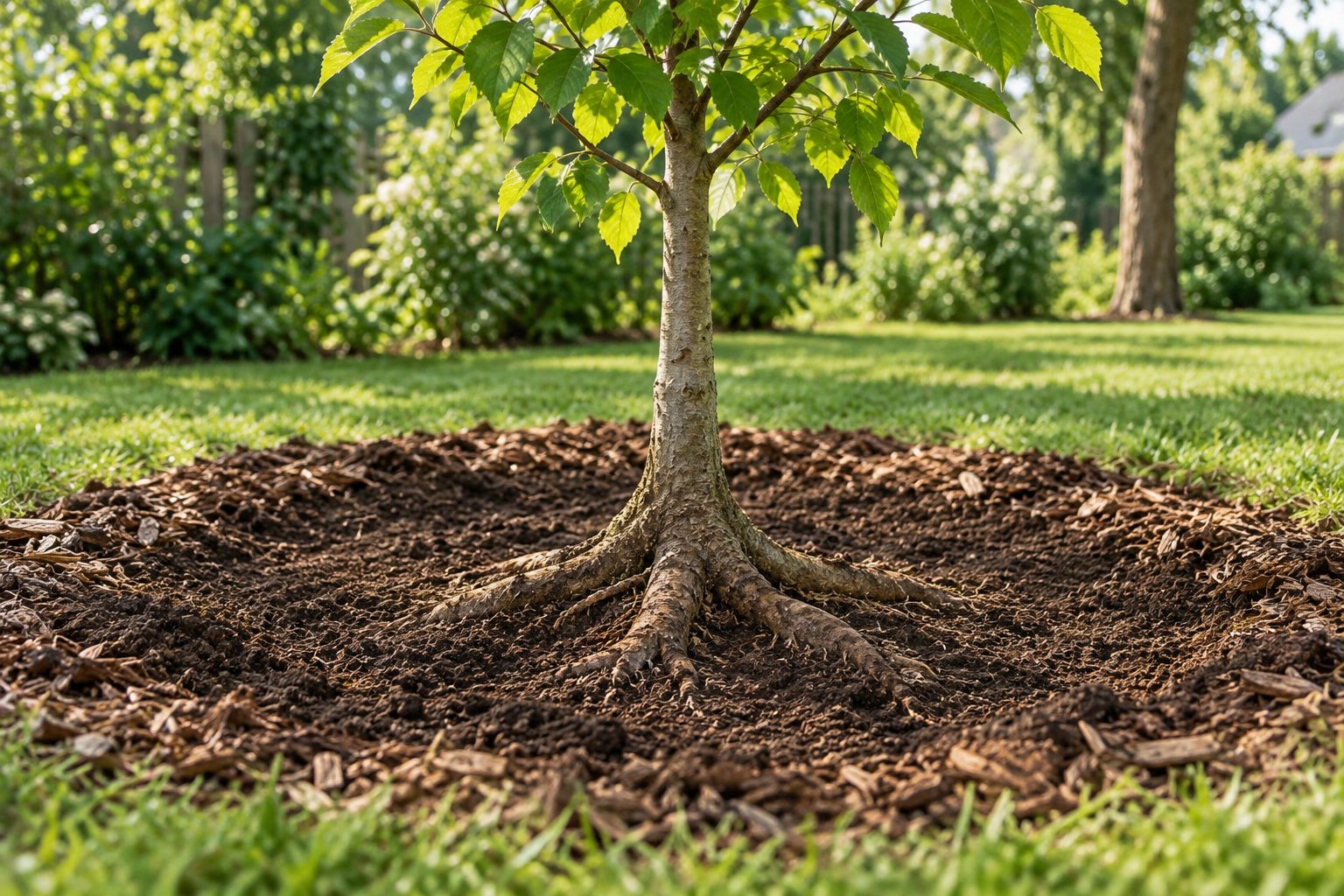
A mulch layer on the soil surface serves a different purpose from wood mixed into the planting hole. Surface mulch helps conserve moisture and moderate soil temperature. A deep pocket of buried grindings creates a decomposing planting base.
That distinction matters when choosing the right mulch: material selection cannot compensate for incorrect placement around a newly planted tree. For a Rochester yard, assess the mulch alongside local soil moisture and drainage rather than borrowing a watering routine from a drier climate.
A typical organic mulch layer is 2–3 inches deep. Keep it 3–6 inches away from the trunk, leaving the root flare visible. Do not build a mound against the bark or use mulch to conceal a tree planted too deeply.
Fresh tree chips can serve as surface mulch when used appropriately. They do not need to fill the planting hole, and keeping every chip from the removed tree is not a requirement for successful replanting.
Can you plant immediately after stump grinding?
There is no universal waiting period after stump grinding. You can plant when the location has suitable soil, adequate drainage, a stable base, and room for the root ball without obstructing wood.
Waiting alone does not turn a chip-filled cavity into a sound planting site. For a 2026 replacement, inspect the conditions rather than choosing an arbitrary date after removal.
Should you replace the old tree with the same species?
Not automatically: identify why the old tree failed first. If the species outgrew the space or struggled with the site's drainage, choosing it again repeats the mismatch.
A different species can be appropriate where a specific pest or disease affected the original tree. The replacement still needs to suit the soil, light, mature-size limits, and local growing conditions; changing species is not a substitute for correcting a damaged site.
What should you ask before accepting the estimate?
Ask the crew to separate removal, stump work, debris handling, and replacement planting. A tidy surface does not tell you what remains underneath.
Make these questions part of the discussion:
- Does the stump work suit the proposed planting location?
- Will grindings be removed, spread elsewhere, or left on site?
- Who supplies and places any soil needed afterward?
- What access will equipment need, and how will the future planting area be protected?
- Does the scope include planting, or only preparation?
- What condition should the yard be in when cleanup is complete?
The answers help you compare the same work across estimates. For a 2026 project, put the intended replacement location on a simple yard sketch so everyone is discussing the same spot.
FAQ
Can I plant a new tree directly over an old stump?
Do not plant a new tree directly over remaining stump wood. The root ball needs suitable soil and stable support, so remove obstructing material or choose another location.
How long should I wait before planting a tree where one was removed?
There is no universal waiting period for planting a tree where one was removed. The deciding factors are remaining wood, soil stability, drainage, and the cause of the original tree's decline.
Does stump grinding remove all the old roots?
Stump grinding does not remove all the old roots. Roots beyond the ground stump remain underground and can interfere with a nearby planting hole.
Can I leave stump grindings in the planting hole?
Do not use concentrated stump grindings as backfill for the new tree. Buried wood decomposes and settles, so prepare the planting area with suitable soil instead.
How wide should the new planting hole be?
A common guideline is a planting hole 2–3 times as wide as the root ball. Keep the base firm and set the depth according to the root flare rather than digging an unnecessarily deep hole.
How much mulch should I put around the replacement tree?
Use a typical organic mulch layer 2–3 inches deep, kept 3–6 inches away from the trunk. Leave the root flare visible and avoid piling mulch against the bark.
Can Spartan Tree and Landscape handle removal and replacement planting?
Spartan Tree and Landscape provides tree removal, stump grinding, and planting in the Rochester, NY area. Request an individual estimate that states the site preparation and cleanup included in your project.
One last thing
The old tree's location is not an instruction to plant there again. Before committing, mark the proposed replacement spot and picture the mature canopy beside your roof, driveway, and overhead lines. Moving the planting location now is simpler than managing another tree that outgrows the same space.