




Best overall: swamp white oak. Best for seasonally wet ground: bald cypress. Best for disturbed urban soil: common hackberry. Best for a smaller, well-drained yard: Allegheny serviceberry. This 2026 guide compares the best trees for clay soil in Rochester, NY, by drainage, mature size, and the space your yard actually provides.
- Swamp white oak leads the best trees for clay soil Rochester NY shortlist where a large shade tree fits.
- Bald cypress suits seasonally wet ground; Allegheny serviceberry needs drainage despite tolerating clay.
- Common hackberry fits disturbed urban sites but brings fruit litter and potential leaf galls.
- Spartan Tree and Landscape provides planting and tree removal services for Rochester-area homeowners.
Why this matters
Clay is a soil texture, not a drainage diagnosis. A clay yard on a slope and a compacted low spot beside a driveway present different growing conditions. Choosing a tree simply because its label says clay-tolerant misses that distinction.
For homeowners in Rochester, Webster, and eastern Monroe County, the next step is a site-specific planting plan. Spartan Tree and Landscape provides tree planting and removal services; discuss the existing tree, access route, and cleanup before choosing its replacement.
Spartan Tree and Landscape is a fit for Rochester-area homeowners who need tree removal and planting considered together. Start with the site, not a nursery cart.
What makes the best tree for clay soil?
Use these criteria to judge the shortlist before buying:
- Drainage fit: Match the species to ordinary moisture conditions, including where water collects after rain.
- Mature space: Allow room for the full canopy and trunk, not just the young tree being planted.
- Rooting conditions: Separate naturally heavy soil from soil compressed by construction or repeated vehicle traffic.
- Light: Check the planting spot’s exposure after any planned removal changes the shade.
- Maintenance: Decide whether fruit, needles, leaf cleanup, or corrective pruning fits your yard routine.
Cold hardiness matters too, but it does not fix a wet planting hole or a canopy squeezed between buildings. The better choice fits all the conditions together.
Clay-tolerant trees at a glance for 2026
These are species comparisons, not promises about a particular nursery specimen. NC State Extension’s Plant Toolbox profiles describe the soil tolerances and mature-size ranges used here; inspect the actual planting site before making a final selection.
| Tree | Best for | Standout feature | Key limitation |
|---|---|---|---|
| Swamp white oak | Large yards needing long-term shade | Tolerates clay and periodic wetness | Needs substantial canopy space; drops acorns |
| Bald cypress | Large, seasonally wet planting areas | Tolerates wet soils; deciduous conifer | Large mature size; root knees can complicate mowing |
| Common hackberry | Disturbed urban planting sites | Tolerates varied soils, including clay | Fruit litter and leaf galls |
| Allegheny serviceberry | Smaller yards with draining clay | Flowers, fruit, and smaller stature | Not a solution for persistently waterlogged soil |
1. Swamp white oak: best clay-soil tree for long-term shade
Swamp white oak, Quercus bicolor, is the default pick when you have room for a substantial shade tree. It tolerates clay and periodic wet conditions, making it a stronger starting point than a tree that requires consistently sharp drainage.
Plan for a tree commonly reaching 50–60 feet tall, with a broad crown. That rules out a narrow strip beside the house, even when the soil itself suits the species.
Swamp white oak pros:
- Tolerates clay and periodically wet soil.
- Develops a broad shade canopy.
- Supports wildlife through its acorns and role as a native oak.
Swamp white oak cons:
- Needs room well beyond the planting hole.
- Acorns add cleanup around patios and walking areas.
- Does not remove the need to investigate persistent standing water.
Best for: A large Rochester-area yard where shade is the goal and the mature crown can spread without crowding structures.
Choose the planting location before choosing the specimen. A large tree put in a cramped spot creates a future pruning or removal problem.
Verdict: Buy for roomy sites with clay soil and a long-term shade goal.
2. Bald cypress: best clay-soil tree for seasonally wet ground
Bald cypress, Taxodium distichum, fits a different job: a large planting area that becomes wet seasonally. It is a deciduous conifer, so its soft needles turn color and fall rather than remaining green all winter.
This is not a small ornamental. A typical mature height of 50–70 feet calls for deliberate placement away from overhead conflicts and tight building clearances.
Bald cypress pros:
- Tolerates wet soils, including clay.
- Offers fine-textured foliage and seasonal color.
- Suits a large landscape where wetness limits other choices.
Bald cypress cons:
- Can develop woody root knees, particularly in wet conditions.
- Drops needles, so it is not a year-round privacy screen.
- Requires substantial mature space.
Best for: A large, sunny area with seasonal wetness where mowing around possible root knees will not become a constant frustration.
A wet-soil tree does not repair drainage against a foundation. Deal with water movement as a separate property issue rather than expecting roots to solve it.
Verdict: Buy for a spacious, seasonally wet site; skip as an evergreen screen.
3. Common hackberry: best clay-soil tree for disturbed urban sites
Common hackberry, Celtis occidentalis, tolerates a wide range of soil conditions, including clay. It belongs on the shortlist when the challenge includes disturbed ground rather than moisture alone.
Expect a substantial shade tree, commonly 40–60 feet tall. Soil tolerance does not mean its roots can grow normally beneath pavement or through a severely compressed planting area.
Common hackberry pros:
- Tolerates varied soil textures and urban growing conditions.
- Handles dry conditions once established.
- Produces fruit used by birds.
Common hackberry cons:
- Fruit creates litter beneath the canopy.
- Leaf galls can affect appearance.
- Its mature size excludes narrow spaces near buildings.
Best for: A roomy residential site with clay or disturbed soil where tolerance matters more than a perfectly tidy canopy.
Think about what sits underneath. A bird-supporting fruit tree beside a lawn presents a different cleanup job than the same tree over a frequently used patio.
Verdict: Buy for a difficult urban site with adequate rooting space; skip where fruit litter is unacceptable.
4. Allegheny serviceberry: best clay-soil tree for smaller yards
Allegheny serviceberry, Amelanchier laevis, offers spring flowers, edible fruit, and fall color in a smaller tree. It tolerates clay when the soil drains, making it an option where an oak’s eventual canopy would be too much.
A typical height of 15–25 feet makes serviceberry easier to fit into a residential planting plan. Smaller does not mean suitable directly against the house or beneath every utility line.
Allegheny serviceberry pros:
- Fits smaller planting areas than the large shade trees above.
- Provides flowers, fruit, and fall foliage.
- Offers food for birds.
Allegheny serviceberry cons:
- Needs drainage; persistent waterlogging is a poor match.
- Fruit can create mess near paving.
- Rust and leaf diseases can affect appearance.
Best for: A smaller yard with draining clay where ornamental interest matters more than a broad shade canopy.
Check the botanical name when selecting a tree. Serviceberry names cover several species and hybrids, and their eventual size and form differ.
Verdict: Buy for a smaller, draining site; skip for a waterlogged depression.
How these trees were ranked
The 2026 shortlist ranks by site fit: drainage first, mature space second, then maintenance. Swamp white oak takes the default position because it combines clay tolerance with a broad shade-tree role; the other choices solve narrower planting needs.
These are horticultural selections, not results from a local planting trial. No species wins on every property, and none substitutes for inspecting the ground where it will grow.
Check the planting spot before choosing a tree
For a 2026 planting project, walk the actual location rather than judging the whole yard from the driveway. Look after rain as well as during dry weather.
- Water movement: Identify low spots, roof discharge, and runoff crossing the proposed planting area.
- Rooting space: Look for nearby paving, buried construction debris, and repeated traffic routes.
- Mature clearance: Consider buildings, overhead lines, driveways, and neighboring canopies.
- Access route: Measure gates and identify where equipment or a delivered tree would enter.
A soil test can inform nutrient and pH decisions. It does not show whether the planting spot has enough physical space or whether water collects there after storms.
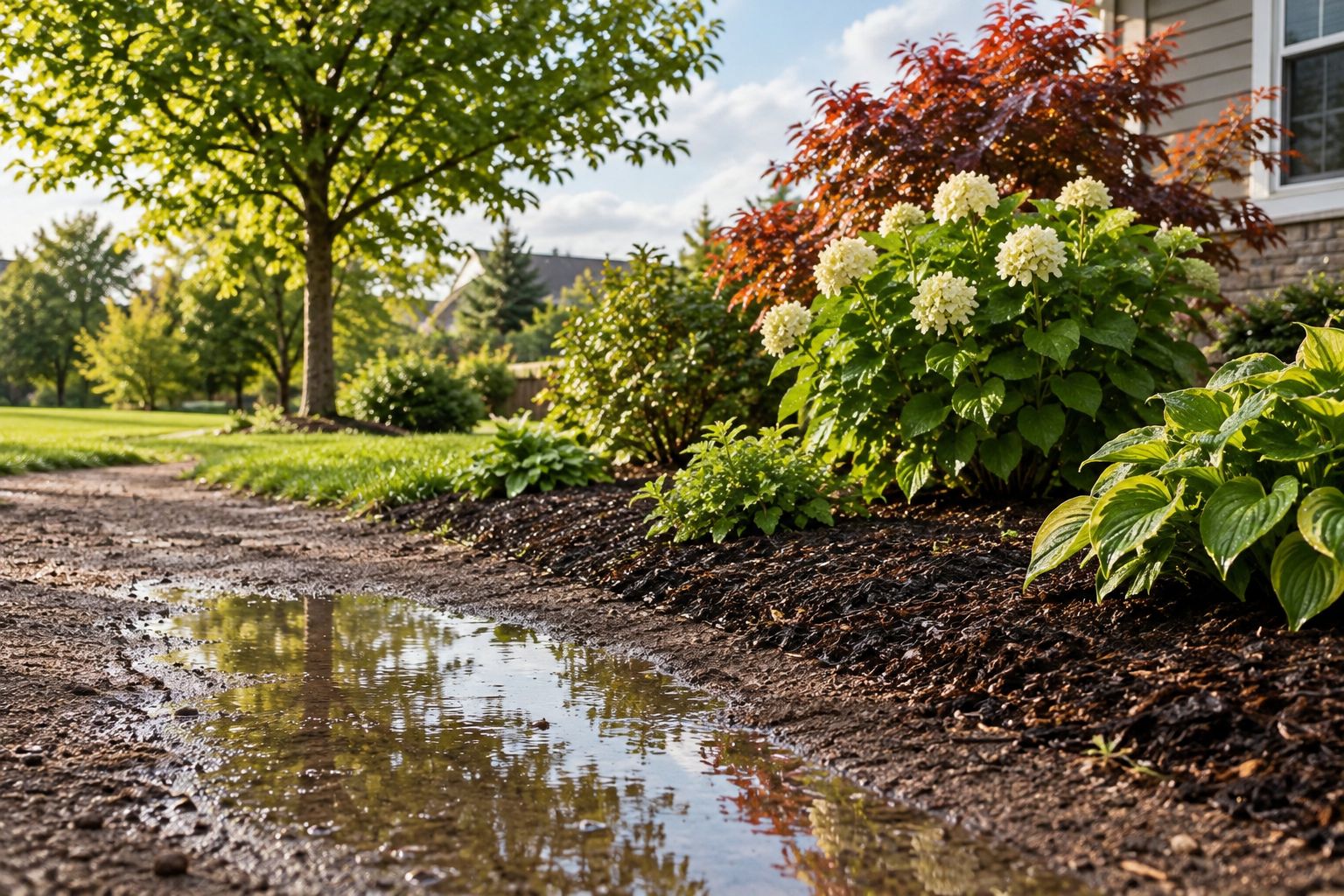
Compaction needs its own assessment. In a construction-disturbed yard, addressing soil compaction is a separate task from selecting a clay-tolerant tree: matching the species does not restore pore space lost to heavy traffic. Ask how the proposed planting plan deals with that restriction.
Plant for the soil you have
Dig a broad planting hole rather than a deep pit. Common extension guidance calls for a hole about 2–3 times the root ball’s width, with the root flare visible at the finished soil surface.
Avoid making a pocket of rich amended soil inside dense clay. Backfill principally with the excavated soil unless a site-specific recommendation calls for a different approach. Do not put gravel in the bottom as a drainage fix.
Spread 2–3 inches of mulch over the surrounding soil, keeping it away from the trunk. Mulch should cover the root area, not bury the root flare.
Water according to root-ball moisture and surrounding soil conditions. Clay can remain wet beneath a dry-looking surface, so a fixed daily watering habit is a poor substitute for checking moisture. Newly planted trees still need establishment care even when the species tolerates drought later.
Replacing a tree? Set the removal scope first
If your 2026 project starts with removing an existing tree, settle the removal and planting plan together. Stump grinding does not automatically leave a ready-made planting site: remaining roots, grindings, and disturbed ground all affect the next step.
Ask Spartan Tree and Landscape to address these items in an individual estimate:
- Removal scope: Identify the tree and any nearby structures affecting the work.
- Access: Explain gate widths, fences, soft ground, and driveway constraints.
- Stump work: Specify whether grinding is included and what material remains.
- Cleanup: Put log removal, chip handling, and the finished work area in writing.
- Replacement planting: Discuss location, species, and soil preparation separately.
Careful removal and thorough cleanup belong in the scope, not in assumptions. Ask who your direct crew contact will be and agree on how planting space will be protected during removal.
You can request an individual estimate with photos of the tree, planting area, and access route. Photos help frame the discussion; they do not replace the site assessment needed to define the work.
Which clay-soil tree should you choose?
Choose swamp white oak if you have a large yard and want lasting shade. Choose bald cypress for seasonal wetness, common hackberry for a disturbed urban site, or Allegheny serviceberry for a smaller area with drainage.
For a 2026 replacement project, mark the proposed planting location before removal begins. Protecting that area from unnecessary traffic is easier than correcting additional compaction afterward.
FAQ
What's the best tree for clay soil in Rochester, NY?
Swamp white oak is the default choice for a large Rochester yard with clay soil and room for a broad canopy. Choose another species when seasonal wetness, limited space, or maintenance needs change the job.
Which tree should I plant in a wet clay yard?
Bald cypress is a candidate for a spacious, seasonally wet planting area. Assess the water source separately, especially where drainage affects a building.
What's a smaller tree for clay soil near Rochester?
Allegheny serviceberry suits a smaller planting area when the clay drains. It is not a substitute for correcting persistent waterlogging.
Can I plant a tree where a stump was ground out?
Stump grinding alone does not establish that the same spot is ready for planting. Assess remaining roots, grindings, soil condition, and available space before choosing the replacement location.
Should I add gravel beneath a tree in clay soil?
No, a gravel layer beneath the root ball is not a drainage fix. Choose an appropriate site and keep the root flare at the finished soil surface.
How much does planting a replacement tree cost?
A replacement planting needs an individual estimate. Tree size, site access, soil preparation, stump work, and cleanup scope determine what the job includes.
One last thing
A tree can tolerate clay and still fail in the wrong planting hole. Before approving the planting location, ask the crew to identify the root flare and explain where it will sit relative to finished grade. That practical check matters more than a clay-tolerant label.