





Homeowners insurance in New York can cover storm-related tree removal when a fallen tree damages covered property, but coverage depends on your policy and the circumstances. A tree lying in your yard without covered damage is generally a different claim from a tree on your house. Your deductible, debris-removal terms, exclusions, and any applicable limits determine what the insurer pays—not the removal estimate alone.
- New York storm damage tree removal insurance coverage depends on covered damage, policy terms, and exclusions.
- A fallen tree on a house and a fallen tree on an empty lawn raise different coverage questions.
- Photograph damage from a safe location, contact your insurer, and keep removal records.
- Spartantreeny provides Rochester-area tree removal; your insurer determines whether your policy pays.
Why this matters
After a Rochester storm, you have two separate jobs: make the property safe and establish what your insurer will cover. Mixing them up creates trouble. A crew can explain the removal work, but it cannot decide your claim.
Spartantreeny tree removal is best for Rochester-area homeowners seeking a site-specific removal estimate, not an insurance decision. Start with Spartantreeny for the service conversation, and speak with your insurer about coverage. Keep those conversations connected through photographs, written scope, and itemized records.
Does homeowners insurance cover tree removal in New York?
Sometimes—but storm damage alone does not make every tree-removal bill covered. For a 2026 claim, the useful question is whether your policy covers the cause of loss, the damaged property, and the particular removal expense.
These situations give you a starting point for that conversation. They are not coverage decisions.
| Situation | Coverage question to ask | Best next step |
|---|---|---|
| A tree falls onto your house | Does the policy cover the cause of damage and removal needed for repairs? | Report the damage and ask about emergency protection |
| A tree damages a detached garage, shed, or fence | Is that structure covered, and what terms apply? | Identify the damaged structure in the claim |
| A tree falls onto an open lawn | Does the policy include removal without damage to covered property? | Ask before assuming cleanup is covered |
| A fallen tree obstructs access | Does the policy contain an applicable access-related removal provision? | Describe exactly what access is blocked |
| A standing tree appears dangerous | Is preventive removal excluded or otherwise addressed? | Arrange an assessment without assuming reimbursement |
| A tree falls onto a vehicle | Does the vehicle's comprehensive coverage apply? | Contact the auto insurer as well |
The distinction matters when comparing estimates. A reasonable removal bill and an eligible insurance expense are not the same thing. Get the work described clearly, then ask the insurer which portions fall within your coverage.
A tree falls on your house or another structure
A tree striking your house creates a different coverage question from ordinary yard cleanup. Homeowners policies commonly address damage from wind and falling objects, subject to their terms and exclusions. The insurer still needs to establish what happened and which parts of the loss are covered.
Tell the insurer whether the tree rests on the roof, has broken a wall, or has damaged another structure. Include visible damage from a safe position. Do not climb onto the roof or walk beneath suspended limbs to improve your photographs.
Ask whether removal needed to reach or repair the structure is handled differently from hauling away debris afterward. Also ask how the insurer wants temporary protection documented. A bill described only as tree work gives the adjuster less information than a scope that separates the actual tasks.
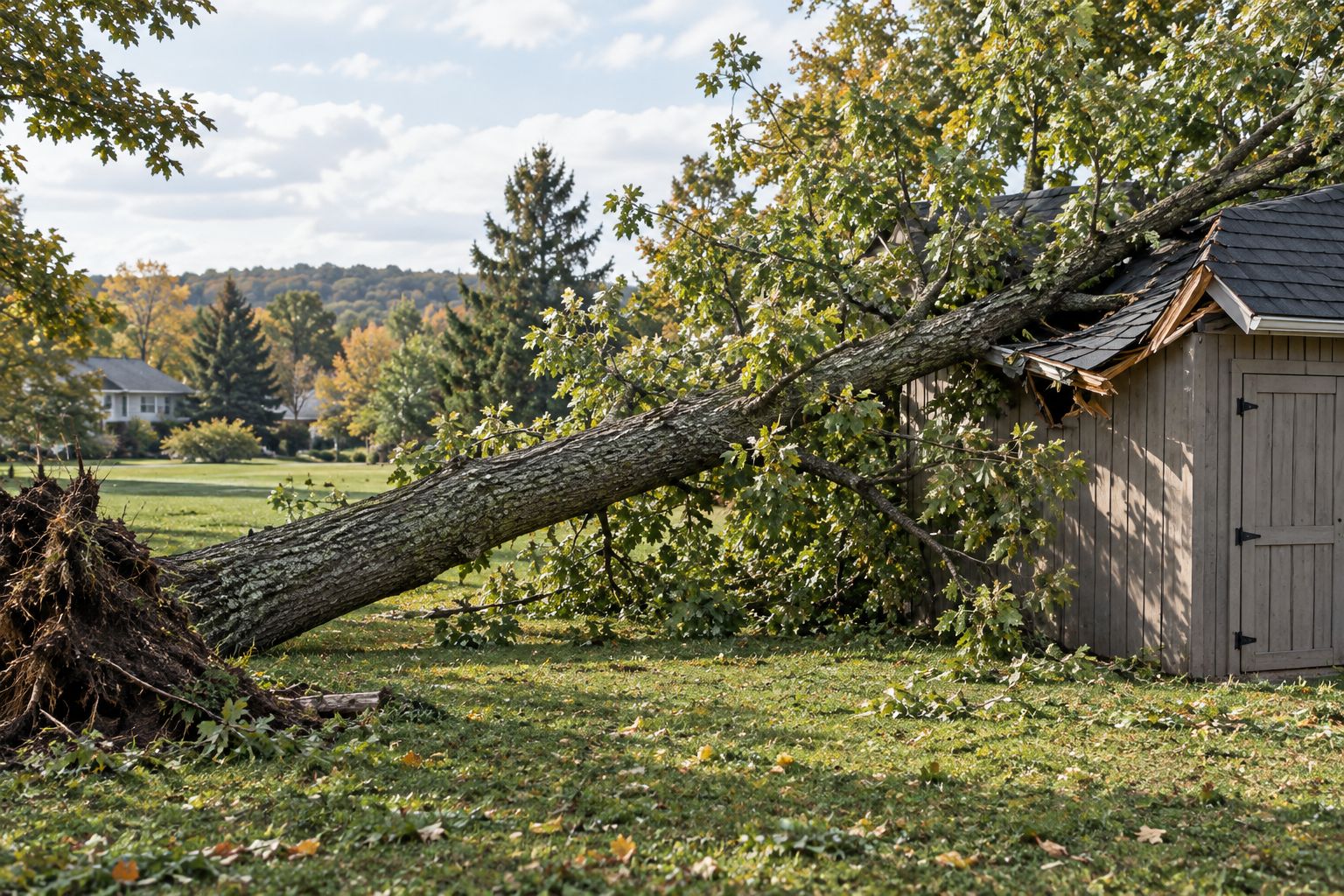
Keep the initial damage and the later cleanup separate in your records. The insurer needs to understand what the storm caused, not just what the property looked like after the crew finished.
A tree falls in the yard without damaging a structure
A fallen tree on an otherwise undamaged lawn is generally less likely to qualify for removal coverage than a tree that damages covered property. Some policies contain additional removal provisions, so check the actual wording rather than treating that general rule as a denial.
Explain whether the tree blocks a driveway, entrance, or another access point. An obstruction does not automatically establish coverage; the policy must contain a provision that applies to your circumstances.
For a 2026 claim in Webster or eastern Monroe County, give the insurer a plain description: where the tree fell, what it touched, and what it prevents you from using. Avoid calling everything structural damage if the tree has only landed nearby. Accurate details make the coverage discussion more useful.
A standing tree needs removal before it falls
Do not assume homeowners insurance pays for preventive tree removal. Removing a standing tree because it is dead, declining, or threatening a building is ordinarily a maintenance question, not the same claim as removing a tree after a covered loss.
A tree that remains standing after a storm still needs attention if it has hanging limbs, a split trunk, or disturbed ground around its base. Keep people away and request an assessment. Photographs alone do not establish whether it is safe to leave in place.
For planned removal in Rochester, Webster, and eastern Monroe County, ask for an individual estimate based on the tree and the property. Waiting for an assumed insurance payment is not a removal plan. Ask the insurer directly while you establish the work needed.
Why storm damage tree removal insurance coverage varies
The same storm can produce different claim outcomes on neighboring properties. For a 2026 policy review, focus on these factors rather than a neighbor's settlement:
- Cause of loss. Ask whether the event that caused the tree to fall is covered and whether an exclusion applies.
- Property damaged. A house, detached structure, vehicle, and open lawn raise different coverage questions.
- Removal purpose. Removing a tree from a damaged building and clearing scattered yard debris are different tasks. Ask how each is treated.
- Policy limits. Debris removal and related expenses can have specific limits or conditions. Request the applicable language.
- Deductible. An accepted claim does not mean the insurer pays the full bill. Confirm the deductible that applies to the loss.
- Condition and maintenance. Decay, prior damage, and maintenance issues can become part of the insurer's review. Describe known conditions accurately.
You do not need to interpret the whole policy yourself. Ask the adjuster to identify the provision supporting the decision and explain it in writing. That gives you something concrete to compare against the estimate and claim documents.
What should you do before a storm-damaged tree is removed?
Protect people first, then preserve the information needed to explain the work. Do not delay action around an immediate hazard just to collect better photographs.
- Keep clear. Stay away from hanging limbs, unstable trees, damaged structures, and any tree touching utility lines. Treat downed lines as energized and contact the utility or emergency services as appropriate.
- Document safely. Photograph the whole scene and visible damage from a safe location. Include the tree's position relative to the house, driveway, fence, or outbuilding.
- Notify the insurer. Report the loss promptly. Ask what documentation is needed and how emergency removal or temporary protection should be handled.
- Request a written scope. Have the removal work described clearly, including access, protection around structures, debris handling, and cleanup.
- Clarify authorization. Ask whether the insurer needs an inspection before nonurgent work begins. Record whom you spoke with and what instructions you received.
- Keep the records. Retain photographs, estimates, invoices, payment records, and claim correspondence. Request clarification if the final work differs from the original scope.
For your 2026 claim file, organize records by event rather than leaving them scattered across texts and email. Keep the initial damage photographs alongside the removal estimate. That makes it easier to answer questions about why particular work was necessary.
What should a Rochester tree-removal estimate include?
An estimate should explain the job well enough that you understand what will happen to your property. Ask about careful removal, protection around nearby structures, and cleanup—not just whether the crew can get the tree down.
Discuss these details directly with the crew:
- Access: gates, driveway space, fences, tight side yards, and other restrictions.
- Tree size and position: the tree's size, lean, broken sections, and contact with buildings.
- Nearby structures: roofs, garages, sheds, decks, and other features that affect the work.
- Debris handling: what happens to logs, branches, and smaller material.
- Cleanup scope: what the crew will remove and what remains afterward.
- Stump work: whether stump grinding is included, excluded, or separately described.
These details affect removal work, but they do not establish insurance coverage. Ask for an individual estimate rather than a guaranteed online figure. If you are comparing proposals, compare the same scope; hauling away wood and leaving it onsite are not equivalent jobs.
Request an individual removal estimate
Discuss tree access, nearby structures, debris handling, and cleanup for your Rochester-area property.
Does insurance cover a neighbor's tree falling on my house?
A neighbor's tree falling on your house does not automatically make the neighbor responsible for the bill. Report damage to your own insurer and explain where the tree originated. Liability is a separate question that depends on the facts, including any evidence of a previously known hazard.
Keep existing photographs or written communications relevant to the tree's condition. Do not assume either that the neighbor must pay or that ownership settles the insurance question. Let the insurers evaluate coverage and responsibility.
Does insurance cover stump grinding after storm damage?
Stump grinding is not automatically included just because tree removal is covered. Ask whether the policy and approved scope address the stump, exposed roots, or only the fallen portion of the tree.
Have stump work identified separately in the estimate when appropriate. That keeps a landscaping decision from becoming confused with removal needed to address the covered damage.
Should I remove the tree before the adjuster arrives?
Do not leave an immediate hazard in place solely to wait for an adjuster. Contact the insurer promptly, document safely, and ask how to handle necessary emergency work.
For nonurgent removal, ask whether the insurer wants an inspection first. A 2026 claim should document both the original damage and the reason work happened before an inspection, if that was necessary.
FAQ
Does New York homeowners insurance cover every tree that falls during a storm?
No. Storm damage tree removal insurance coverage depends on the policy, the cause of loss, the property damaged, and applicable exclusions. A fallen tree on an open lawn is not the same coverage situation as a tree on your house.
What should I tell my insurer when a tree falls on my Rochester home?
Describe where the tree fell, what it damaged, and whether an immediate hazard remains. Provide photographs taken safely and ask what documentation the insurer needs before removal.
Can a tree crew guarantee that insurance will pay?
No. Your insurer determines coverage under your policy. The crew can provide a removal estimate and records describing the work performed.
Is removing a dead tree before it falls usually covered?
Preventive removal of a dead tree is generally treated as maintenance rather than removal after a covered loss. Ask your insurer about your policy, and arrange an assessment without assuming reimbursement.
Does homeowners insurance cover a tree falling on my car?
Vehicle damage is generally a question for your auto insurer and any applicable comprehensive coverage. Tell both insurers if the same tree also damaged your home or another covered structure.
Will insurance pay for complete yard cleanup after a storm?
Do not assume complete yard cleanup is covered. Ask which debris-removal expenses qualify, what limits apply, and whether the proposed cleanup extends beyond the approved work.
What if the removal estimate is higher than the insurer's allowance?
Compare the estimate's scope with the insurer's approved work and request an explanation of any difference. Ask the crew to clarify necessary tasks rather than assuming every difference is covered.
One last thing
Before you authorize removal, ask what will still be there when the crew leaves. A tree off the roof, a pile of logs in the yard, and a fully cleared work area are different outcomes. Get debris handling, stump work, and cleanup written into the scope so the insurance discussion and the removal plan describe the same job.