





In New York in 2026, you generally start with your own homeowners insurer when a neighbor’s tree damages your insured property; the neighbor does not automatically owe you money because the tree grew on their land. A negligence claim usually depends on evidence that the neighbor knew, or should have known, the tree was dangerous and failed to act. Your deductible, debris removal coverage, and damage to an uninsured part of the yard remain separate questions.
- Neighbor tree fell on my property New York: start with your insurer, not an assumption that your neighbor pays.
- Visible decay, earlier complaints, and inspection records can matter when establishing notice of a dangerous tree.
- Tree removal coverage and responsibility for the damage are separate questions; check both before authorizing work.
- Spartantreeny provides Rochester-area tree removal; insurers and legal advisers address coverage and disputed liability.
Why this matters
A fallen tree creates separate jobs: make the area safe, document the damage, and work out who pays. Mixing them together leads to arguments before anyone has checked the policy or preserved the evidence.
For homeowners in Rochester, Webster, and eastern Monroe County, the practical move is to arrange a qualified assessment while your insurer reviews coverage. Spartantreeny provides tree removal and tree care in the Rochester area; ask for a written scope covering careful removal, cleanup, and any remaining stump work. Do not treat a removal estimate as a ruling on your neighbor’s liability.
Who pays when a neighbor’s tree falls on your property in New York?
Ownership alone does not decide who pays. Your property insurance and the neighbor’s potential negligence are different routes, and both require facts beyond where the trunk stood.
New York’s Department of Financial Services addresses falling trees in its homeowners insurance consumer guidance. Coverage depends on the damaged property, the cause of loss, and the policy language. New York negligence law separately considers whether the tree owner had actual or constructive notice of a dangerous condition.
| Situation | Where to start | What needs checking |
|---|---|---|
| A tree damages your insured house during a storm | Your homeowners insurer | Covered cause, deductible, removal terms, and emergency protection |
| A tree falls into the yard without damaging an insured structure | Your insurer and a removal contractor | Whether the policy covers debris removal in that situation |
| A tree had visible defects before it fell | Your insurer; legal advice if liability is disputed | Evidence of the defect, notice, and failure to take reasonable action |
| A tree lands on your vehicle | Your auto insurer | Whether your auto policy includes applicable comprehensive coverage |
| A tree contacts utility wires | The utility and emergency services when needed | Immediate safety and who must clear the electrical hazard |
This table is a starting point for a 2026 claim, not a promise of coverage. Read the applicable policy provisions and ask the adjuster to explain exclusions or limits in writing.
When does the neighbor become responsible?
A neighbor’s responsibility generally turns on negligence, not simply ownership. You need more than proof that the tree crossed the property line when it fell.
The New York Court of Appeals decision Ivancic v. Olmstead addresses notice of a defective tree. Its central distinction is between a dangerous condition the owner knew or reasonably should have discovered and a defect that was not readily observable. The decision does not make every tree owner an insurer against every falling branch.
Actual notice: the owner knew about the problem
Actual notice can involve a prior inspection, a documented warning, or an earlier discussion identifying a particular dangerous condition. A dated message describing a split trunk is different from a general complaint that leaves keep landing in your yard.
Keep the original correspondence and any replies. A warning helps establish what someone knew; it does not, by itself, prove that the tree was dangerous or that negligence caused the damage.
Constructive notice: the owner should have known
Constructive notice concerns a condition the owner reasonably should have discovered. Visible decay, a substantial dead section, or an obvious structural defect can be relevant evidence, depending on the circumstances.
Hidden internal decay presents a different question. A tree that looks rotten after it breaks does not automatically prove that its owner had notice before it fell. An insurer, qualified tree professional, or attorney can help distinguish a visible warning sign from damage revealed only by the failure.
Why responsibility and coverage vary
The answer changes with the evidence and the policy, not with which neighbor argues hardest. These factors deserve attention:
- Prior condition: Was there an observable defect before the failure, or only damage visible afterward?
- Notice: Did the owner receive a specific warning, inspection finding, or documented complaint?
- Opportunity to act: What happened between the warning and the failure, and what action did the owner take?
- Cause of failure: Was the loss associated with wind, a defective tree, or circumstances requiring further investigation?
- Property damaged: A house, fence, vehicle, and open lawn raise different coverage questions.
- Policy terms: Deductibles, exclusions, debris removal provisions, and coverage limits affect what the insurer pays.
For a 2026 claim, organize your records around these questions. Describing the incident as an act of nature or calling the tree obviously unsafe does not replace evidence.
What should you do immediately after the tree falls?
Stay clear of the tree and utility wires
Keep people and pets away from the fallen tree, hanging limbs, and damaged buildings. Do not climb onto a damaged roof or walk underneath branches suspended in another tree.
Treat a fallen wire as energized. Contact the utility, and call 911 for an immediate threat to life, fire, or another emergency; do not try to move the tree away from the wire yourself.
Photograph the damage from a safe position
Capture the overall scene, the property affected, and the tree’s original location if you can do so safely. Include visible trunk defects, the broken base, damaged fencing, and access restrictions.
Save earlier photographs and messages as well. Do not approach an unstable trunk or enter your neighbor’s property to get a better picture.
Notify your insurer promptly
Describe what happened without guessing why the tree failed. Ask what documentation the insurer needs before removal and what steps you should take to prevent additional damage.
If urgent work cannot wait, document the condition as safely as possible and retain invoices. Follow your policy’s notice and loss-mitigation requirements rather than assuming every emergency expense will be reimbursed.
Arrange a written removal scope
Ask the contractor to identify which tree sections will be removed, how nearby structures will be protected, and what cleanup includes. Confirm whether stump grinding is separate and whether the work requires access across the property line.
Do not authorize work on the neighbor’s remaining tree or property without resolving permission. Removing fallen material from your yard is not blanket permission to work across the boundary.
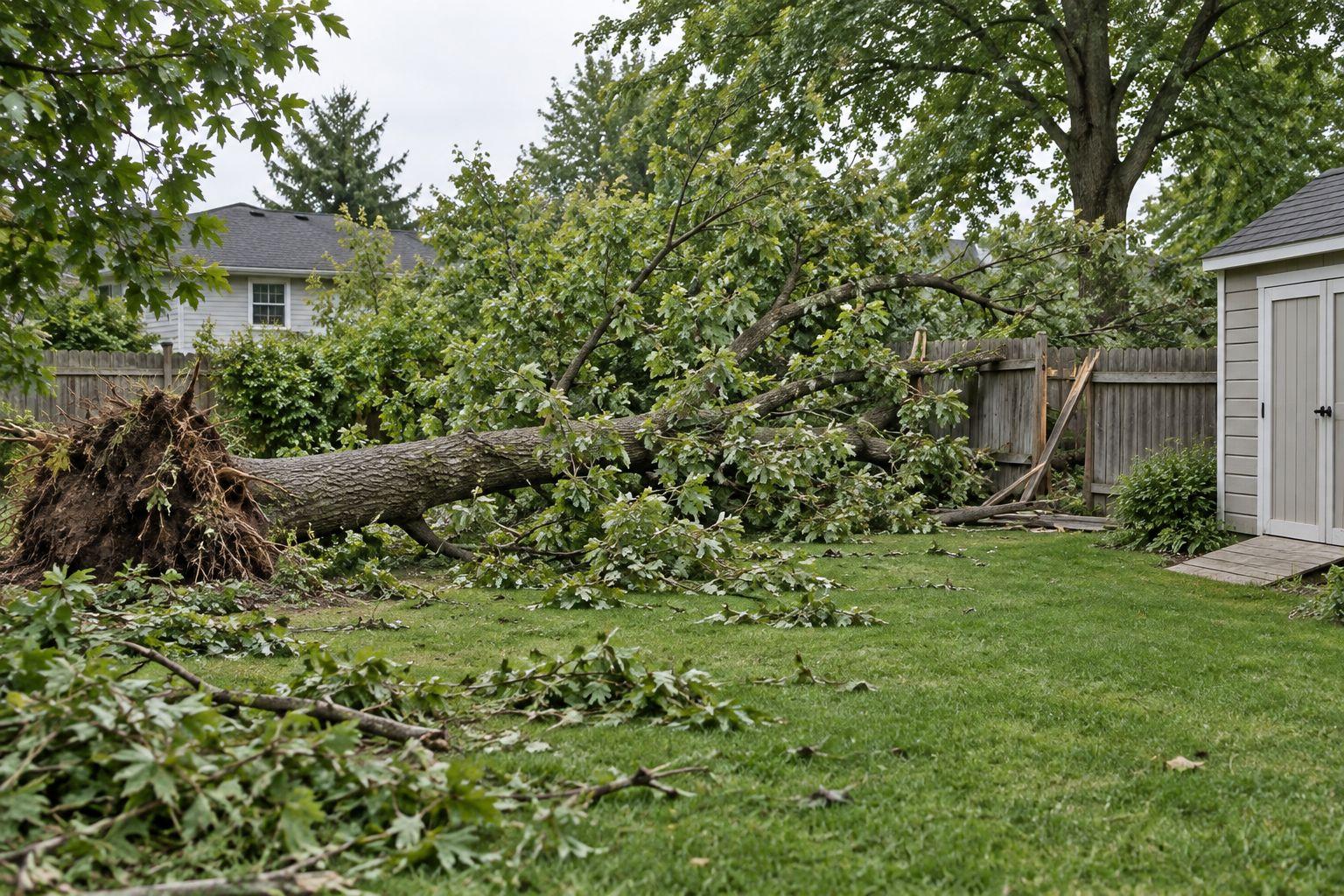
A useful estimate separates removal from related work. That gives you and the adjuster a clearer record than a single description saying only tree cleanup.
What should a Rochester-area removal estimate include?
For planned or post-storm work in Rochester, Webster, and eastern Monroe County, ask the crew to explain the job in plain language. You need to know what will happen on your property and what condition the site will be left in.
- Access: Identify gates, narrow passages, fences, and equipment routes.
- Tree size and position: Explain whether the tree is standing, grounded, suspended, or resting on a structure.
- Nearby structures: Point out the house, garage, shed, fence, and anything else within the work area.
- Cleanup scope: Specify what happens to logs, branches, brush, and smaller debris.
- Stump work: Confirm whether grinding is included or quoted separately.
- Crew communication: Identify who will explain the removal plan and approve changes with you.
Spartantreeny is a tree removal option for Rochester-area homeowners, not a substitute for an insurance coverage decision. When requesting an estimate, ask to discuss careful removal and thorough cleanup directly with the crew. Keep questions about reimbursement separate from questions about the work itself.
Request an individual tree removal estimate
Discuss access, nearby structures, removal scope, and cleanup for your Rochester-area property.
Does your neighbor have to pay your deductible?
Your neighbor does not automatically owe your deductible. Your policy determines your initial claim payment, while recovery from a neighbor depends on a separate basis for liability.
Ask your insurer whether it will pursue recovery through subrogation and how any recovered deductible would be handled. Do not promise a contractor that the neighbor’s insurer will pay before that insurer accepts responsibility.
If the deductible or uninsured loss becomes a dispute, preserve the estimate, invoices, photographs, and correspondence. Get New York legal advice before treating a payment demand as an established debt.
What if the tree falls into your yard but hits nothing?
A fallen tree in an otherwise undamaged yard does not automatically trigger debris removal coverage. Policies can distinguish between removing a tree that damages covered property and clearing a tree that simply lands on the lawn.
Ask the insurer to identify the provision that applies to your situation. If removal is not covered, the neighbor is still not automatically responsible; negligence remains a separate issue.
Before hiring anyone, settle the work boundary and cleanup scope. A branch pile, the main trunk, and the stump are different parts of the job, and your estimate should say which are included.
How can you address a dangerous neighboring tree before it falls?
Start with a specific, calm message about what you can observe from your own property. Describe the location and visible concern without declaring the tree dead or unsafe unless a qualified assessment supports that statement.
Ask the owner to arrange an assessment, and keep a copy of the correspondence. Photographs taken safely from your property can help document the condition and when you raised it.
For a planned removal in 2026, settle access permission and the cleanup boundary before work starts. A clear agreement about using a driveway or opening a fence is easier to manage before equipment arrives.
Do not cut a neighbor’s tree down yourself. Questions about encroaching branches, disputed boundaries, or permission deserve separate advice; they are not resolved by your concern that the tree might fall.
FAQ
My neighbor’s tree fell on my property in New York. Who do I call first?
Call emergency services or the utility first if there is an immediate hazard; otherwise, notify your own property insurer promptly. Document the damage safely and ask what the insurer needs before removal.
Does my neighbor automatically pay because the tree was theirs?
No, tree ownership alone does not establish liability in New York. Responsibility generally depends on negligence, including whether the owner knew or should have known about a dangerous condition.
Does homeowners insurance cover a neighbor’s tree hitting my house?
Your homeowners policy can cover damage from a neighbor’s falling tree, subject to its terms, exclusions, and deductible. Ask your insurer to confirm both the property damage coverage and the applicable removal provisions.
Can I remove the tree before the insurance adjuster visits?
Ask your insurer what documentation it requires before removal, while addressing immediate safety and preventing further damage. Photograph conditions safely, keep invoices, and do not delay emergency action solely to preserve the scene.
Will a written warning make my neighbor responsible in 2026?
A written warning does not automatically establish responsibility in 2026. It can help document notice, but the dangerous condition, reasonableness of the warning, and circumstances of the failure still matter.
Who pays if the tree lands on my car instead of my house?
Start with your auto insurer to determine whether applicable comprehensive coverage covers the damage. A separate claim against the tree owner depends on the facts supporting liability.
Does tree removal include stump grinding and all cleanup?
Tree removal does not necessarily include stump grinding or every cleanup task. Get a written estimate specifying logs, branches, brush, stump work, and the agreed work area.
One last thing
The evidence most easily lost during cleanup can be the evidence most useful in a dispute. Once the broken trunk and decayed sections are cut up and hauled away, reconstructing their original condition becomes harder.
Before nonurgent removal, ask your insurer whether it wants photographs, an inspection, or particular material preserved. Do not store unstable wood or leave a hazard in place for evidence. For your 2026 records, keep the removal scope and the insurance correspondence together: one explains the work, and the other explains who agreed to pay.