




Best overall for a spacious yard: sugar maple. Best for a moist site: red maple. Best for a smaller yard: serviceberry. These are the best trees for fall color in Rochester, NY, when you match their mature size and soil needs to the planting spot—not just the nursery tag.
- Best trees for fall color in Rochester, NY: sugar maple for spacious yards, serviceberry for smaller planting spaces.
- Red maple suits moist sites; black gum offers red fall foliage where soil and drainage fit.
- Spartan Tree and Landscape provides tree planting and removal for Rochester homeowners planning a replacement.
- Choose mature size, drainage, and clearance before choosing leaf color.
Why the planting spot matters more than the color
A tree that looks right beside your driveway today can outgrow that space. For Rochester, Webster, and eastern Monroe County homeowners, the useful question is not simply which tree turns red. It is which tree can grow without crowding your roof, overhead wires, driveway, or neighboring trees.
For your 2026 planting plan, separate the wish list from the site requirements. Color belongs on the wish list; root space, sunlight, and drainage are requirements. If shade is also a priority, compare these choices with the best shade trees to plant in Rochester, NY.
Spartan Tree and Landscape serves Rochester homeowners who need tree removal and replacement planting planned together. Settle the removal, stump, access, and cleanup questions before deciding where the replacement belongs.
What makes the best tree for fall color?
These criteria put long-term fit ahead of a good-looking autumn photograph:
- Mature size: Allow room for the full canopy, not just the young tree you bring home.
- Soil and drainage: Match the species to the actual planting area, including wet pockets and compacted ground.
- Fall display: Consider yellow, orange, and red, but expect variation with weather and the individual tree.
- Site exposure: Check sunlight, wind exposure, and nearby pavement or salted roads.
- Upkeep: Account for leaves, fruit, pruning, and the space needed to work around the tree.
- Replacement logistics: If an existing tree is coming down, resolve stump grinding and planting location together.
Best fall-color trees at a glance
| Tree | Best for | Standout feature | Key limitation |
|---|---|---|---|
| Sugar maple | Spacious yards with good drainage | Yellow, orange, and red autumn foliage | Large canopy; poor choice for confined, salty sites |
| Red maple | Moist, acidic planting areas | Red foliage potential and broad site adaptability | Fall color varies; alkaline soil can cause problems |
| Serviceberry | Smaller planting spaces | Fall color, spring flowers, and fruit | Fruit creates cleanup near pavement |
| Black gum | Red fall color in a permanent planting spot | Strong scarlet autumn display | Site selection and transplant handling matter |
| American hornbeam | Partly shaded yards | Fall foliage on a smaller woodland tree | Slow growth; not a quick shade solution |
For this 2026 guide, mature-size references follow North Carolina State Extension's Plant Toolbox species profiles. Species size is a planning reference, not a guarantee for an individual tree; named cultivars can differ.
1. Sugar maple: best fall-color tree for spacious yards
Sugar maple (Acer saccharum) is the default choice when you have room for a large tree and well-drained soil. Its autumn foliage includes yellow, orange, and red, often with several colors across the canopy. This is a long-term shade-tree choice, not a tree to squeeze between a house and driveway.
North Carolina State Extension lists sugar maple at 40–80 feet tall. Check the mature spread of the specific selection, too; height alone does not tell you whether branches will eventually crowd the roof.
Sugar maple pros:
- Offers a varied autumn palette rather than red alone.
- Develops a substantial shade canopy.
- Fits a large residential lawn with adequate rooting space.
Sugar maple cons:
- Does not suit a narrow planting strip or restricted root area.
- Tolerates road salt and compacted urban conditions poorly.
Best for: A spacious Rochester-area yard with good drainage, room away from structures, and limited salt exposure.
Before buying, look beyond the center of the lawn. Consider where snow gets piled, where vehicles cut across the grass, and where water stands after rain. Those conditions can rule out an otherwise attractive planting spot.
Verdict: Buy sugar maple for room to grow; skip it for a cramped roadside strip.
2. Red maple: best fall-color tree for a moist site
Red maple (Acer rubrum) suits a broader range of moisture conditions than sugar maple. It is a useful candidate when your planting area stays moist and the soil is acidic, but that does not make every wet corner suitable.
North Carolina State Extension lists red maple at 40–70 feet tall. It is still a large tree, and the name does not guarantee that every specimen will deliver the same shade of red in autumn.
Red maple pros:
- Offers red fall-color potential.
- Tolerates moist conditions.
- Provides a large shade canopy where space allows.
Red maple cons:
- Autumn color varies between individual trees and selections.
- Alkaline soil can lead to nutrient-related leaf yellowing.
Best for: A roomy, moist planting area where soil conditions support red maple.
For a 2026 purchase, ask which cultivar is being supplied and what its expected mature dimensions are. Do not accept a generic red maple label as a complete planting specification. If your lawn stays wet because construction compacted the soil, address that condition rather than treating the species choice as the whole solution.
Verdict: Buy red maple for a compatible moist site; hold until soil questions are settled.
3. Serviceberry: best fall-color tree for a smaller yard
Serviceberry offers more than autumn leaves. Canadian serviceberry (Amelanchier canadensis) produces spring flowers, fruit, and yellow-to-orange or red fall color, giving a smaller planting space interest across seasons.
North Carolina State Extension lists Canadian serviceberry at 15–30 feet tall. Serviceberries include several species and cultivars, so confirm the botanical name rather than assuming every nursery plant has the same size or form.
Serviceberry pros:
- Fits smaller spaces than the large maples listed here.
- Combines autumn color with spring flowers.
- Produces fruit used by birds.
Serviceberry cons:
- Fallen fruit can be a nuisance beside walks and patios.
- Rust and leaf diseases can affect appearance.
Best for: A smaller Rochester or Webster yard where you want seasonal interest without a large shade-tree canopy.
Decide whether you want a single-trunk tree or a multistem form before requesting an estimate. That choice changes the footprint and how you maintain the surrounding bed. Smaller does not mean suitable directly beneath every utility line; check the actual selection and required clearance.
Verdict: Buy serviceberry for a smaller planting space; skip a fruit-drop location beside your main walkway.
4. Black gum: best fall-color tree for a red focal point
Black gum (Nyssa sylvatica), also called tupelo, is a strong candidate when red autumn foliage is the main goal. Its glossy leaves turn scarlet, orange, or purple-red, making it a useful focal tree where the site fits.
Choose the planting position carefully. Black gum prefers acidic soil and can be difficult to transplant once established because of its root structure.
Black gum pros:
- Produces a strong red autumn display.
- Offers glossy foliage during the growing season.
- Provides fruit used by wildlife on fruit-bearing trees.
Black gum cons:
- Moving an established tree is difficult.
- Alkaline soil is a poor match.
Best for: A homeowner who wants a red fall-color focal point and can commit to a suitable permanent location.
Black gum deserves a deliberate site check, not an impulse purchase based on autumn photographs. Ask about soil, drainage, mature dimensions, and nursery stock handling before choosing it. A careful planting decision matters more than choosing the largest specimen.
Verdict: Buy black gum for a suitable permanent spot; hold if the soil or layout is unresolved.
5. American hornbeam: best fall-color tree for partial shade
American hornbeam (Carpinus caroliniana) is a smaller woodland tree with yellow, orange, and red autumn foliage. Its smooth, muscular-looking trunk adds interest after the leaves fall.
American hornbeam suits partial shade and moist, well-drained soil. It is a different choice from European hornbeam, so check the botanical name when comparing nursery recommendations.
American hornbeam pros:
- Works in partly shaded planting areas.
- Offers fall color without a large maple canopy.
- Adds distinctive bark and branching interest.
American hornbeam cons:
- Slow growth makes it a poor choice for quick shade.
- Dry, exposed planting areas are not its preferred setting.
Best for: A partly shaded yard or woodland edge where a smaller tree fits the landscape.
Do not place American hornbeam under an established tree without considering root competition. Shade tolerance does not remove the need for soil volume and water during establishment. Look at the entire planting area, not simply the gap between branches overhead.
Verdict: Buy American hornbeam for partial shade; skip it when fast canopy growth is the priority.
How the trees are ranked
The order reflects residential use cases, not a claim that one species wins on every property. Sugar maple leads for a spacious, well-drained yard; red maple fills the moist-site slot; serviceberry serves smaller spaces. Black gum prioritizes red foliage, while American hornbeam addresses partial shade.
For 2026 planning, use the table to narrow the choices, then confirm the actual site. None of these trees earns a recommendation for a location that fails its basic requirements.
Plan removal and replacement as one job
If you are replacing an existing tree, settle the work area before ordering the new one. Spartan Tree and Landscape provides tree removal, stump grinding, and tree planting; an individual estimate should make clear which tasks are included.
Walk through these points directly with the crew:
- Access: Identify gates, narrow passages, overhead wires, and surfaces that need protection.
- Stump work: Clarify whether grinding is included and what material remains afterward.
- Planting position: Check clearances, underground utilities, drainage, and the old root area.
- Cleanup scope: Put log removal, brush removal, grinding debris, and finish work in writing.
Do not assume stump grinding leaves a ready-to-plant hole. Wood fragments, remaining roots, and disturbed soil all affect the replacement plan. A nearby planting location can be more practical than putting the new tree directly over the old stump.
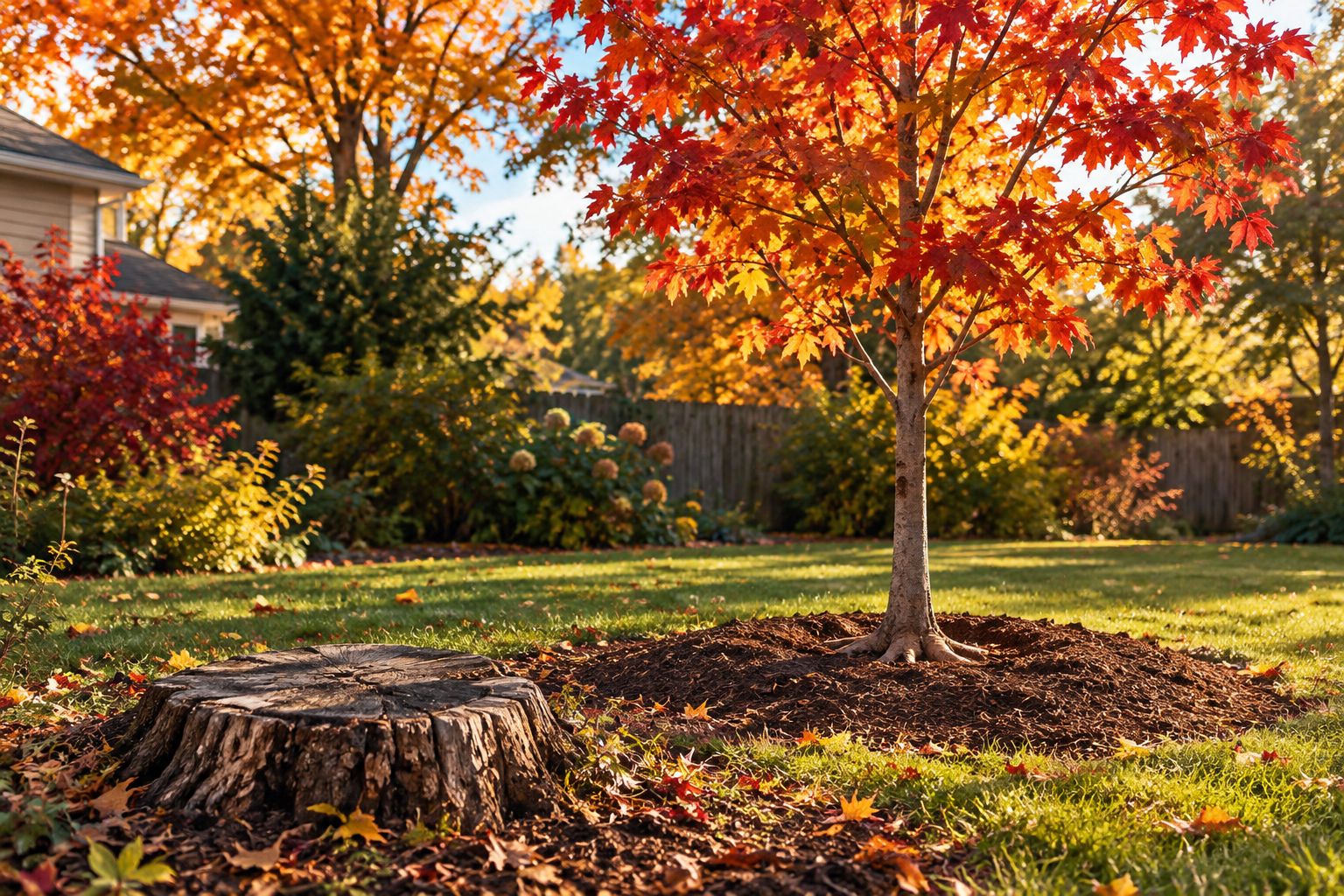
Tree size, access, nearby structures, and cleanup scope affect the removal work. For planting, discuss the species, stock size, soil preparation, and establishment care. Request a tree removal and planting estimate based on your property rather than expecting a fixed online figure.
Which fall-color tree should you choose?
Choose sugar maple if you have a spacious, well-drained yard. Choose serviceberry if a large canopy does not fit. Those are the clearest starting points for homeowners comparing these trees.
For a moist site, investigate red maple. For a red focal point, consider black gum after checking soil suitability. For partial shade, consider American hornbeam rather than forcing a sun-oriented choice into the wrong spot.
The best 2026 planting decision starts with the space you actually have. A smaller tree in the right location beats a large tree that will need repeated clearance work.
FAQ
What's the best tree for fall color in a Rochester yard?
Sugar maple is the default choice for a spacious, well-drained Rochester yard. Serviceberry is a better starting point when a large shade tree will not fit.
Which small tree has good fall color in Webster, NY?
Serviceberry is a good candidate for a smaller Webster yard. Confirm the species, cultivar, mature size, and fruit-drop location before planting.
Is red maple better than sugar maple for fall color?
Red maple is not automatically better than sugar maple. Choose red maple for a compatible moist site and sugar maple for a spacious, well-drained location; autumn color varies with the tree and weather.
Which tree should I consider for red autumn leaves?
Black gum is a strong candidate for red autumn foliage. Check acidic soil suitability and choose a permanent planting location before committing.
Can I plant a fall-color tree where another tree was removed?
A removed tree's location needs assessment before replanting. Remaining roots, grinding debris, soil condition, and clearances determine whether that spot or a nearby location makes more sense.
How much does tree removal and replacement planting cost?
Tree removal and replacement planting need an individual estimate. Tree size, access, nearby structures, stump work, cleanup, and the replacement tree's planting requirements determine the scope.
Will a tree have the same fall color every year?
No tree guarantees an identical autumn display every year. Weather, tree health, species, and cultivar affect color, so choose for site suitability as well as appearance.
One last thing
Photograph the planting spot while your existing trees still have leaves. A bare winter canopy can make a crowded location look open; the leaf-on view shows the space the new tree will actually share.
When you discuss your 2026 project with Spartan Tree and Landscape, bring that photograph and identify what you want to keep clear. Careful placement now is better than planning future pruning to correct a poor location.