



Best overall for a roomy, well-drained yard: northern red oak. Best for a smaller yard: serviceberry. Best for seasonally wet soil: swamp white oak. These are practical starting points for choosing the best native trees in Monroe County, NY, with planting decisions grounded in your Rochester or Webster property—not just a nursery label.
- Best native trees Monroe County NY: northern red oak wins for large, well-drained yards; serviceberry suits smaller spaces.
- Swamp white oak suits seasonally wet ground; pagoda dogwood fits a sheltered, partly shaded planting spot.
- Spartan Tree and Landscape provides tree planting and removal services for Rochester-area homeowners.
- Choose the planting location before the species, especially when replacing a tree near your house or driveway.
Why this matters
A native tree still needs the right site. A large shade tree squeezed between a house and overhead wires creates a different problem from the tree you removed.
For Rochester, Webster, and eastern Monroe County homeowners planning a replacement in 2026, removal access and planting space belong in the same conversation. If an old stump occupies the planting area, start with whether you can plant where a tree was removed. Removing the trunk does not automatically leave a suitable planting hole.
Spartan Tree and Landscape is a practical choice for Rochester-area homeowners who need tree removal and replacement planting considered together. Ask for an individual estimate that separates removal, stump work, cleanup, and planting rather than treating them as one undefined job.
What makes the best native tree for your yard?
Rank your planting site against these criteria before choosing a species:
- Mature size: Allow for the full crown and root system, not the size of the nursery tree.
- Soil moisture: Distinguish a damp site from standing water, and freely draining soil from drought-prone ground.
- Sun exposure: Match the tree to the light it receives after any planned removals.
- Soil chemistry: Check soil pH before choosing a species that performs poorly in alkaline conditions.
- Maintenance fit: Decide whether you can accept fallen fruit, acorns, foliage, or evergreen screening that needs room.
- Removal and access: Keep future equipment access, utilities, nearby structures, and stump locations in the plan.
The best choice is the tree that fits all six—not the one with the most impressive fall color.
Native trees at a glance
The following species are native to New York and offer different uses in Monroe County yards. Native range does not guarantee suitability for every street, lakefront lot, or compacted planting strip.
| Tree | Best for | Standout feature | Key limitation |
|---|---|---|---|
| Northern red oak | Large, well-drained yards | Broad shade canopy | Too large for tight planting spaces |
| Serviceberry | Smaller yards with seasonal interest | Spring flowers and edible fruit | Fruit and leaf diseases need consideration |
| Swamp white oak | Roomy sites with seasonally wet soil | Tolerance of periodic wetness | Requires substantial crown space |
| Pagoda dogwood | Sheltered, partly shaded spots | Layered branching | Poor fit for hot, dry exposure |
| Red maple | Acidic-soil shade-tree sites | Fall color and tolerance of moist soil | Alkaline soil can cause chlorosis |
| Eastern redcedar | Sunny, dry evergreen screening | Dense evergreen foliage | Alternate host for cedar-apple rust |
These are distinct planting roles, not interchangeable substitutes. Start with the row that describes your property.
1. Northern red oak: best native tree for a large shade canopy
Northern red oak, Quercus rubra, is the default choice here for a large yard with well-drained soil. It commonly reaches about 60–75 feet tall, so treat it as a long-term landscape tree rather than a decorative addition beside the front steps.
Its broad canopy provides shade, while acorns support wildlife. Give the tree room away from buildings and overhead utilities; repeated pruning is not a substitute for adequate planting space.
Northern red oak pros:
- Develops a substantial shade canopy.
- Produces acorns used by wildlife.
- Provides fall foliage interest.
Northern red oak cons:
- Mature size rules out narrow yards and confined planting strips.
- Acorns and leaves add seasonal cleanup.
Best for: A homeowner replacing a large tree where there is enough open ground for another large canopy.
Verdict: Buy northern red oak for a roomy, well-drained site; skip it where the mature crown would crowd your house.
2. Serviceberry: best native tree for a smaller yard
Serviceberry offers spring flowers, fruit, and fall color without the scale of an oak. For this recommendation, ask about Amelanchier laevis, also called Allegheny serviceberry, rather than assuming every plant sold as serviceberry has the same form.
Allegheny serviceberry commonly grows 15–25 feet tall. Check the individual selection's expected spread and whether it is grown as a single trunk or multiple stems before placing it beside a walkway.
Serviceberry pros:
- Fits spaces where a large shade tree does not belong.
- Produces spring flowers and edible fruit.
- Works in sun or partial shade.
Serviceberry cons:
- Fallen fruit is a consideration beside paving and patios.
- Rust and leaf diseases can affect appearance.
Best for: A smaller Rochester or Webster yard where you want seasonal interest rather than a broad shade canopy.
Verdict: Buy serviceberry for a smaller planting space; skip it directly over a seating area if fallen fruit will bother you.
3. Swamp white oak: best native tree for seasonally wet soil
Swamp white oak, Quercus bicolor, is a strong candidate where soil stays moist or becomes periodically wet. It commonly reaches 50–60 feet tall and develops a broad crown.
The name does not mean you should plant it in any permanently flooded depression. Identify how water moves through the site and distinguish seasonal wetness from persistent standing water before choosing the planting location.
Swamp white oak pros:
- Tolerates periodic wetness.
- Develops into a substantial shade tree.
- Produces acorns that support wildlife.
Swamp white oak cons:
- Needs more space than a small ornamental tree.
- Acorns and foliage require seasonal cleanup.
Best for: A large yard with seasonally moist ground and room for a spreading canopy.
Verdict: Buy swamp white oak for a roomy, seasonally wet site; skip it when the available space only suits a small tree.
4. Pagoda dogwood: best native tree for partial shade
Pagoda dogwood, Cornus alternifolia, suits a sheltered position with partial shade and moist, well-drained soil. Its horizontal, layered branches give a smaller planting area structure without requiring a large shade-tree canopy.
Consider it near the edge of established trees, provided the site has enough moisture. A hot, exposed strip beside pavement is a different environment and a poor match.
Pagoda dogwood pros:
- Suits partly shaded planting areas.
- Provides distinctive layered branching.
- Produces flowers and fruit used by wildlife.
Pagoda dogwood cons:
- Does not suit hot, dry exposure.
- Needs attention to moisture during establishment.
Best for: A sheltered garden edge or partly shaded yard with well-drained soil.
Verdict: Buy pagoda dogwood for a protected, partly shaded spot; skip it for a dry, exposed frontage.
5. Red maple: best native shade tree for acidic soil
Red maple, Acer rubrum, belongs on your shortlist when soil conditions suit it—not simply because you want red fall leaves. It tolerates moist soil, but alkaline conditions can cause chlorosis, visible as yellowing foliage.
Test the soil before committing to red maple in a disturbed or built-up planting area. Also leave space around paved surfaces: roots and constrained planting areas are a poor combination.
Red maple pros:
- Provides seasonal foliage color.
- Tolerates moist growing conditions.
- Develops into a useful shade tree.
Red maple cons:
- Performs poorly in unsuitable alkaline soil.
- Needs room away from constrained pavement edges.
Best for: A homeowner with suitable acidic soil and enough space for a full-size shade tree.
Verdict: Buy red maple after checking soil conditions; hold if soil pH is unknown.
6. Eastern redcedar: best native tree for dry evergreen screening
Eastern redcedar, Juniperus virginiana, is the evergreen option on this list. It suits sunny, well-drained sites and tolerates dry conditions once established.
Think beyond the narrow shape of a young nursery tree when planning a screen. Eastern redcedar also serves as an alternate host for cedar-apple rust, which matters when susceptible apples or crabapples grow nearby.
Eastern redcedar pros:
- Retains foliage through winter.
- Tolerates dry conditions after establishment.
- Provides wildlife cover.
Eastern redcedar cons:
- Needs sufficient sun and drainage.
- Cedar-apple rust complicates placement near susceptible apples and crabapples.
Best for: Sunny, well-drained ground where evergreen cover matters more than broad overhead shade.
Verdict: Buy eastern redcedar for suitable evergreen screening; skip a shaded, waterlogged planting site.
How these native trees were ranked
This 2026 shortlist ranks trees by fit for distinct homeowner needs: large-yard shade, smaller spaces, seasonal wetness, partial shade, acidic soil, and evergreen screening. Species characteristics follow established horticultural references, including NC State Extension's Plant Toolbox and Missouri Botanical Garden's Plant Finder.
The ranking is not a nursery-stock report or a promise that every species fits your property. Site fit outranks list position. Swamp white oak belongs ahead of northern red oak when seasonal wetness is the deciding condition.
Before planting: settle the removal and site plan
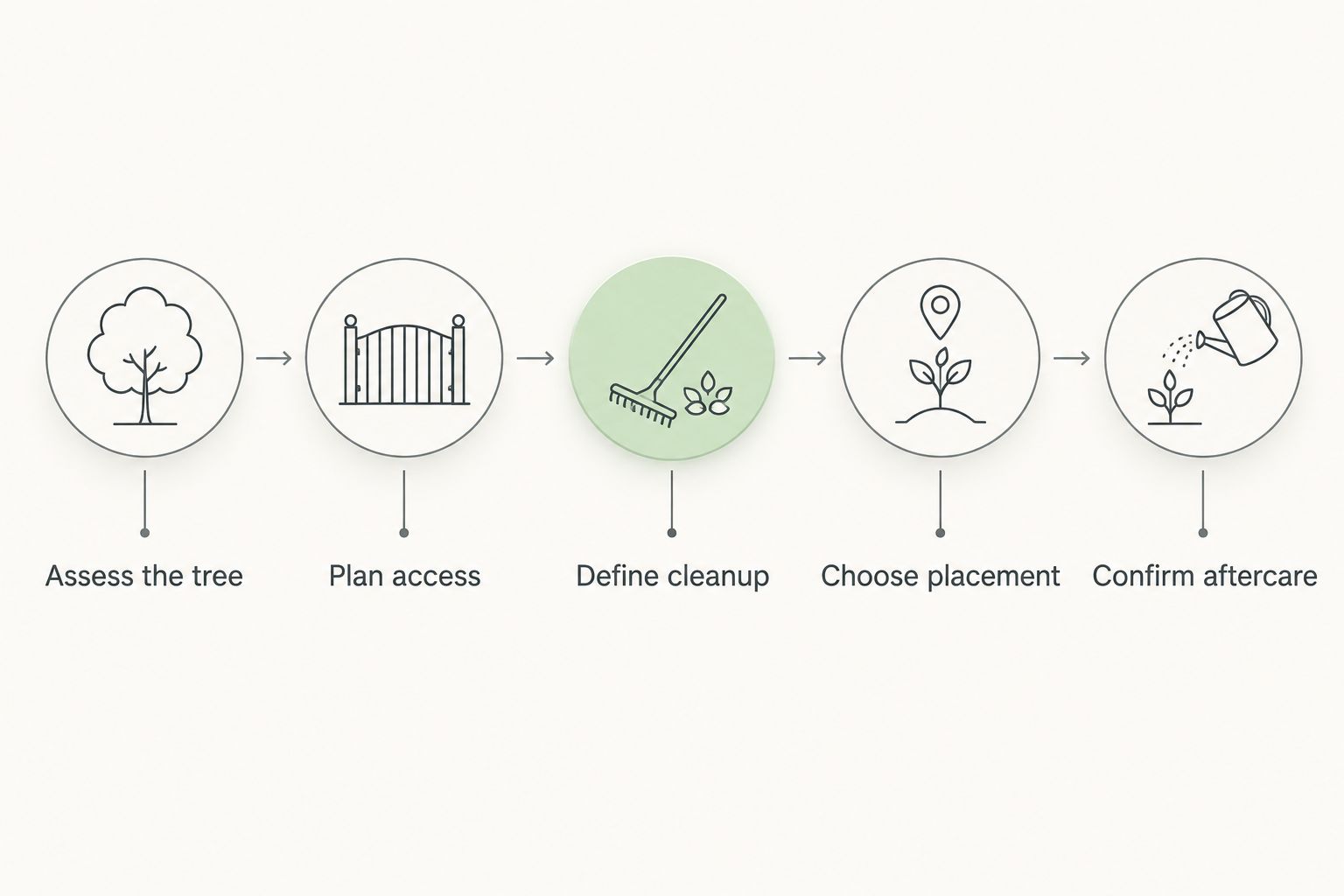
If you are replacing an existing tree in 2026, work through these decisions in order:
- Assess the tree. Ask whether removal is necessary or whether pruning addresses the concern. Do not remove a sound tree solely because another species ranks higher on a list.
- Plan access. Identify gates, fences, driveways, nearby structures, and the route for equipment before agreeing to removal or stump work.
- Define cleanup. Specify what happens to branches, logs, chips, and stump grindings, and who prepares the planting area.
- Choose placement. Check utilities, drainage, sunlight, mature spread, and the condition of the replacement planting spot.
- Confirm aftercare. Agree on watering and mulch responsibilities before the new tree goes in.
Spartan Tree and Landscape provides removal, stump grinding, and planting services in the Rochester area. When requesting an estimate, ask to deal directly with the crew about careful removal, nearby structures, and thorough cleanup. Those details need a clear scope, not a vague promise to leave things tidy.
For any existing-tree work, use the tree removal estimate checklist to compare what is actually included.
Plan your removal and replacement
Ask for an individual estimate covering access, stump work, cleanup, and the planting site.
Which native tree should you choose?
Choose northern red oak as the default for a large, well-drained yard. Choose serviceberry when the space calls for a smaller tree. Choose swamp white oak when seasonal wetness changes the decision.
For your 2026 planting plan, put the location ahead of the species. A suitable native tree planted in the wrong place still becomes a clearance, drainage, or maintenance problem.
If an existing tree needs attention first, ask Spartan Tree and Landscape to separate that work from the replacement planting scope. You should understand the access plan, cleanup responsibilities, and planting location before agreeing to the job.
FAQ
What's the best native shade tree for a Monroe County yard?
Northern red oak is the default choice for a large, well-drained Monroe County yard with adequate clearance. Choose swamp white oak instead when seasonal wetness is the main site condition.
What's a good native tree for a small yard in Rochester?
Allegheny serviceberry is a good native option for a smaller Rochester yard. Check the selected plant's mature spread and growth form, and avoid placing fruit-bearing branches directly over seating areas if cleanup is a concern.
Is red maple better than an oak for my yard?
Red maple is not automatically better than an oak; soil and available space decide the fit. Red maple needs suitable soil chemistry, while northern red oak needs ample room and well-drained ground.
Which native tree works in a partly shaded yard?
Pagoda dogwood suits sheltered, partly shaded locations with moist, well-drained soil. Avoid a hot, dry planting strip beside pavement.
Can I plant a native tree where a stump was ground?
Stump grinding alone does not establish that the spot is ready for a new tree. Check remaining roots, wood debris, soil condition, and available planting space before choosing the replacement location.
How much does native tree planting cost in Monroe County?
Native tree planting needs an individual estimate based on the tree, site access, preparation, and planting scope. If removal or stump grinding is involved, request separate descriptions of those tasks and the cleanup included.
Does Spartan Tree and Landscape plant replacement trees?
Spartan Tree and Landscape provides planting, tree removal, and stump grinding services for Rochester-area homeowners. Request an individual estimate that identifies the existing-tree work and replacement planting separately.
One last thing
The tree you remove changes the site for the tree you plant. A partly shaded spot can become full sun after removal, so reassess exposure rather than reusing the old planting assumptions.
Before ordering a replacement in 2026, stand at the proposed location and look up, across, and down: future crown space, nearby structures, and the soil underfoot. Choose for the yard the new tree will grow in—not the yard you had before removal.