





Storm damage tree removal needs urgent assessment when a tree develops a new lean, lifts its roots, splits through the trunk, or leaves broken limbs hanging above people or property. Keep clear of the damaged area; a professional assessment determines whether the whole tree needs removal or whether targeted pruning can address the damage.
- Storm damage tree removal starts with isolating hazards, not cutting branches.
- New leaning, lifted roots, split trunks, and hanging limbs need urgent professional assessment.
- Spartantreeny provides Rochester-area homeowners with tree removal and 24/7 emergency tree services.
- Tree contact with power lines requires the utility; do not approach or attempt cleanup.
What signs mean a storm-damaged tree needs emergency removal?
A storm-damaged tree needs urgent professional assessment when its support has changed or broken wood threatens an occupied area. Emergency assessment does not automatically mean complete removal. The decision depends on the damage, the remaining structure, and what the tree could strike.
For Rochester, Webster, and eastern Monroe County homeowners, the first decision is whether people can safely stay away from the hazard. This guide to when a tree problem cannot wait until morning explains the distinction between an urgent hazard and work that can be scheduled.
| Visible condition | What it means for your next move | What not to assume |
|---|---|---|
| New lean with lifted soil or exposed roots | Keep people away and request urgent assessment | That the trunk must snap before the tree can fall |
| Fresh trunk split or separated main stems | Avoid the area beneath and around the damaged tree | That branches still carrying leaves are secure |
| Broken limb suspended in the canopy | Keep the space below unused until assessed | That a hanging branch will fall straight down |
| Tree resting on a building or another tree | Stay away from the loaded tree and damaged structure | That cutting the visible end will release it safely |
| Tree or branch touching a power line | Stay clear and contact the utility | That a quiet line is de-energized |
| Small debris already on clear ground | Check for overhead and electrical hazards before cleanup | That a clear driveway means the canopy is safe |
Why this matters
The storm ending does not make a damaged tree stable. Broken branches can remain caught overhead, and a partially uprooted tree can still be standing when you first look outside.
For your 2026 storm-preparation plan, separate two jobs: keeping people away now and deciding what tree work is necessary afterward. You do not need to diagnose the tree yourself to report a new lean, lifted roots, or a hanging limb.
A new lean or lifted root plate
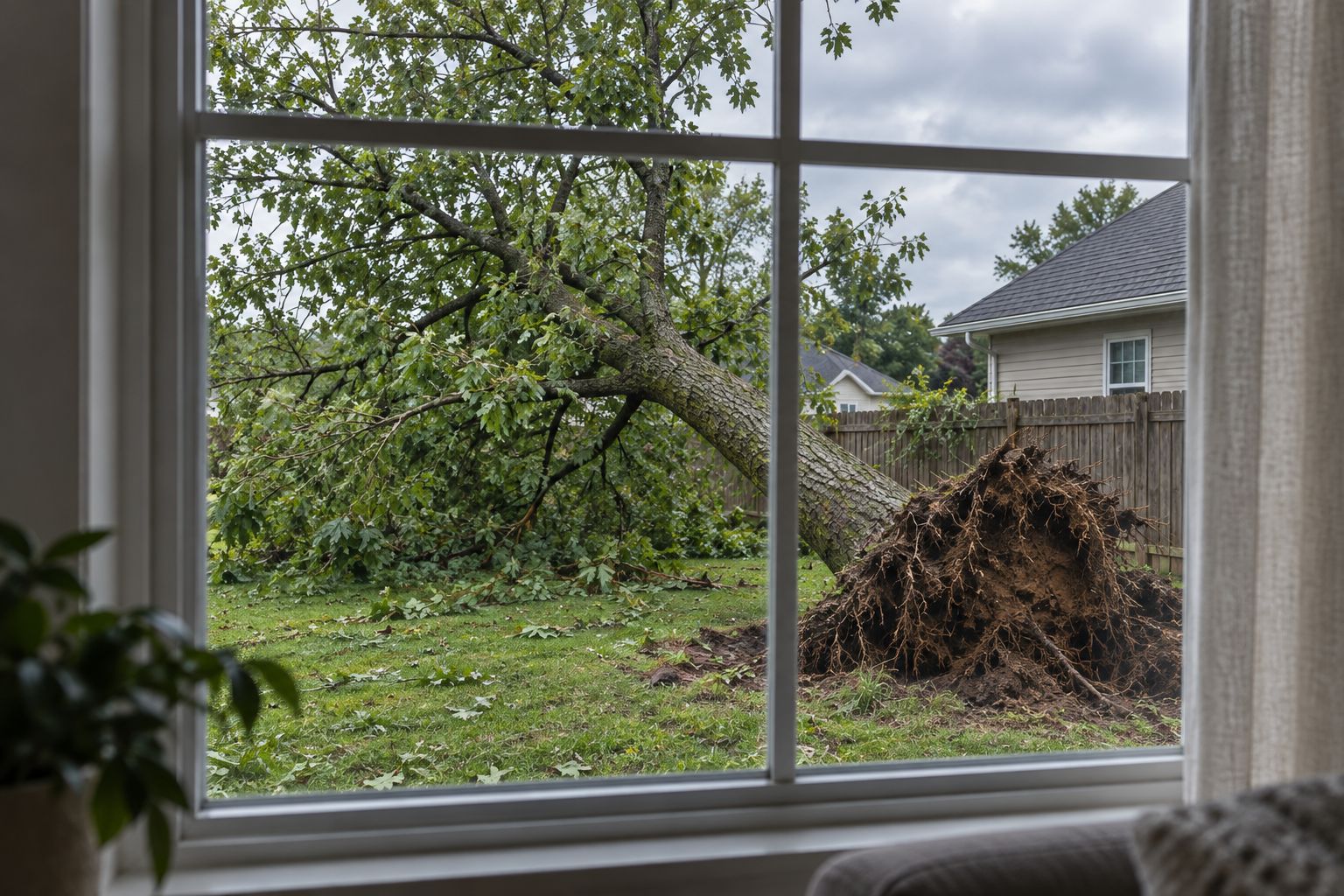
A fresh lean after a storm deserves attention, especially when the ground has cracked or risen around the base. Movement in the root plate means the tree's anchorage has changed; the fact that the trunk remains upright does not settle the question of stability.
Look only from a safe position. Do not walk around the base to inspect cracks, step onto raised soil, or pull at exposed roots.
Useful details to report include:
- Whether the lean appeared during the storm.
- Whether soil has lifted or cracked near the trunk.
- Whether the tree now points toward a house, driveway, sidewalk, or neighboring property.
- Whether you can see the area without approaching the tree.
A new lean plus ground movement is a reason to keep the area clear, not a reason to try straightening the tree yourself. An old lean and a new lean are different observations, but neither can be judged safely from appearance alone.
A split trunk or broken main attachment
A fresh split through the trunk or between large stems is more serious than scattered twigs on the lawn. The damage affects wood supporting a substantial part of the tree.
Warning signs include newly separated stems, a visible opening at a major branch attachment, or a large section hanging away from the trunk. Do not stand underneath to get a better photograph or check whether the split moves.
A strap, rope, or improvised brace is not a homeowner repair for storm-damaged structural wood. Ask for an assessment of the remaining tree, not just removal of the most obvious broken piece.
Hanging limbs and trees resting on other objects
A branch caught in the canopy remains a hazard even when it looks firmly wedged. It can shift as surrounding branches move, and pulling from below puts you in the path of falling wood.
A tree resting on a roof, fence, or another tree also needs controlled handling. The object supporting it changes how the damaged wood is loaded; removing one piece can move another.
Keep these areas unused:
- The space beneath hanging limbs.
- A driveway or walkway under a damaged canopy.
- The area around a tree resting against a building.
- Any route that passes beneath a tree caught in another tree.
Do not climb onto a roof or ladder to reach storm debris. The first useful action is keeping people out, not making the yard look normal.
What should you do before the tree crew arrives?
Use this sequence in your 2026 household storm plan. Skip photographs and property protection whenever either requires approaching the hazard.
- Keep people clear. Bring children and pets away from the affected area. Do not move a vehicle if reaching it means passing under damaged wood.
- Check for immediate danger from a safe place. If someone is injured, trapped, or facing an immediate threat to life, call 911. Report downed or tree-contacted electrical lines to the utility and stay away.
- Describe the change. Report a new lean, lifted soil, split trunk, hanging branch, or contact with a structure. Plain observations are more useful than guessing whether the tree is dead.
- Photograph only from safety. Use a window or an unaffected location if it provides a clear view. Do not enter the hazard area for a better angle.
- Request assessment and explain access. Mention blocked entrances, narrow gates, nearby buildings, and any known utility involvement.
- Leave cutting to the crew. Do not cut a bent limb, pull a suspended branch, or attempt to free a tree resting on something else.
When you call, give the property address and explain what the tree threatens. A branch over an unused corner of a yard and a branch over the only occupied entrance create different access problems.
Does storm damage always require full tree removal?
No. Storm damage can call for complete removal, selective pruning, or debris cleanup, depending on the condition of the remaining tree. A photograph helps communicate the problem but does not replace an assessment of stability and access.
| Approach | Best for | Main benefit | Limitation |
|---|---|---|---|
| Complete removal | A tree assessed as unsafe to retain | Removes the remaining tree hazard | Removes the tree entirely and requires a defined cleanup scope |
| Selective pruning | Branch damage on a tree assessed as suitable to retain | Addresses damaged limbs while retaining the tree | Does not correct failed roots or a structurally unsound trunk |
| Debris cleanup | Fallen material with no unresolved overhead or standing-tree hazard | Clears affected ground and access | Does not establish that nearby standing trees are safe |
Choose the work that addresses the actual hazard, not simply the work that removes visible debris. Ask the person assessing the tree to explain why the remaining structure can stay or why it needs removal.
Why storm damage tree removal scope varies
The visible break is only part of the job. For a Rochester-area estimate in 2026, ask how these factors affect the proposed work:
- Tree size: The trunk and canopy determine how much material must be handled.
- Damage location: A broken branch, split trunk, and shifted root plate require different assessments and removal plans.
- Access: Gates, fences, driveways, and usable working space affect how the crew reaches the tree.
- Nearby structures: Roofs, garages, sheds, and neighboring property affect how sections must be controlled.
- Utility involvement: Contact with electrical lines requires utility coordination before affected tree work proceeds.
- Cleanup scope: Branch hauling, larger wood, stump grinding, and treatment of the work area need separate clarification.
Do not expect a reliable individual estimate from tree height alone. Describe the site, then have the proposed scope put in writing.
What should you ask a Rochester tree service before approving work?
Ask what must happen immediately and what can wait. Emergency hazard work and the final cleanup do not have to mean the same thing, so establish what each part includes before approving it.
Use these questions when reviewing a 2026 estimate:
- Which tree or damaged sections does the work cover?
- Why is removal recommended instead of pruning?
- How will the crew handle access near the house, fence, or driveway?
- What branches, logs, and chips will leave the property?
- Is stump grinding included or separate?
- What cleanup remains after the immediate hazard is addressed?
- Can the company provide current insurance documentation?
- Who will explain changes if additional damage becomes visible?
Spartantreeny provides storm damage tree removal for Rochester-area homeowners who need a local crew to assess the damage. Its stated services include 24/7 emergency tree service; the work your property needs still requires an individual assessment.
For planned removal after the immediate danger has passed, focus on careful handling, thorough cleanup, and direct communication with the crew. Ask for those expectations in writing rather than assuming every estimate covers the same work.
Request a tree assessment
Describe the damage, nearby structures, access, and cleanup you need at your Rochester-area property.
Can a storm-damaged tree wait until morning?
A storm-damaged tree should not wait for routine scheduling when broken or unstable wood threatens people, occupied space, or essential access. Keep the area clear and request emergency assessment rather than deciding that darkness makes the problem safer to postpone.
If the damage is limited to debris already on the ground, with no electrical or overhead hazard, cleanup is a different task. Check the standing trees from safety before treating the situation as ordinary yard work.
Can you remove a storm-damaged branch yourself?
Do not attempt to remove a suspended, bent, split, or loaded branch yourself. Storm-damaged wood can move unpredictably when cut, and a ladder puts you closer to the hazard without controlling it.
Even small ground debris should wait if power lines or damaged limbs are nearby. Clear access only where you can do so without entering the affected area.
FAQ
What are the clearest signs a storm-damaged tree is dangerous?
A new lean, lifted soil around the roots, a split trunk, and suspended broken limbs are clear reasons to keep away and request urgent assessment. Tree contact with electrical lines also requires the utility.
Does a leaning tree always need removal after a storm?
A leaning tree does not automatically need removal, but a new lean after a storm needs professional assessment. Lifted roots or fresh ground movement make keeping the area clear especially important.
Who should I call if a tree falls on power lines?
Call the electric utility and stay away from the tree and lines. Call 911 if there is an immediate threat to life, an injury, or someone trapped; never assume a fallen line is de-energized.
Can a tree with green leaves still be unsafe?
A tree with green leaves can still have serious structural damage. Leaf color does not establish that its roots, trunk, or major branch attachments remain stable after a storm.
Does emergency tree removal include stump grinding?
Do not assume emergency tree removal includes stump grinding. Ask for the written scope to identify hazard removal, hauling, stump work, and final cleanup separately.
Does Spartantreeny offer emergency tree service near Rochester?
Spartantreeny offers 24/7 emergency tree services in the Rochester, NY area. Describe the damage and location when requesting an assessment; do not approach the tree to collect extra details.
What should I photograph before storm tree cleanup?
Photograph the overall damage, affected structures, and visible tree defects only from a safe location. Skip photographs that require walking beneath hanging limbs, approaching electrical lines, or entering a damaged structure.
One last thing
An upright tree is not proof of a stable tree. After the obvious debris is cleared, ask whether the remaining trunk, major attachments, and root area need further assessment.
Keep any safe photographs and the written work scope with your 2026 property records. They give you a useful reference when explaining what changed and what work was completed.