





Emergency tree service addresses an immediate safety threat; regular tree removal handles a tree that can be assessed and removed on a planned schedule. For homeowners in Rochester, Webster, and eastern Monroe County, the deciding factor is the danger—not whether a storm caused the damage. An emergency call also does not automatically include stump grinding, complete debris removal, or an insurance-covered claim.
- Emergency tree service vs regular tree removal comes down to immediate danger, not simply storm damage.
- A tree on power lines requires the utility; keep people away and do not attempt cutting.
- Planned tree removal gives homeowners time to compare written estimates, access requirements, and cleanup scope.
- Spartan Tree and Landscape provides planned removal and 24/7 emergency tree services for Rochester-area property owners.
Emergency tree service vs regular tree removal: what's different?
Emergency tree service prioritizes making a dangerous situation safe. Regular removal prioritizes completing an agreed job under planned conditions. Both require controlled work around your home, driveway, landscaping, and neighboring property.
For Rochester-area homeowners, Spartan Tree and Landscape provides both planned tree removal and 24/7 emergency tree services. That service coverage is not a promise of a particular arrival time; describe the hazard when you call so the crew can assess the situation.
| Decision point | Emergency tree service | Regular tree removal |
|---|---|---|
| Best for | An immediate threat from a fallen, broken, or unstable tree | A removal that can be safely assessed and scheduled |
| First priority | Keep people away and address the immediate hazard | Assess the tree, access, nearby structures, and work scope |
| Scheduling | Based on hazard assessment and crew availability | Arranged after assessment and agreement on the job |
| Work scope | Can begin with stabilization or removal of the dangerous portion | Can define the complete removal and cleanup before work starts |
| Main advantage | Addresses a dangerous situation without treating it as routine work | Gives you time to compare estimates and prepare the property |
| Main limitation | Immediate safety work and final cleanup can be separate stages | A planned appointment does not address a hazard that becomes urgent |
Why this matters
Calling every damaged tree an emergency does not explain what help you need. Saying that a split limb hangs over your front door gives the crew a much clearer picture than saying the tree looks bad.
The opposite mistake is more serious: treating a newly unstable tree as a routine yard project. Your job is to report what you can see from a safe place, not to inspect a cracked trunk up close or decide how it should be cut.
For your 2026 property maintenance plan, separate trees you want removed from conditions that require immediate attention. That distinction helps you request the right assessment without guessing at the removal method.
Emergency tree service: best for an immediate threat
Emergency service fits situations where a tree or large limb threatens people, occupied areas, structures, or essential access. Examples include a tree resting on a house, a broken limb suspended above an entrance, or a newly leaning tree with lifted soil around its base.
These observations justify urgent professional assessment. They do not tell you whether the tree will fall, how soon it will move, or what equipment the crew needs.
Stay outside the area the tree or limb could reach. Do not walk underneath damage to photograph it, pull on hanging branches, or try to release a limb caught in another tree.
What to do before the crew arrives
- Move people away. Keep children, visitors, and pets out of the affected area. Use another entrance if a damaged limb threatens a doorway.
- Check for utility involvement from a distance. If a tree touches or threatens electrical wires, contact the utility. Treat downed wires and anything touching them as energized.
- Call emergency responders for immediate danger. Call 911 if someone is injured, trapped, or facing an immediate threat. Do not enter a damaged structure to investigate.
- Describe the situation clearly. Give your address, what the tree is touching, whether access is blocked, and whether you see wires.
- Follow the safety instructions you receive. Do not move debris, climb the tree, or start cutting while waiting.
Emergency work has a specific limitation: making the immediate hazard safe does not necessarily finish the entire property cleanup. Ask what happens first, what remains afterward, and how additional work will be authorized.
Regular tree removal: best for a planned job
Regular removal fits a tree that needs professional assessment but presents no apparent immediate threat. You might be planning a property change, addressing an unwanted tree, or arranging an evaluation of a declining tree before deciding what to do.
Do not label a tree safe simply because it is still standing. A homeowner's observation is the starting point for an estimate, not a substitute for an on-site assessment.
Planned work gives you room to discuss access, nearby buildings, fencing, overhead lines, and where material will go. You can also ask whether pruning is an appropriate alternative instead of assuming complete removal is necessary.
The main advantage is a defined scope before cutting begins. The limitation is that conditions can change between the estimate and the appointment; report a new lean, fresh split, or hanging limb rather than waiting silently for the scheduled date.
What a useful planned-removal estimate covers
- Tree identification: Make clear which tree or trees the estimate includes.
- Access: Discuss gates, driveways, fences, and anything that restricts equipment movement.
- Property protection: Ask how the crew will work around structures and landscaping.
- Debris handling: Confirm what happens to branches, logs, and smaller material.
- Stump work: Establish whether grinding is included, excluded, or separately proposed.
- Completion: Ask what the site will look like when the agreed work is finished.
For a removal you are planning in 2026, get these details in writing. A clear scope gives you a fairer comparison than two estimates describing different jobs.
Why the work and estimate vary
A tree's size matters, but it is not the whole job. A smaller damaged tree leaning against a building creates a different problem from a larger tree with open access and room around it.
These factors affect both the removal plan and the individual estimate:
- Access: Narrow gates, limited driveway space, and restricted equipment routes change how material can be handled.
- Tree size: Height, trunk size, and canopy spread affect the amount of material and the space involved.
- Tree condition: Broken, split, dead, or suspended sections change how the crew approaches the work.
- Nearby structures: Houses, garages, fences, vehicles, and neighboring property limit where branches and trunk sections can go.
- Utility involvement: Wires require coordination with the utility and cannot be treated as ordinary obstacles.
- Cleanup scope: Removing the immediate hazard, hauling debris, grinding a stump, and addressing the remaining site are different tasks.
Ask what the estimate includes before comparing totals. An emergency hazard-removal scope and a planned removal with debris hauling and stump work are not equivalent jobs.
Spartan Tree and Landscape provides tree removal and stump grinding, but confirm the scope for your property rather than assuming every service is bundled together. Ask about careful removal, thorough cleanup, and who you will deal with on the crew.
How do I describe the problem when I call?
Tell the crew what changed and what is exposed to harm. Useful information includes a branch resting on a roof, a fresh crack in the trunk, a blocked driveway, or soil lifting beside a newly leaning tree.
A practical call description follows this order:
- Location: Give the property address and explain where the tree stands.
- Visible damage: Describe what you can see without approaching it.
- What is underneath: Identify a house, entrance, walkway, vehicle, or occupied space.
- Wires: Report any visible contact with overhead lines.
- Access: Explain whether the driveway or another entrance remains usable.
- Photos: Offer pictures taken from a safe location if the crew requests them.
Do not guess at tree height, diagnose internal decay, or promise that equipment will fit through a gate you have not measured. Accurate observations help more than confident estimates.
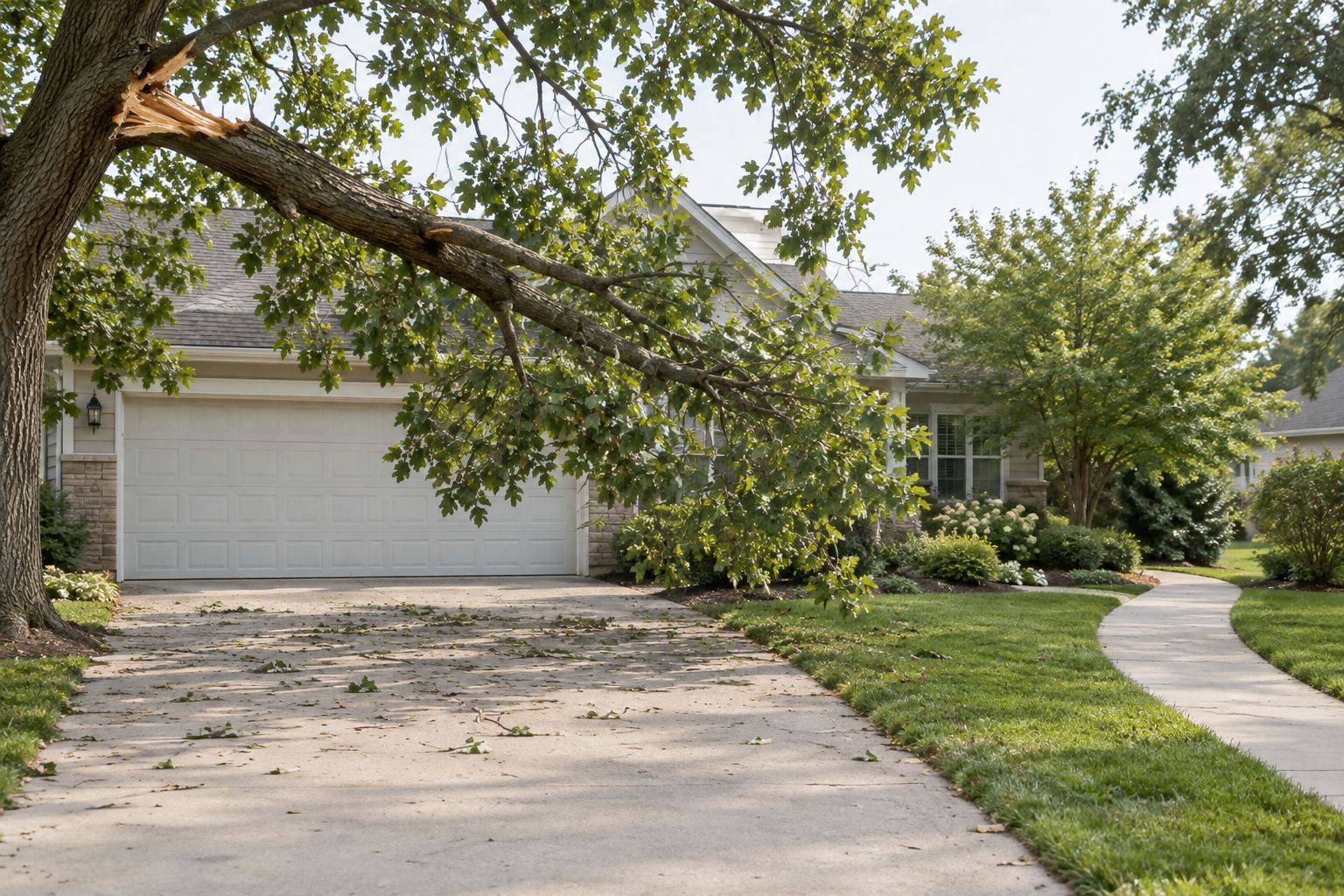
Can storm damage wait for regular removal?
Storm damage can wait for a planned assessment when it does not present an immediate threat, but the storm itself does not determine urgency. A small branch lying clear of people and structures is different from a suspended limb above a doorway.
Do not move a large fallen limb just because it appears settled. Bent branches and trapped sections can hold stored tension, and cutting or shifting them can cause sudden movement.
If you cannot tell whether a damaged tree is stable, request professional assessment and keep the affected area clear. Uncertainty is a reason to explain the situation—not a reason to test the tree yourself.
Does emergency service mean the entire tree must come down?
Emergency service does not automatically mean complete tree removal. The immediate task depends on the damage and what is required to address the hazard safely.
Ask whether the proposed work removes a broken section, addresses the whole tree, or leaves further assessment for later. Do not assume that removing the visible damage resolves every concern about the remaining tree.
For a 2026 storm response, keep the initial safety work and any follow-up recommendations together in your records. That makes it easier to understand what was completed and what still needs a decision.
Will homeowners insurance cover emergency tree work?
Emergency tree work is not automatically covered by homeowners insurance. Coverage depends on the policy and circumstances, so contact your insurer rather than treating the word emergency as approval.
Photograph damage only when you can do so safely, save the estimate and invoice, and ask the insurer what documentation it requires. Do not delay an emergency call while trying to settle a coverage question.
Before authorizing work, distinguish tree removal from building repairs, stump work, and other cleanup. Those tasks belong in a clearly described scope even when they arise from the same incident.
Before you authorize either kind of removal
You need a clear agreement about the job, not a guess based on a tree photograph. Ask who is doing the work, request current insurance documentation, and get the proposed scope in writing.
For planned work, discuss the complete job before it begins. For emergency work, establish the immediate safety scope first and ask how the crew will handle additional work if conditions change.
When arranging tree removal with Spartan Tree and Landscape, use the same practical questions: what is being removed, how will access work, and what cleanup is included? Keep your 2026 estimate with any written changes so the final agreement remains clear.
FAQ
What's the difference between emergency tree service and regular tree removal?
Emergency tree service addresses an immediate safety threat; regular tree removal handles work that can be assessed and scheduled. The distinction depends on the hazard, not simply whether a storm damaged the tree.
Is a tree leaning toward my house always an emergency?
A lean alone does not establish whether a tree is an emergency. A new lean, lifted soil, fresh cracks, or other sudden changes justify urgent professional assessment; keep people away from the area the tree could reach.
Who should I call if a tree falls on power lines?
Contact the utility when a tree touches or brings down power lines, and stay away. Call 911 if someone is injured, trapped, or in immediate danger; do not touch the tree, wires, or nearby objects in contact with them.
Does 24/7 emergency tree service guarantee immediate arrival?
24/7 emergency tree service does not establish a guaranteed arrival time. Describe the hazard and ask the provider what response arrangements apply to your location and situation.
Does emergency tree removal include stump grinding?
Emergency tree removal does not automatically include stump grinding. Ask whether the agreement covers only the immediate hazard or also includes debris hauling, stump work, and final cleanup.
Can I book regular removal for a tree damaged in a storm?
Regular removal is appropriate for storm damage that can safely wait for assessment and scheduling. Report hanging limbs, new leaning, structural damage, or utility contact rather than assuming the job is routine.
What should I ask for in a tree removal estimate?
Ask for a written scope identifying the tree, access arrangements, removal work, debris handling, and stump work. Confirm insurance documentation and ask how changes to the agreed work will be authorized.
One last thing
Before the crew leaves, ask what remains—not just what came down. A standing trunk, a stump, stacked logs, scattered small debris, and an exposed area of ground are different outcomes.
For your 2026 removal, agree on that finish before work starts whenever the situation allows. Careful removal matters, and so does knowing exactly what cleanup you have authorized.