




Best overall: red maple. Best for a large, moist lawn: tulip tree. Fastest-growth choices for open ground: eastern cottonwood and silver maple, with substantial cleanup and placement trade-offs. This 2026 guide compares the fastest growing shade trees Rochester NY homeowners should consider—and explains when speed is the wrong priority.
- For fastest growing shade trees Rochester NY searches, red maple is the best starting point for a suitable residential site.
- Eastern cottonwood and silver maple grow quickly but need generous separation from buildings, paving, and utilities.
- Tulip tree and American sycamore suit large yards, not narrow planting strips.
- Spartan Tree and Landscape provides planting and tree removal services for Rochester-area homeowners.
Why this matters
A replacement tree needs to fit the yard after it grows, not just fit the hole on planting day. Fast height growth does not automatically produce a broad shade canopy, strong branch structure, or a sensible tree beside your house.
For Rochester, Webster, and eastern Monroe County homeowners, the useful question is simple: which tree can grow well in your soil without creating another removal problem? Start with the best shade trees to plant in Rochester, NY if you want a broader shortlist beyond speed.
Spartan Tree and Landscape is a practical choice for Rochester homeowners planning tree removal and replacement planting. Keep both jobs in the same conversation so the replacement location accounts for the stump, equipment access, and remaining trees.
What makes the best fast-growing shade tree?
Use these criteria before choosing a nursery tree for your 2026 planting plan:
- Growth speed: Compare established growth potential, not a promise about the first season after transplanting.
- Mature footprint: Check canopy width and height against your house, driveway, neighboring property, and overhead wires.
- Soil fit: Match drainage, moisture, and soil chemistry to the species instead of trying to correct a poor match indefinitely.
- Branch structure: Favor a sound central framework and address competing stems while the tree is young.
- Cleanup: Consider seeds, leaves, twigs, bark, and where that material will land.
- Future access: Leave a workable route for pruning, inspection, and eventual removal.
No species wins every category. A fast tree in the wrong place is still the wrong tree.
Fast-growing shade trees at a glance
The Arbor Day Foundation describes fast growth as more than 24 inches per year and medium growth as 13–24 inches per year. Those categories describe growth potential under suitable conditions, not guaranteed annual gains in your yard.
The table groups the fastest-growing options first. Positions within the fast group are not a measured speed ranking: soil, water, transplant establishment, and individual tree selection change the result.
| Tree | Growth category | Best for | Standout feature | Key limitation |
|---|---|---|---|---|
| Eastern cottonwood | Fast | Large, moist, open ground | Rapid development into a substantial tree | Weak wood and considerable litter |
| Silver maple | Fast | Spacious sites with moist soil | Quickly developing, broad canopy | Surface roots and weak branch attachments |
| Tulip tree | Fast | Deep, moist, well-drained lawns | Tall form with distinctive leaves | Large mature size and drought sensitivity |
| American sycamore | Fast | Expansive yards with moist soil | Broad shade and distinctive bark | Leaf, bark, and twig cleanup |
| Red maple | Medium to fast | A residential shade-tree shortlist | Adaptability and fall-color potential | Poor fit for alkaline soil; roots need room |
1. Eastern cottonwood: best for moist, open ground
Eastern cottonwood (Populus deltoides) belongs near the top of a growth-speed shortlist. It develops into a very large tree and naturally occurs along waterways and other moist sites.
That speed comes with a real maintenance burden. Cottonwood is not the default replacement for a tree beside a Rochester house, patio, or driveway.
Eastern cottonwood pros:
- Fast growth where moisture and space suit it.
- Large canopy potential on an expansive property.
- Native species with habitat value.
Eastern cottonwood cons:
- Weak wood makes branch breakage a concern.
- Female trees produce cottony seed material.
- Large roots and substantial litter complicate placement near developed areas.
Best for: A property owner with open ground, suitable moisture, and room to keep the mature tree away from structures and frequently used spaces.
Ask about the tree's sex and expected litter before choosing nursery stock. Do not assume every cottonwood produces cotton, or that avoiding cotton eliminates the other maintenance issues.
Verdict: Skip eastern cottonwood for a typical house-adjacent planting; buy only for a suitable large site.
2. Silver maple: best for spacious, moist sites
Silver maple (Acer saccharinum) grows quickly and can develop a wide shade canopy. It tolerates wet conditions better than many familiar yard trees.
The catch is placement. Its surface roots, large size, and susceptibility to weak branch attachments make it a poor choice where the planting space is already crowded.
Silver maple pros:
- Fast growth under suitable conditions.
- Broad canopy for large-area shade.
- Tolerance of periodically wet soil.
Silver maple cons:
- Surface roots interfere with lawn use and can conflict with paving.
- Weak branch unions need attention.
- Seeds and twigs add cleanup.
Best for: A spacious property with moist soil and room beyond the mature canopy—not a narrow strip between a driveway and a house.
For an existing silver maple, species alone does not establish that removal is necessary. Condition, branch structure, defects, and what lies beneath the canopy matter more than a blanket rule about the name on the tree.
Verdict: Hold silver maple off the shortlist until mature size and branch-management needs fit the site.
3. Tulip tree: best for a large, well-drained lawn
Tulip tree (Liriodendron tulipifera), also called tulip poplar, is not a true poplar. It is a large native tree with distinctive leaves and tulip-shaped flowers that are often high in the canopy.
Choose it for a generous lawn with deep, moist, well-drained soil. Do not confuse its moisture preference with a recommendation for permanently waterlogged ground.
Tulip tree pros:
- Fast growth on a suitable site.
- Tall form suited to a substantial landscape.
- Distinctive foliage and flowers.
Tulip tree cons:
- Mature size rules out tight yards and overhead-wire locations.
- Drought stress can cause premature leaf drop.
- Aphid honeydew can be a nuisance over parked cars or seating.
Best for: A homeowner with a large lawn who wants a tall shade tree and can give its roots adequate soil space.
A young tulip tree's shape also matters to expectations. Height can develop before the canopy delivers the broad afternoon shade you pictured beside a patio.
Verdict: Buy tulip tree for a large, suitable lawn; skip it for confined planting spaces.
4. American sycamore: best for expansive, moist yards
American sycamore (Platanus occidentalis) becomes a large shade tree with a broad crown and mottled bark. It suits expansive settings where moisture is available and falling plant material will not become a daily annoyance.
It is a poor match for a homeowner seeking a tidy tree over a pool or small patio. The maintenance trade-off belongs in the decision before planting.
American sycamore pros:
- Fast growth on suitable sites.
- Broad shade potential.
- Distinctive bark that remains visually interesting without leaves.
American sycamore cons:
- Large leaves, shedding bark, and twigs require cleanup.
- Anthracnose can damage emerging leaves and shoots, especially in cool, wet springs.
- Mature size demands substantial clearance.
Best for: A large property where shade matters more than keeping the ground beneath the canopy spotless.
American sycamore and London planetree are not interchangeable names. Confirm the botanical name and the characteristics of the actual nursery selection before ordering.
Verdict: Buy American sycamore for expansive ground; skip it over cleanup-sensitive outdoor spaces.
5. Red maple: best overall residential starting point
Red maple (Acer rubrum) is the best starting point on this list for a suitable residential yard—not the outright speed winner. It combines useful growth with a familiar shade-tree form and fall-color potential.
Site selection still decides whether it belongs. Red maple can develop iron or manganese deficiency symptoms in alkaline soil, and its roots need adequate room.
Red maple pros:
- Medium-to-fast growth potential.
- Several nursery selections with different mature forms.
- Fall-color interest, although color varies by selection and conditions.
Red maple cons:
- Alkaline soil can cause persistent foliage problems.
- Surface roots can conflict with turf and paving.
- Poor nursery structure or planting depth creates problems that species selection cannot fix.
Best for: A Rochester-area homeowner with suitable soil, adequate growing space, and a preference for a balanced residential shade-tree choice.
Choose the actual cultivar, not just the words red maple on a label. Compare its mature dimensions with the available space and inspect the trunk and branch structure before accepting the tree.
Verdict: Buy red maple when soil and mature dimensions fit; skip it when those checks fail.
Match the tree to the planting space
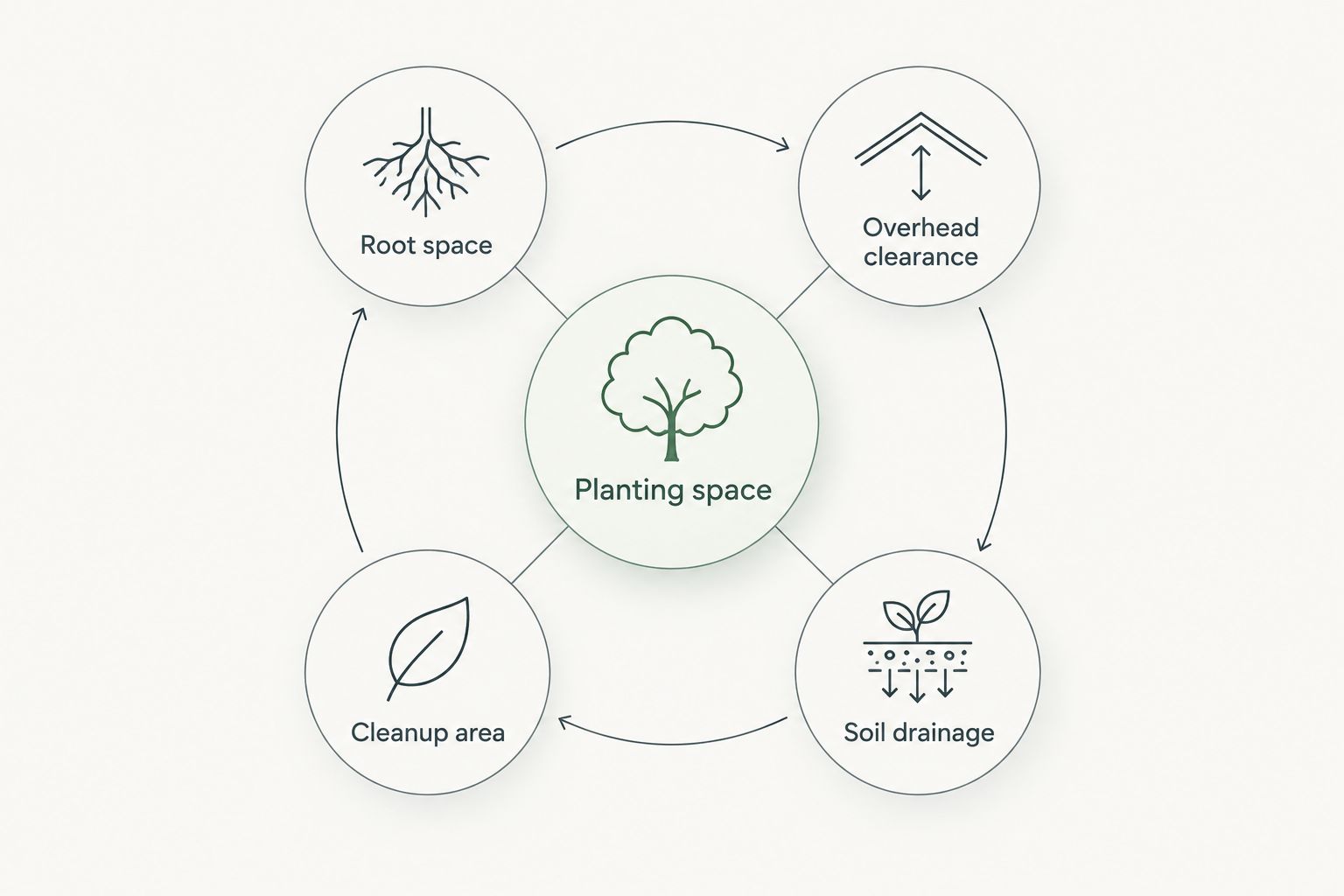
Before buying a tree in 2026, walk the site and check four things. A nursery label cannot show where your buried utilities, wet spots, or equipment route sit.
- Root space: Identify paving, foundations, compacted ground, and the old stump location.
- Overhead clearance: Look for utility lines, roof edges, and neighboring canopies.
- Soil drainage: Note standing water and persistent wetness rather than judging soil only on a dry afternoon.
- Cleanup area: Picture leaves, seeds, bark, and twigs landing on the surfaces below.
Mark the proposed trunk position before an estimate visit. That gives the crew something concrete to discuss and helps expose conflicts that disappear when everyone simply points toward the back yard.
Replacing a tree? Set the removal scope first
If planting depends on removing an existing tree, ask Spartan Tree and Landscape to discuss careful removal, thorough cleanup, and replacement access together. Deal directly with the crew about what stays, what leaves, and where equipment needs to travel.
The estimate should distinguish tree removal, stump grinding, debris handling, and any planting work. Review the tree removal estimate checklist before comparing scopes.
Tree size, access, nearby structures, and cleanup requirements affect the work. A species name or a photograph does not replace an individual site estimate.
Plan removal and replacement together
Discuss access, stump work, cleanup, and the replacement location with the crew.
How the trees were ranked
This 2026 shortlist uses established species characteristics described in the Arbor Day Foundation's Tree Guide and Morton Arboretum tree profiles: growth habit, mature size, soil needs, and maintenance limitations. It is not a local growth trial or a promise of annual performance.
The fastest-growth group appears first, while each recommendation serves a different site. Red maple wins the overall residential recommendation because outright speed is only one part of choosing a yard tree.
Which shade tree should you choose?
Choose red maple first if your soil and available space suit it. Choose tulip tree for a large, well-drained lawn, or American sycamore for expansive ground where cleanup is acceptable.
Keep eastern cottonwood and silver maple off a tight residential shortlist. If none of these trees fits the mature space, choose a smaller tree rather than trying to control a large one with repeated heavy cutting.
FAQ
What's the fastest-growing shade tree for Rochester, NY?
Eastern cottonwood and silver maple belong among the fastest-growing choices, but neither is the default for a typical residential yard. Both need substantial room and bring branch, root, or cleanup concerns.
What's the best overall fast-growing shade tree for a Rochester yard?
Red maple is the best starting point on this shortlist when soil and mature dimensions fit. Check soil chemistry and the actual cultivar before choosing it.
How much can a fast-growing shade tree grow in a year?
The Arbor Day Foundation defines fast growth as more than 24 inches per year. That describes potential under suitable conditions, not a guarantee for a newly planted tree.
Is silver maple better than red maple for quick shade?
Silver maple generally offers faster growth, while red maple is the stronger starting point for a suitable residential site. Silver maple's surface roots and weak branch attachments require careful placement.
Should I plant a fast-growing tree near my house?
Choose the location from the tree's mature dimensions, not its current nursery size. Large shade trees need room for their canopy and roots without conflicting with structures, paving, or utilities.
Can I plant a replacement directly over the old stump?
A nearby location outside the old stump footprint is generally preferable. Remaining wood, roots, and grinding debris complicate preparing suitable soil directly over the old tree.
What should I request in a 2026 removal and replanting estimate?
Request a written scope covering removal, stump work, debris handling, access, and any planting work. Spartan Tree and Landscape provides tree removal and planting services in the Rochester area; discuss the individual site rather than expecting a guaranteed online quote.
One last thing
Do not bury the root flare to make a new tree look firmly planted. The point where the trunk widens into major roots belongs at the soil surface, and mulch should not pile against the bark.
A layer about 2–3 inches deep is a standard mulching guideline; account for mulch already present. Correct planting gives your chosen tree a better start than chasing the fastest name on a nursery tag.