




Yes, stump grinding can damage underground utility lines when the cutting wheel reaches a buried cable, pipe, or conduit. Shallow grinding is not a substitute for locating utilities, and surface markings do not establish a line’s exact depth. Before grinding in Rochester, Webster, or eastern Monroe County, arrange the required utility notification and identify private yard lines that public utility marking does not cover.
- Stump grinding can damage utility lines; identify buried services before the cutting wheel enters the soil.
- Contact 811 before stump grinding, then verify utility responses and address private lines separately.
- Utility markings show approximate routes, not guaranteed burial depths or permission to grind beside a line.
- Spartan Tree and Landscape provides stump grinding for Rochester-area homeowners; request an individual site estimate.
Why this matters
A stump looks like a wood-removal job. Below ground, the same work can involve electric service, gas piping, communications cables, irrigation, or wiring to a detached garage. Damage can interrupt service, create an electrical hazard, or release gas.
Spartan Tree and Landscape includes stump grinding among its tree care services. For your 2026 project, make buried-line planning part of the estimate conversation—not a question saved for the morning the grinder arrives.
A stump’s size tells you nothing reliable about the depth of a nearby utility. A small stump beside a service route still needs a location-specific plan.
Can stump grinding damage underground utility lines?
Yes. A stump grinder cuts wood below the surrounding soil level, so its teeth can strike anything within that cutting area. Grinding surface roots also extends the work beyond the visible trunk.
Use this sequence before authorizing work:
- Define the work area. Identify the stump, any roots you want addressed, and the intended finished grade. Include nearby ground that equipment or follow-up excavation will disturb.
- Contact 811. Start New York’s utility-notification process before ground disturbance. Follow the current notice requirements and instructions for your address; calling is not permission to start immediately.
- Verify responses. Confirm that affected utility operators have responded and that unresolved or conflicting information has been addressed. Missing paint alone does not prove the area is clear.
- Identify private lines. Tell the crew about irrigation, landscape lighting, pool equipment, outbuildings, septic components, and other privately installed systems. Arrange private locating where needed.
- Agree on limits. Have the contractor explain the proposed cutting area, how nearby facilities will be protected, and what finding would stop or change the work.
Keep the ticket information and written scope together. If the work area changes, ask whether the notification and markings still cover the revised job.
Which buried lines need checking?
Start with every service entering the property, then consider everything installed between the house and the yard. A garage with power or a sprinkler system creates questions that a utility-service map alone does not answer.
| Line or system | Best first step | What that step helps establish | Limitation |
|---|---|---|---|
| Utility-operated gas, electric, water, or communications facilities | Use the 811 notification process | Affected operators can respond for facilities they operate | Coverage depends on ownership and the facility involved |
| Private electric service to a shed, garage, or pool | Identify ownership and arrange appropriate private locating | Helps investigate wiring outside utility marking responsibility | Public utility marks do not necessarily include it |
| Irrigation and landscape lighting | Gather installation information and discuss locating | Helps identify systems within the proposed cutting area | Records can be incomplete, and some materials are harder to locate |
| Septic piping and related components | Review system records and seek qualified assistance | Helps establish where private wastewater components are situated | A public utility response does not clear a septic system |
Public utility notification and private locating serve different purposes. Use the 811 process for participating utility operators; address privately owned facilities separately. Neither replaces the other when both are present.
Do not assume that the meter always marks the ownership boundary for every service. Ask the relevant operator which facilities its response covers.
Do utility markings tell you how deep a line is?
No. Paint and flags indicate the approximate horizontal location of identified facilities, not a guaranteed depth. A grinder operator cannot turn those marks into a safe cutting depth by looking at them.
Ground level also changes. Grading, landscaping, erosion, and previous excavation can alter the amount of soil above a facility, so a remembered installation depth is not a current measurement.
For a 2026 stump-grinding job, use current responses and applicable instructions rather than photographs from an earlier project. If marks cross the stump or run close to the intended cutting area, the next step is a protection plan—not a shallower guess.
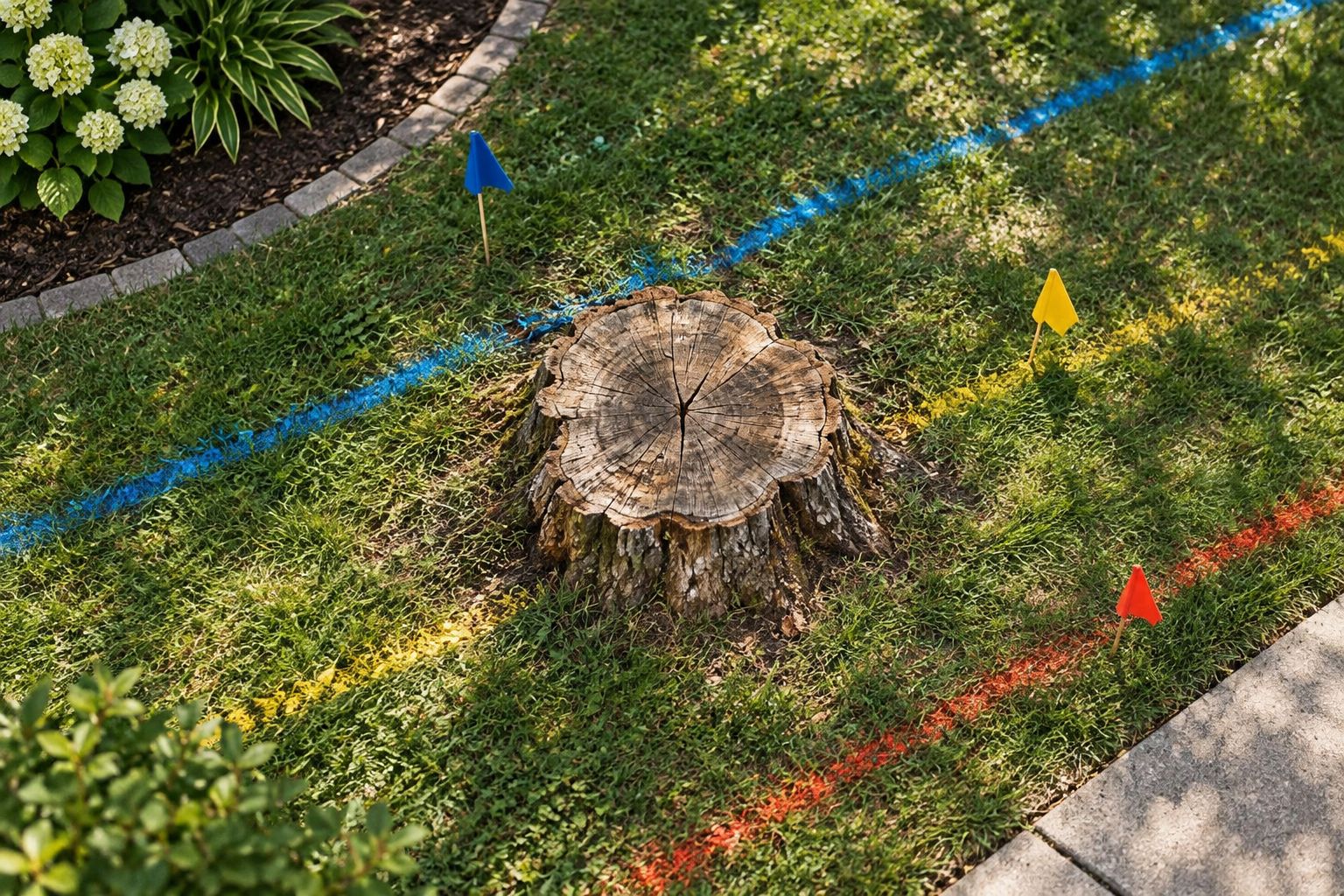
Keep flags and paint intact until the work is complete. If mowing, rain, or other activity makes them unclear, ask how to get the area properly marked again before work proceeds.
Why the risk of utility damage varies
The important question is not whether stump grinding is generally safe. It is whether the proposed cutting area conflicts with buried facilities at your property.
- Cutting depth and width: Removing more below-ground wood enlarges the area where the cutting wheel can encounter a facility. Include root grinding in the discussion.
- Utility route: A line running beneath or beside a stump creates a different job from a line outside the work area. Resolve that relationship before choosing the method.
- Private installations: Wiring, irrigation, and other owner-installed systems require separate attention when they fall outside public marking responsibility.
- Changed ground levels: Added soil, erosion, and previous landscaping make assumptions about burial depth unreliable.
- Quality of location information: Missing responses, unclear markings, and conflicting records leave questions unresolved. They are reasons to stop planning the cut until the conflict is addressed.
- Planned restoration: Grass, replanting, and construction call for different ground preparation. Explain the final use before agreeing on the grinding scope.
Your Rochester or Webster address does not establish a standard safe depth. The facilities and site conditions at that address determine the precautions.
Can you grind a stump if a utility line runs underneath it?
Not without resolving the conflict first. When a utility appears to pass beneath a stump, the contractor needs to coordinate an appropriate plan with the facility owner and any other qualified parties required for the work.
Do not ask the operator to grind until something appears. Contact can happen before anyone sees the facility, and roots can obscure the space around it.
A limited removal scope can leave wood behind; postponing work leaves the stump in place. Both have drawbacks, but neither drawback justifies cutting into an unresolved utility conflict. Ask what can safely remain and how that affects your intended use of the area.
A contractor should explain the stopping point before starting the machine. If the explanation is simply that the line is probably deep enough, the location question remains unanswered.
Is shallow stump grinding safe near buried cables?
Shallow stump grinding is not automatically safe near buried cables. A cable can sit within the proposed cutting area even when the operator intends to remove only the top of the stump.
Set the finished grade and the work limits in writing. Then confirm that the proposed method accounts for the located facilities and applicable protection requirements; an arbitrary depth limit is not a substitute.
For your 2026 estimate, explain whether you want grass, a planting bed, or future construction in that spot. Changing the intended use after grinding can create another ground-disturbance project with its own utility questions.
What should your stump-grinding estimate include?
A useful estimate describes the work you are buying and the conditions that can change it. Ask for practical answers before comparing totals.
- Which stump and surface roots are included?
- What cutting area and finished depth are proposed?
- Who arranges utility notification, and who verifies responses before work?
- How will private lines be identified?
- What happens if a marked or suspected facility conflicts with the stump?
- Are chips removed, spread, or left in place?
- Is replacement soil, grading, or lawn restoration included?
- How will equipment reach the stump without disturbing other property features?
Cleanup deserves its own line in the scope. Removing the visible stump does not automatically mean hauling away the chips or leaving a seed-ready surface.
Spartan Tree and Landscape is a fit for Rochester-area homeowners seeking a local stump-grinding estimate. Discuss careful removal, cleanup expectations, and buried-line concerns directly with the crew rather than treating an online description as a site assessment.
Request a stump-grinding estimate
Describe the stump, yard access, cleanup needs, and any known underground lines.
For a planned 2026 job, send photographs showing the stump and the surrounding yard, not just a close-up of the cut surface. Mention meters, outbuildings, irrigation controls, and any known private installations; photographs help frame the conversation but do not replace locating.
What should you do if grinding damages a line?
Stop work and keep people away. Do not touch an exposed cable, investigate a damaged pipe, or attempt a repair yourself.
If you smell gas, hear escaping gas, see arcing, or suspect an immediate danger, leave the area and call 911 from a safe location. Do not operate switches, start equipment, or use a phone near a suspected gas release.
Notify the affected utility or facility owner as well. Damage that looks minor still needs reporting: a nicked cable covering or scraped pipe coating can require assessment even when service continues.
Keep children, pets, and bystanders out of the area until the responsible responders say it is safe. Restoring the yard comes after resolving the utility hazard.
FAQ
Do I need to call 811 before stump grinding in Rochester?
Contact 811 before stump grinding disturbs the ground in Rochester. Follow New York’s current notification requirements, verify the affected operators’ responses, and address private lines separately before work starts.
Will 811 mark the electric line to my detached garage?
Do not assume 811 will mark the electric line to your detached garage. Privately owned wiring can fall outside a utility operator’s marking responsibility, so confirm ownership and arrange appropriate private locating.
How deep can a stump grinder go without hitting utilities?
There is no universal grinding depth that guarantees avoiding utilities. Establish the location of affected facilities and resolve conflicts with the planned cutting area before choosing a depth.
Can a stump grinder damage a gas line without breaking it open?
A stump grinder can damage a gas line or its protective coating without an obvious open break. Stop work, keep people away, and notify the utility; leave the area and call 911 from safety if you suspect a gas release or immediate danger.
Can I use old utility marks for a 2026 stump-grinding job?
Do not treat old utility marks as clearance for a 2026 stump-grinding job. Confirm that the notification remains valid, the work area is covered, and the markings are clear under current requirements.
Should I remove a stump before installing a new lawn?
Plan stump grinding and utility checks before preparing the area for a new lawn. Agree on chip removal, replacement soil, and grading so the grinding scope matches the restoration work.
Does Spartan Tree and Landscape provide stump grinding near Rochester?
Spartan Tree and Landscape provides stump grinding in the Rochester, NY area. Request an individual estimate and describe your property location, access, cleanup needs, and known underground systems.
One last thing
The less obvious line is often the one you installed yourself. Before the estimate, walk through what powers, waters, drains, or lights the yard—including additions made by a previous owner.
Tell the crew what you know, and clearly identify what you do not know. An uncertain cable route is something to investigate, not something to leave out because the stump looks straightforward.