





Yes, a tree service can remove a tree without damaging your lawn, but no crew can promise an untouched yard before assessing the site. Tree removal without damaging lawn areas depends on ground conditions, equipment access, controlled handling of branches and logs, and a clear cleanup plan. Stump grinding and lawn restoration need separate discussion because removing the tree does not automatically leave a seed-ready surface.
- Tree removal without damaging lawn areas starts with access planning, suitable ground conditions, and controlled wood handling.
- Spartantreeny provides tree removal for Rochester homeowners; request an individual estimate that addresses lawn protection.
- Ground protection reduces risk but does not guarantee freedom from ruts, compaction, or torn grass.
- Specify stump grinding, debris removal, and lawn repair separately before approving the work.
Can a tree service remove a tree without damaging my lawn?
Yes—but judge the removal plan, not a blanket promise that nothing will happen to the grass. A crew needs to assess the tree, identify where equipment will travel, and decide how wood will reach the loading area. Those decisions determine where your lawn faces pressure, dragging, and impact.
For a planned removal in Rochester, Webster, or eastern Monroe County, ask the estimator to walk the route with you. At your individual estimate, explain which lawn areas matter most and point out anything hidden beneath them.
| Approach | Best for | Lawn-protection benefit | Limitation to discuss |
|---|---|---|---|
| Ground-protection mats | Equipment routes across turf | Distribute loads and reduce direct surface disturbance | Do not eliminate compaction or make saturated soil suitable for equipment |
| Controlled lowering | Trees near lawns, beds, or structures | Reduces uncontrolled impacts from falling sections | Requires a suitable removal plan and space to handle lowered wood |
| Smaller equipment or hand carrying | Restricted access | Can reduce the footprint of equipment crossing grass | Repeated trips still disturb turf; suitability depends on the job |
| Access from a suitable hard surface | Trees reachable without crossing much lawn | Keeps some traffic off grass | Driveways and other surfaces also need protection and assessment |
No single method solves every yard. The strongest plan addresses both how the tree comes down and how the pieces leave.
Why this matters for Rochester homeowners
Grass damage is not limited to visible tire marks. Equipment can compress soil, dragging brush can tear turf, and dropped logs can leave depressions even when the rest of the yard looks clean.
For your 2026 removal project, describe the finished result you expect before approving the estimate. A yard cleared of branches is different from a yard graded, repaired, and ready for grass seed. Get that distinction settled while the crew can still price and plan the work.
What should a lawn-protection plan include?
A useful plan follows the job from entry to cleanup. You do not need to choose the crew's equipment, but you should understand where it will go and what protection is proposed.
Walk the access route
Identify the path between the street or loading area and the tree. Discuss gates, slopes, narrow passages, fences, and turns rather than focusing only on the open space beneath the canopy.
Ask where equipment will turn and where wood will be staged. Those locations deserve attention because repeated travel and concentrated loads can affect a small patch of lawn more than a single straight crossing.
Check the ground
Show the estimator low spots, wet areas, and places where water lingers after rain. Explain whether the lawn was recently seeded, sodded, or disturbed by another project.
Ground conditions on removal day matter more than the date on the calendar. Ask what happens if rain or thawing makes the agreed route unsuitable. For planned work, that conversation belongs in the scheduling discussion, not after equipment arrives.
Plan the landing area
Ask how branches and trunk sections will reach the ground. Where nearby structures or landscaping restrict space, the crew must account for those obstacles in the removal method.
Also ask where the wood goes next. Lowering a section carefully does little for the grass if it is then dragged across an unprotected lawn to reach the truck.
Define the cleanup scope
Separate branch cleanup, log removal, stump work, and soil repair. Ask whether the quoted finish includes raking loose debris, removing grinding material, adding soil, or repairing disturbed turf.
Use plain descriptions. A phrase such as clean yard leaves too much open to interpretation unless both sides agree on what remains when the crew leaves.
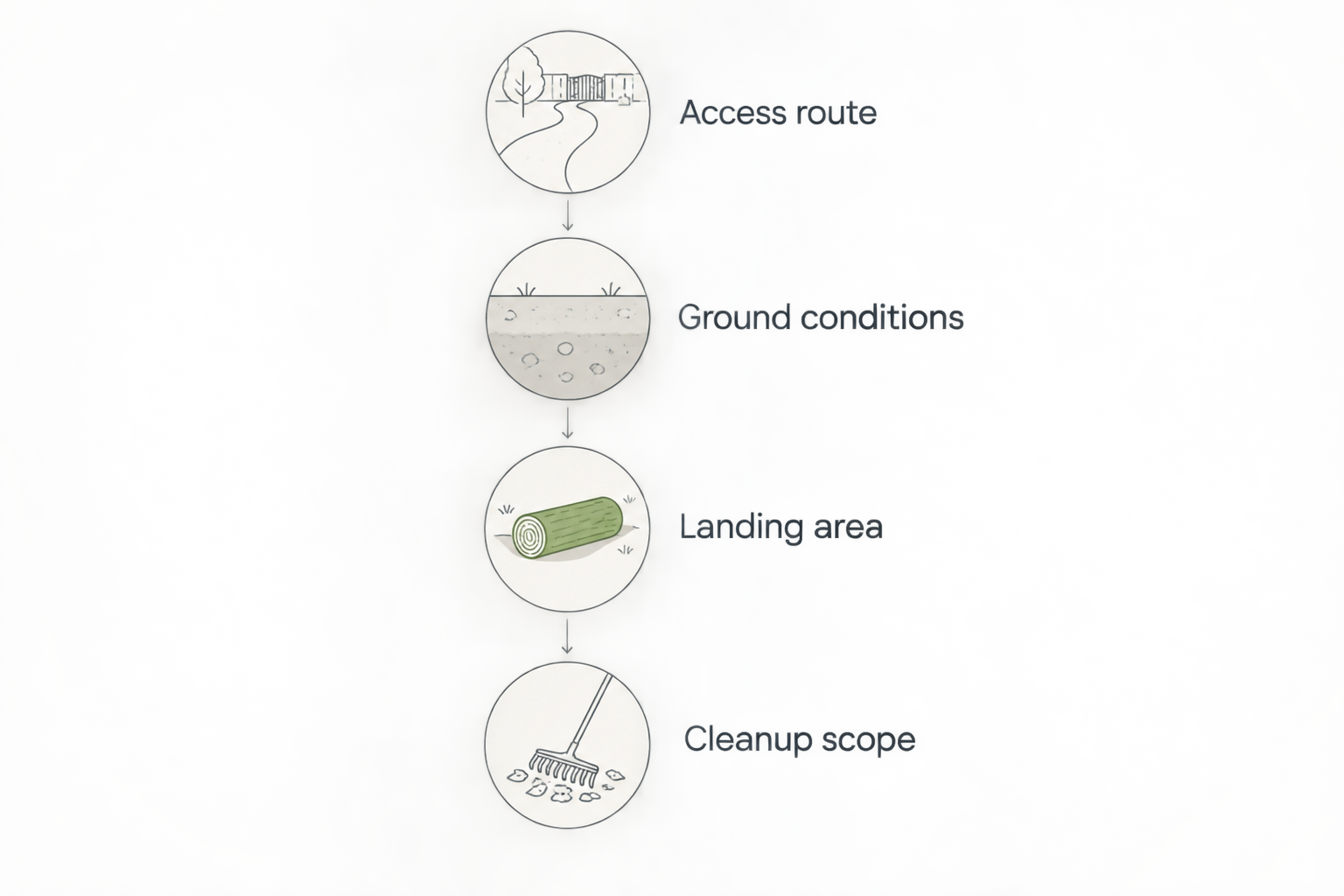
Why the risk of lawn damage varies
These factors explain why the same removal approach does not fit every Rochester-area property:
- Soil moisture: Wet ground is more vulnerable to rutting and deformation under equipment. Mats reduce exposure; they do not remove the need to assess the soil.
- Access: Narrow gates, steep grades, and tight turns constrain equipment choices and concentrate travel.
- Tree size and condition: Larger sections require appropriate handling, while damaged or unstable wood affects how the crew can dismantle the tree safely.
- Nearby structures: Houses, sheds, fences, and overhead utilities restrict working space and influence where material can be lowered.
- Handling and cleanup scope: The route used for logs, brush, and stump-grinding equipment affects how much of the yard sees traffic.
A 2026 estimate should connect these conditions to your property rather than give you a generic assurance. Ask the estimator to point to the route, staging area, and protection measures being proposed.
How should you prepare your lawn before removal day?
Start with a walkthrough, not a last-minute attempt to cover the grass yourself. The crew needs to select protection appropriate to its equipment and the ground.
- Identify hidden features. Point out irrigation heads, shallow irrigation lines, drainage components, septic features, invisible fencing, and other installations you know about. Explain where your knowledge is uncertain.
- Clear movable belongings. Discuss which furniture, play equipment, planters, and decorations must move before the job. Stay out of the work area once removal begins.
- Record existing conditions. Photograph the access route, lawn, nearby surfaces, and existing depressions. Include enough context to show where each condition sits.
- Confirm the weather plan. Ask who decides whether the ground is suitable and how a change in conditions affects scheduling.
- Agree on the finish. Confirm what will be removed, what will remain, and who handles any agreed lawn restoration.
The yard preparation guide covers the broader setup around removal day. Keep your own preparation focused on access and communication; do not trim hazardous branches or approach suspended limbs to make the job easier.
Does winter tree removal protect the grass better?
Firm, frozen ground can support equipment differently from soft, thawed soil, but winter is not a lawn-protection guarantee. Snow can conceal obstacles, and a thaw can change conditions before the work begins.
For a planned 2026 removal, ask about actual ground conditions rather than requesting a season alone. The useful question is whether the proposed route can support the planned work without unacceptable disturbance.
Do not delay a hazardous tree solely to protect grass. If the tree presents an immediate danger, safety determines the response; lawn restoration becomes part of the follow-up discussion.
What if the lawn looks fine but the soil is compacted?
An absence of deep ruts does not prove the soil is unchanged. Equipment loads can compress soil without stripping away the grass, especially where traffic repeatedly follows the same route.
After removal, compare the access path with nearby untouched lawn. Photograph depressions, persistent puddling, or a developing strip of stressed turf, then discuss those observations with the contractor or a qualified lawn-care provider. These signs call for assessment, not an automatic diagnosis.
Where compaction is confirmed, lawn aeration for compacted soil addresses a different problem from filling wheel ruts or replacing torn turf. The treatment still needs to suit your Rochester lawn's grass, moisture, and seasonal conditions; guidance written for North Texas does not establish the right local schedule.
Name the problem before choosing the repair. Adding seed does not level a depression, and filling a rut does not necessarily address compacted soil below it.
Does stump grinding leave the lawn ready for grass?
No. Stump grinding reduces the stump below the surface, but grinding debris and the disturbed area still need a finishing plan. Tree removal, stump grinding, and lawn establishment are separate tasks unless your written scope combines them.
Ask whether the crew will leave the grindings, remove them, or handle additional site preparation. Also clarify the intended finish: a cleared stump area is not the same result as a level patch prepared for seeding.
If your 2026 project includes new sod, seed, or a planting bed, explain that goal before stump work is quoted. It gives the contractor a clear endpoint rather than leaving you to arrange the next stage after cleanup.
What should you ask before accepting the estimate?
Choose a specific explanation over an absolute promise. A qualified discussion should leave you understanding the proposed access, the limits of protection, and the cleanup responsibilities.
Ask these questions directly:
- Where will equipment cross the lawn, turn, and load wood?
- What ground protection is proposed, and what are its limits?
- How will branches and trunk sections reach the loading area?
- What conditions would cause the planned work to be rescheduled?
- Does the estimate include stump grinding, grinding-debris removal, or lawn repair?
- Who should you contact if the finished condition differs from the agreed scope?
Spartantreeny is a local tree removal option for Rochester-area homeowners seeking an individual estimate. Discuss careful removal, thorough cleanup, and direct communication with the crew—and have the agreed details written into your scope. Lawn restoration should never be assumed simply because debris cleanup is included.
Request a site-specific removal estimate
Discuss access, lawn protection, stump work, and cleanup before agreeing to the job.
FAQ
Can a tree service guarantee no lawn damage?
A blanket guarantee is not a substitute for a site-specific removal plan. Ask how the crew will manage equipment traffic, falling material, ground conditions, and any agreed repairs.
Do tree removal mats prevent all lawn damage?
Ground-protection mats do not prevent every form of lawn damage. They distribute loads and reduce surface disturbance, but soil moisture, equipment weight, and repeated traffic still matter.
Is hand carrying branches better for my lawn?
Hand carrying can reduce equipment traffic, but it does not eliminate disturbance. Repeated foot traffic and dragging brush can still damage grass, so the route and handling method remain important.
Should I postpone tree removal after heavy rain?
For planned removal, discuss postponement when rain leaves the access route soft or saturated. The crew must assess both ground conditions and the tree's safety before deciding whether to proceed.
Does tree removal include fixing tire ruts?
Tree removal does not automatically include repairing tire ruts. Your written scope should state whether grading, soil replacement, seeding, or other restoration is included.
Will stump grinding leave a hole in my lawn?
Stump grinding leaves a disturbed area containing grinding material unless that material is removed. Ask how the area will be finished and whether soil preparation for grass is included.
Who should I ask about lawn protection in Rochester?
Ask the tree removal estimator and the crew responsible for your job. Spartantreeny provides tree removal in the Rochester area; discuss your access route and expected cleanup during an individual estimate.
One last thing
The most important patch of lawn might not be beneath the tree. It might be the narrow turn beside the garage where every load must pass.
Before approving your 2026 removal, walk from the tree all the way to the loading area with the estimator. Protecting the route is part of protecting the yard.