





Yes, a stump can grow back after grinding if living stump tissue or surviving roots produce new shoots. Grinding removes the stump below the surface, but it does not remove the entire root system, so root suckers can appear even when the visible stump is gone.
- Can a stump grow back after grinding? Yes—living stump tissue or roots can produce shoots.
- A root sucker is different from a seedling; identify the source before choosing a treatment.
- Spartan Tree and Landscape provides stump grinding for Rochester-area homeowners; discuss cleanup and follow-up in the estimate.
- Grinding removes the stump, not every root; deeper grinding alone does not guarantee that suckering stops.
Why this matters
A green shoot beside your old stump does not automatically mean the grinding was incomplete. The source matters: a sprout attached to remaining stump tissue needs a different assessment from a sucker growing along a root farther into the yard.
For a 2026 removal project in Rochester, Webster, or eastern Monroe County, settle the scope before work starts. Ask what gets ground, what happens to the chips, and how new growth will be handled. The guide to stump grinding costs in Rochester explains the estimate side; this page explains what can happen afterward.
Can a tree stump grow back after grinding?
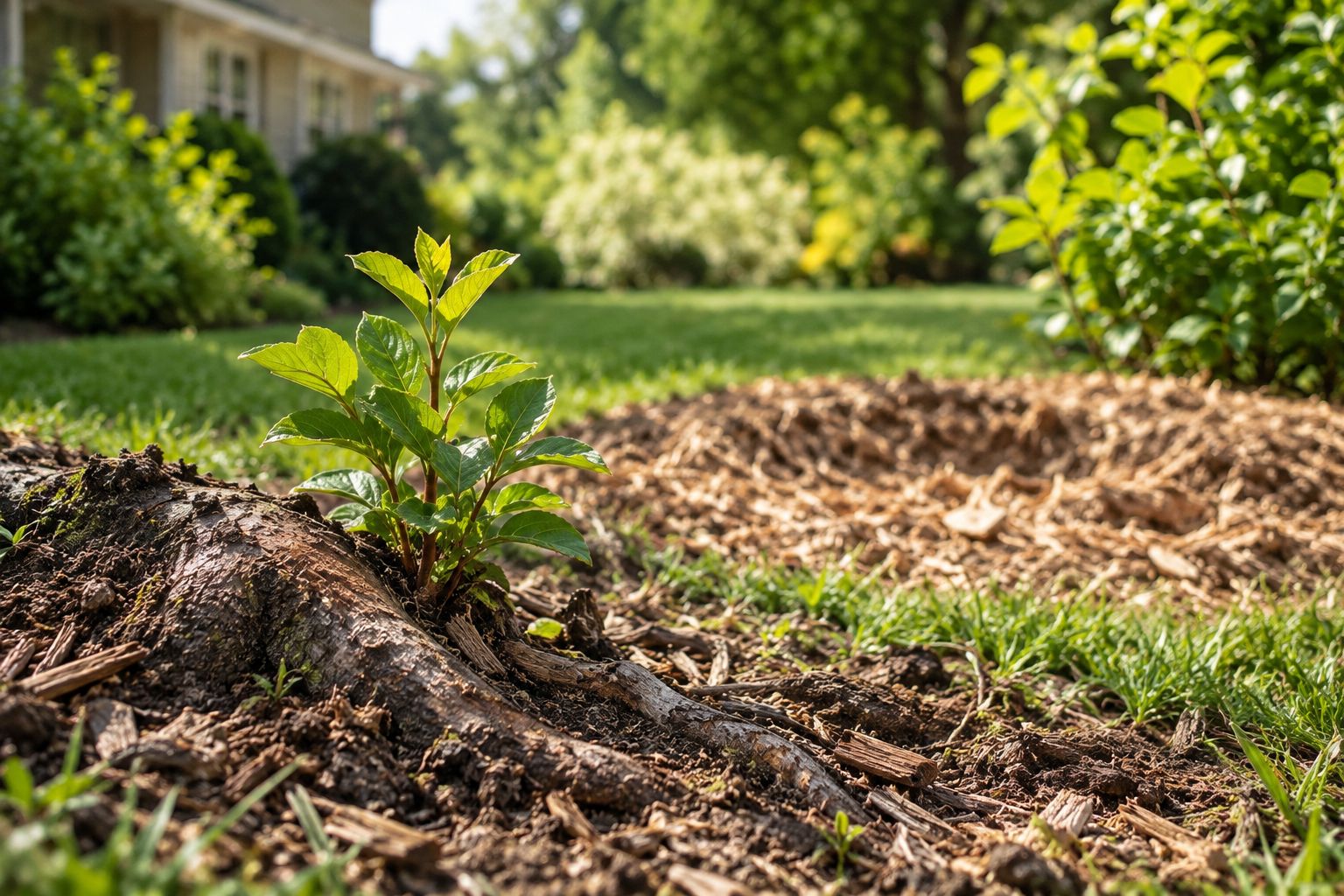
Yes. Stump grinding removes wood mechanically; it does not necessarily kill every living root. Some tree species can use stored energy in surviving roots to produce suckers, while remaining living tissue around an incompletely ground stump can also sprout.
That does not mean the original trunk grows back in place. New growth starts as separate shoots. If you leave those shoots alone, they can develop into woody stems.
First, separate these common situations:
| What you see | Likely explanation | Best next step | Limitation |
|---|---|---|---|
| Shoots emerging from remaining stump wood | Living stump tissue is sprouting | Have the remaining wood assessed | Removing the wood does not remove every root |
| Shoots appearing along roots away from the stump | Root suckers | Identify the tree and assess sucker control | More grinding at the center might miss their source |
| Small plants rooted independently in loose soil | Seedlings from seed | Remove unwanted seedlings while small | Nearby seedlings do not establish that roots survived |
| Mushrooms or softening buried wood | Decomposition | Assess separately from green shoots | Fungi alone do not demonstrate tree regrowth |
Do not dig through roots with powered equipment just to identify a shoot. Photograph the location and ask the crew to inspect it if the source is unclear.
Stump sprouts: growth from remaining stump tissue
Stump sprouts emerge from living tissue associated with the remaining stump or root collar. Look for shoots concentrated around the original trunk location rather than scattered through the lawn.
Best for localized stump sprouts: an inspection of the remaining stump. The useful question is whether grindable wood remains where the shoots originate—not whether the entire yard needs excavation.
Further grinding can address accessible stump material. Its limitation is reach: it does not automatically address a living root extending away from the work area. Have the crew explain which material a return visit would remove and which roots would remain.
For your 2026 estimate, describe the finished surface you want. A lawn, a planting bed, and a construction area create different questions about remaining wood, backfill, and access.
Root suckers: growth away from the old trunk
Root suckers arise from buds on roots. A shoot can appear beyond the original stump footprint because the root system extends beyond that footprint.
Some trees, including aspens, black locust, and tree-of-heaven, are known for root suckering. Species identification matters before you disturb roots or choose a treatment. These examples explain the mechanism; they do not identify the tree in your yard.
Best for scattered root suckers: a species-specific control plan. Repeatedly cutting shoots removes their leaves, but it does not physically remove the root producing them. Continued growth calls for reassessment, not an assumption that another pass over the old stump will solve it.
Be especially cautious around tree-of-heaven. Cutting or disturbing it can stimulate additional suckering, so get qualified advice before treating repeated shoots as routine lawn weeds.
Why regrowth after stump grinding varies
The condition of the living tissue matters more than the appearance of the chip pile. These factors explain why neighboring yards can have different results:
- Tree species. Some trees readily produce root suckers; others are much less inclined to regenerate that way.
- Living stump tissue. Tissue left around the stump or root collar can provide a source for new shoots.
- Surviving roots. Grinding the center does not eliminate roots extending through surrounding soil.
- Stored energy. Living roots can support initial shoot growth using stored reserves.
- Follow-up. Shoots allowed to keep their leaves can continue supplying energy through photosynthesis.
A quiet patch immediately after grinding is not proof that every root is dead. Check the area during active growth, including beyond the original stump location.
What should you do when shoots appear?
Start with observation, not another machine visit. These 4 steps give the crew useful information without turning a small follow-up into unnecessary digging.
- Photograph the site. Take 3 photos: the whole former stump area, the shoot at ground level, and a close view of its leaves. Include surrounding landmarks so the crew can place it.
- Mark the location. Note whether shoots cluster at the old trunk or follow a line across the yard. Do not drive markers into places where buried utilities could be present.
- Confirm the source. Ask whether the growth is a stump sprout, root sucker, or unrelated seedling. Share the original tree identification if you have it.
- Choose the response. Agree on removal, repeat cutting, additional grinding, or a qualified treatment assessment based on the source.
Do not pour salt, fuel, bleach, or other household chemicals into the ground. Those materials are not a substitute for identifying the plant and selecting an appropriate control method.
Which follow-up option fits your yard?
Choose the response that reaches the source of the growth. The most disruptive option is not automatically the most useful, particularly beside a fence, driveway, garden, or retained tree.
| Option | Best for | Practical benefit | Drawback |
|---|---|---|---|
| Monitoring | A ground stump with no new shoots | Avoids unnecessary disturbance | Does not control growth once it appears |
| Repeated shoot removal | Accessible, identified suckers | Removes leafy growth without excavation | Requires follow-up and does not remove roots |
| Additional grinding | Sprouting from remaining accessible stump wood | Addresses material at the stump location | Does not reach every spreading root |
| Root excavation | Sites where roots must be physically removed | Removes targeted woody material | Disturbs soil and needs careful utility planning |
| Qualified treatment assessment | Persistent or species-specific suckering | Matches the method to the plant | Requires attention to labels and nearby vegetation |
Keep herbicide decisions separate from routine grinding decisions. A product must be labeled for the intended use, and the method must account for nearby plants. Do not assume a treatment suitable for a freshly cut stump is appropriate for an old ground stump or scattered shoots.
What should a stump-grinding estimate include?
For a 2026 project, tell the estimator both what you want removed and what you want to use the space for afterward. Equipment access, nearby structures, stump size, and cleanup scope all belong in the conversation.
Ask these questions before approving the work:
- Grinding area: Which stump material and exposed roots are included?
- Access: What route will equipment use, and what obstacles need attention?
- Cleanup: Will chips remain, be removed, or be handled separately?
- Restoration: Who supplies soil, grades the area, and prepares it for planting?
- Follow-up: What happens if sprouts or suckers appear afterward?
Spartan Tree and Landscape is best for Rochester-area homeowners seeking a local tree-removal and stump-grinding estimate. Discuss careful removal, thorough cleanup, and the work directly with the crew. The limit remains the same with any grinding service: removing a stump is not the same as excavating its entire root system.
You can request an individual estimate with the stump location, access details, and photos. Ask for the agreed scope in writing rather than treating an online description as a guaranteed quote.
Can you plant grass after grinding if roots remain?
Yes, remaining roots do not automatically prevent you from restoring a lawn. The immediate questions are whether excess grinding debris needs removal, whether the area has suitable soil, and whether active shoots need control first.
Do not use fresh wood chips as a substitute for a soil planting layer. Decomposing wood can also contribute to later settling, so a surface that looks level on cleanup day can need attention afterward.
For 2026 lawn work, agree on the handoff between grinding and restoration. A ground stump, a cleaned site, and a seeded lawn are different deliverables; have each intended task stated in the estimate.
Does deeper grinding stop every root sucker?
No. Deeper grinding at the old trunk does not reach every root extending away from it. It can address remaining stump material without eliminating distant sources of suckering.
Ask what additional grinding would accomplish before booking it. If the shoots sit beyond the proposed grinding area, the plan needs to explain how their actual source will be managed.
Should you dig out all the roots instead?
Not automatically. Root excavation is a different job from stump grinding and creates more soil disturbance. It is appropriate to discuss when a planned project requires physical root removal, not simply because roots remain underground.
Before excavation, arrange the required utility marking and discuss private underground lines or irrigation that also need locating. Do not cut unidentified roots near a tree you intend to retain without an assessment of that tree.
FAQ
Can a stump grow back after grinding?
Yes, a stump can produce new shoots after grinding if living stump tissue or roots remain. Growth at the old trunk and suckers farther away need different assessments.
Does stump grinding kill all the roots?
No, stump grinding does not remove or necessarily kill the entire root system. Surviving roots of suckering species can produce new shoots.
Do new shoots mean the stump was ground incorrectly?
No, new shoots alone do not establish that grinding was done incorrectly. Root suckers can appear outside the stump area even after the central stump has been removed.
Can I mow over tree suckers in my lawn?
Repeated cutting removes sucker foliage, but it does not physically remove the root source. Identify the tree first, especially if tree-of-heaven is possible, and reassess persistent growth.
Should I put weed killer on shoots after stump grinding?
Do not apply a herbicide until the plant and an appropriate labeled treatment have been identified. Nearby vegetation and the source of the shoots affect the treatment decision.
Can I plant another tree in the ground stump hole?
Do not assume the old stump hole is ready for a new tree. Remaining wood, chips, soil condition, and planting space need assessment before you choose the location.
Who can assess stump regrowth in Rochester or Webster?
Spartan Tree and Landscape provides stump grinding and tree care in the Rochester area. Request an individual estimate and describe whether shoots are at the old stump or elsewhere in the yard.
One last thing
A mushroom and a leafy shoot tell you different things. Mushrooms can accompany wood decay; a leafy shoot shows living plant growth that needs identification. Neither tells you, by itself, whether more grinding is the right answer.
For a 2026 stump project, make 2 checks part of your plan: confirm the cleanup scope before work, then inspect for new shoots during active growth afterward. Get the source identified before paying to repeat the same work.