





Emerald ash borer tree removal cannot wait for routine scheduling when a dead or declining ash has broken limbs, fresh movement, or damage that threatens people or property. For Rochester, Webster, and eastern Monroe County homeowners planning removal in 2026, the next step is an on-site assessment—not climbing the tree, cutting a test branch, or waiting for the next storm to settle the question.
- Prioritize emerald ash borer tree removal when dead ash threatens people, buildings, driveways, or utility lines.
- Spartantreeny is best for Rochester homeowners seeking a crew-led tree removal estimate.
- Emerald ash borer damage can make ash brittle; a standing trunk does not establish safety.
- Your estimate should address access, nearby structures, wood disposal, cleanup, and whether stump grinding is included.
When can't emerald ash borer tree removal wait?
Active failure needs immediate attention; a standing dead ash needs prompt assessment, especially near anything it could hit. If your tree is still standing without an obvious immediate hazard, request an individual estimate and explain that emerald ash borer damage is suspected.
| Tree condition | Best next step | Best for | Limit to understand |
|---|---|---|---|
| Living ash with thinning foliage or suspected infestation | Arrange an assessment before choosing treatment or removal | Homeowners with a potentially retainable tree | Symptoms alone do not establish the cause or structural condition |
| Dead ash near a house, driveway, patio, or neighboring property | Prioritize a removal assessment and restrict exposure | Homeowners managing a foreseeable impact area | Standing upright does not mean branches or the trunk are sound |
| Tree actively moving, splitting, dropping substantial limbs, or contacting wires | Keep clear and seek emergency help | Situations involving immediate danger | Do not approach to inspect, photograph, or move debris |
A dead tree in an unused area presents a different situation from one over a front entrance. That distinction affects urgency, but you should not make the decision from tree height or appearance alone.
Why this matters
Emerald ash borer larvae feed beneath ash bark and damage the tissues that move water and nutrients. As an affected tree declines and dies, branches and stems can become brittle, making removal more hazardous.
Waiting does not preserve your removal options. A tree that appears manageable from the driveway can have deterioration that changes how a crew must approach it. Your 2026 removal plan should start with its current condition, not the date you first noticed sparse leaves.
This matters in established Rochester-area yards where trees stand beside houses, fences, garages, and neighboring properties. The question is not simply whether the ash is dead; it is what can be struck and how the crew can remove it without relying on weakened wood.
How do you recognize emerald ash borer damage?
Start with observations you can make from a safe location. The New York State Department of Environmental Conservation and USDA Forest Service identify canopy decline, bark damage, and characteristic insect evidence as signs used to assess emerald ash borer infestation.
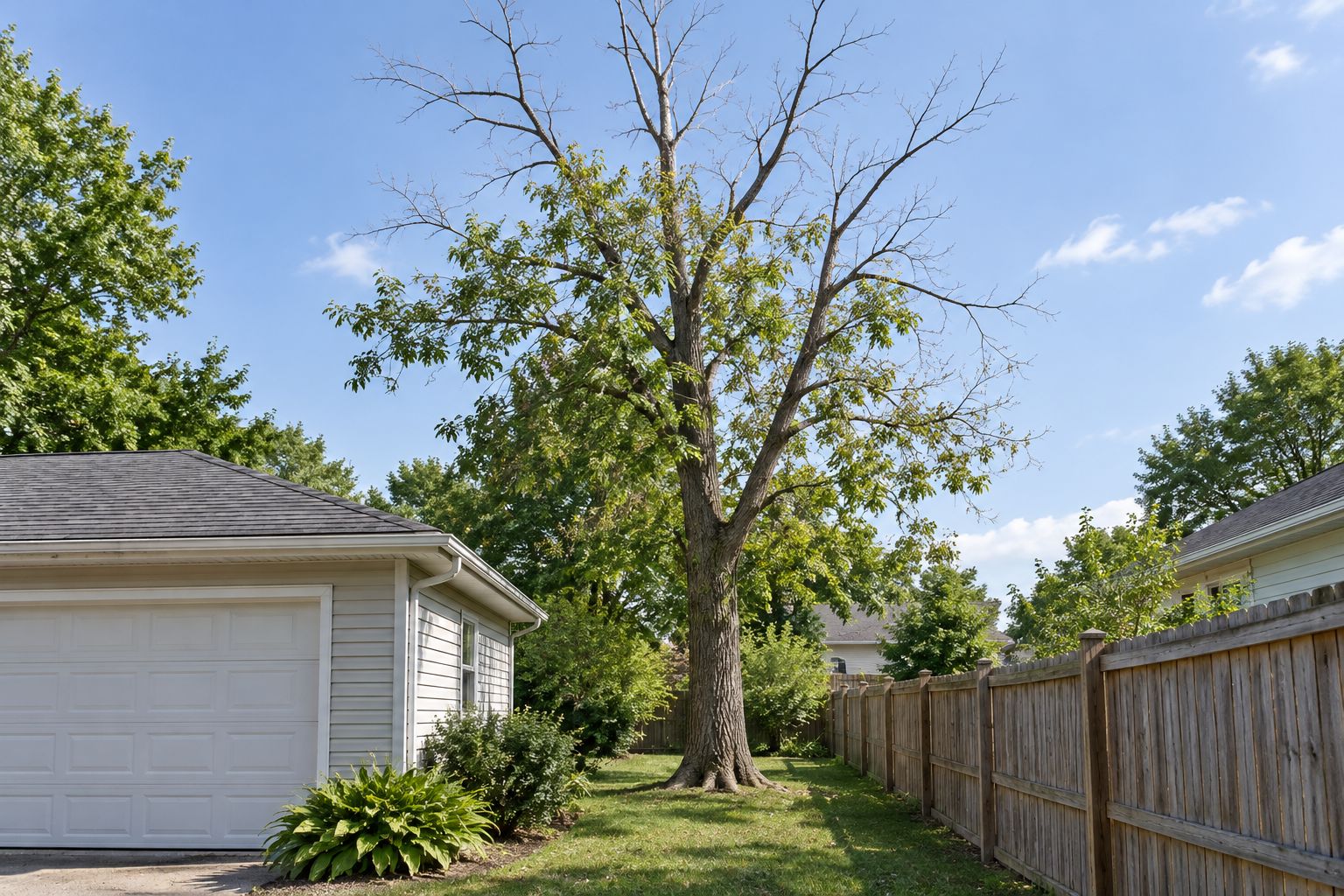
- Thinning crown: Foliage becomes sparse, often beginning in the upper canopy. Drought, root problems, and other conditions can also cause thinning.
- Shoots along the trunk: Stressed ash can produce clusters of new growth below the damaged crown. New leaves do not prove the main canopy is recovering.
- Bark splitting: Splits can expose winding larval galleries beneath the bark. Do not peel bark or climb to search for them.
- Woodpecker activity: Pale patches where birds remove outer bark can accompany feeding on insects beneath it. This sign is not exclusive to emerald ash borer.
- Exit holes: Adult emerald ash borers leave characteristic D-shaped holes approximately 1/8 inch across. Many holes are difficult to see from the ground.
Adult emerald ash borers are metallic green beetles approximately 1/2 inch long. Spotting the insect is not necessary before arranging an assessment, and failing to see it does not rule out infestation.
Tree identification matters too. Common white and green ash typically have compound leaves with 5–9 leaflets and opposite branching. A professional should confirm the species and evaluate the whole tree rather than treating one photograph as a diagnosis.
Why removal urgency varies
A suspected infestation does not produce a universal removal deadline. These conditions determine how quickly your tree needs attention and what precautions belong in the work plan:
- Tree condition: Dead branches, cavities, cracks, and deteriorated stems affect the available removal methods.
- Nearby structures: A house, garage, fence, or neighboring roof leaves less room for falling material.
- People and traffic: A tree beside a regularly used entrance or driveway creates more exposure than one away from occupied areas.
- Site access: Gates, narrow passages, overhead obstacles, and equipment positioning affect how a crew can reach the tree.
- Ground conditions: Slopes, wet soil, and restricted working areas influence equipment placement and property protection.
- Recent changes: A new lean, visible root movement, or fresh splitting deserves attention beyond a routine appointment request.
Describe these conditions when you call, but do not enter the potential fall area to gather details. A useful description never requires putting yourself underneath the problem.
What should you do before the crew arrives?
Your job is to reduce exposure and explain the site. Leave structural inspection and cutting decisions to the people assessing the tree.
- Keep people clear. Stop using the area beneath damaged limbs and anywhere the tree could strike. Move pets away without walking into the hazard area.
- Describe what changed. Explain whether you noticed sudden leaning, a broken branch, a split, or gradual canopy loss. Say whether anything has already been struck.
- Identify nearby obstacles. Mention buildings, fences, wires, parked vehicles, gates, and neighboring property. Photograph only from a safe position.
- Explain access. Tell the crew which entrance reaches the yard and whether a gate or narrow passage limits entry. Let the crew determine equipment needs.
- Confirm the work boundary. Identify the correct tree and explain ownership uncertainty before work is arranged. Do not authorize removal of a neighbor's tree.
If a tree or limb contacts utility lines, stay away and contact the utility. Call 911 for immediate danger to people, fire, or another life-threatening situation; do not attempt to free a wire or move connected debris.
For the distinction between an urgent assessment and an immediate hazard, read when a tree problem cannot wait until morning. The urgency comes from the condition and exposure, not simply the fact that the tree has lost its leaves.
What should your ash removal estimate include?
A useful 2026 estimate describes the work clearly enough that you can compare it with another proposal. A total without a defined scope is not a useful comparison. Ask the estimator to walk through these points with you:
- Tree identification: Make sure the proposal identifies which ash is being removed, especially if several stand together.
- Removal scope: Confirm whether the work covers the whole tree or only specified material. Ask how nearby structures affect the approach.
- Access and protection: Discuss the working route, equipment placement, and protection of features near the tree.
- Wood handling: Specify whether logs, branches, and chips leave the property or whether you want some material retained.
- Cleanup: Agree on what debris will be collected and what condition the work area will be left in.
- Stump work: Confirm whether stump grinding is included, separate, or excluded. Ask who handles the resulting grindings.
Spartantreeny provides tree removal and stump grinding in the Rochester area. For your tree removal estimate, discuss careful removal, thorough cleanup, and the work plan directly with the crew; an individual assessment still needs to establish the method and scope.
Also ask for current insurance documentation and written terms. A verbal assurance does not explain exclusions, disposal responsibilities, or what happens if the agreed scope changes.
Arrange an ash removal assessment
Describe your tree, nearby structures, and access in Rochester, Webster, or eastern Monroe County.
What affects the difficulty of removing dead ash?
Tree size matters, but it does not explain the whole job. An ash beside a garage with limited access requires a different plan from a similar-sized tree in an open yard.
Brittle wood can limit methods that depend on the tree supporting a climber or rigging loads. The crew must assess whether suitable equipment can reach the work area and where material can be lowered or placed. Do not assume that an easy-looking route from the street makes the removal straightforward.
Cleanup scope matters too. Leaving logs where they land is different from hauling wood, removing branches, grinding a stump, and collecting grindings. For a 2026 estimate, write down the finish you want before comparing proposals.
Ask what changes the work, not just what changes the total. That conversation tells you whether competing estimates describe the same removal and the same finished yard.
Can an emerald ash borer treatment save a dead ash tree?
Treatment cannot revive a dead ash tree. Preventive or protective treatment is a separate decision for a living ash, and suitability depends on its condition and an assessment of existing damage.
If your ash still has foliage, ask whether retaining it is realistic before deciding on removal. Do not mistake shoots low on the trunk for proof that the upper tree remains structurally sound.
Can you wait until winter to remove a dead ash?
Winter is not a safety deadline for dead ash removal. A tree showing active failure or threatening an occupied area needs attention based on its condition, not a preferred season.
Seasonal access and ground conditions belong in the scheduling discussion once the hazard has been assessed. Waiting for leaf drop, frozen ground, or a quieter calendar does not reverse deterioration in dead wood.
Can you remove an emerald ash borer tree yourself?
Do not treat a dead ash as a routine chainsaw project. Brittle limbs can break unexpectedly, and nearby roofs, wires, and fences leave little room for an error.
Keeping your feet on the ground does not remove the danger from material overhead. Leave climbing, cutting, rigging, and equipment decisions to a qualified tree-removal crew.
What happens to the wood and stump?
Decide what you want removed before the crew starts. If you want logs retained, explain where you want them placed and let the crew confirm whether that location works with the removal plan.
Do not transport suspected infested firewood without checking current New York requirements. Moving untreated firewood can spread tree pests, and state rules restrict firewood movement. Keeping wood for personal use is not a reason to ignore those restrictions.
The stump needs a separate conversation. Removing the standing tree does not automatically include stump grinding, hauling grindings, adding soil, or reseeding. A clear scope prevents a finished removal from becoming an unfinished yard project.
FAQ
How do I know if my ash tree needs emergency removal?
Fresh splitting, active movement, substantial hanging limbs, or contact with utility lines require immediate attention. Stay clear and describe the hazard when seeking help; call 911 for immediate danger to people or another life-threatening situation.
Does a dead ash tree have to come down immediately?
A dead ash needs prompt assessment, but the urgency depends on its condition and what it could strike. An ash over a home or entrance presents a different exposure from one away from occupied areas.
Can emerald ash borer damage make a tree unsafe before it falls?
Yes, emerald ash borer damage and subsequent deterioration can leave branches and stems brittle while the tree remains standing. A standing trunk does not establish that climbing or working beneath it is safe.
What do emerald ash borer exit holes look like?
Emerald ash borer exit holes are D-shaped and approximately 1/8 inch across. Their absence in a ground-level inspection does not rule out infestation.
Should I get an estimate before deciding whether to treat my ash?
Get an assessment of the living tree before choosing treatment or removal. Treatment cannot revive dead wood, and foliage alone does not establish structural safety.
Does ash tree removal include the stump and cleanup?
Ash tree removal includes only the work specified in your agreement. Confirm stump grinding, wood disposal, branch cleanup, and handling of grindings before accepting the estimate.
Who can assess a dead ash in the Rochester area?
Spartantreeny provides tree removal services for homeowners and property owners in the Rochester area. Request an individual assessment and describe nearby structures, access restrictions, and any recent changes in the tree.
One last thing
New growth can distract you from old damage. An ash with shoots along its trunk can still have a declining crown, so do not let a patch of green settle the removal question.
Before your 2026 estimate visit, write down the tree's location, what it could hit, and the cleanup you expect. That short description gives the crew a useful starting point without asking you to diagnose the tree or step beneath it. Careful removal starts with understanding the whole site—not just naming the insect.