





Removing several trees together changes tree removal cost because the work can share equipment setup, access routes, and cleanup, but each tree still needs its own removal plan. A combined job does not guarantee a lower cost per tree. Stump grinding, wood handling, and yard restoration need separate attention in the estimate so you know exactly what the job includes.
- Batch tree removal cost depends on shared access and setup, not simply the number of trees.
- Spartantreeny provides tree removal for Rochester-area homeowners; request an individual estimate rather than assuming a batch discount.
- Compare combined and phased removal using the same cleanup and stump-grinding scope.
- Keep urgent tree hazards separate from plans to group routine work.
Why this matters
For homeowners in Rochester, Webster, and eastern Monroe County, several unwanted trees often become one planning decision. You want the trees removed carefully, the yard usable afterward, and a written scope that leaves no argument about what stays behind.
The useful question is not whether a crew offers a bulk discount. It is whether combining the work removes repeated tasks without creating a harder job. Start with a tree removal estimate checklist, then ask the estimator to explain which parts of your project can share setup.
For a 2026 estimate, identify every tree you want considered before the property visit. Adding another tree after the crew has planned the work changes the scope; it is not automatically a small extra.
Why does removing several trees at once change tree removal cost?
Batching changes the work plan; it does not make every tree equally easy to remove. A crew might use the same equipment position or debris route for neighboring trees. Trees in different corners of the property, behind separate fences, or beside different structures still present separate problems.
Use this comparison to decide what you want priced. These are planning choices, not promises about the final bill.
| Approach | Best for | What it combines | Main trade-off |
|---|---|---|---|
| Combined removal | Homeowners ready to remove all selected trees | A coordinated equipment, access, and cleanup plan | The full project must fit your budget and property constraints |
| Phased removal | Homeowners separating urgent work from later decisions | Work grouped within each phase | Later work requires another setup and another cleanup plan |
| Selective removal | Homeowners who want some trees retained | Removal of selected trees alongside a retention plan | Remaining trees and landscaping still need protection |
A combined estimate should identify the trees individually even when the contractor presents one project total. Otherwise, it becomes difficult to tell whether competing estimates cover the same work.
Ask the estimator to describe the shared tasks in plain language. Does the equipment stay in one working position? Does the crew use one route for carrying material out? Does each tree require a separate approach? Those answers explain the estimate more clearly than the phrase batch pricing.
Combined removal: best for a settled scope
Combined removal fits a property where you have already decided which trees need to go and the crew can plan the work as one project. The benefit is coordination: access, equipment placement, cutting sequence, and debris handling can be considered together.
The limitation is commitment. You need to agree on the whole scope before work starts, including what happens to the stumps and how much material leaves the property. A larger project also needs a clear plan for protecting the parts of the yard you want to keep.
Do not assume that nearby trees share the same removal method. A tree standing clear of buildings and a tree extending over a garage deserve separate explanations, even if their trunks are close together.
For your 2026 project, ask for the complete combined scope first. Then request a clearly identified alternative if you want to leave a particular tree out. That keeps the comparison tied to actual work rather than a vague discount discussion.
Phased removal: best for separating priorities
Phased removal fits homeowners who need one problem addressed now but have not committed to the rest. It also lets you separate necessary work from changes you are still considering for the landscape.
The drawback is repeated planning and setup. A later visit needs its own access arrangements, equipment decisions, and cleanup. Ask what would need to happen again rather than assuming the remaining trees will carry the same share of the original estimate.
Do not postpone a tree identified as an immediate hazard just to combine it with routine work. If a tree has fallen onto a structure, is contacting utility equipment, or is actively failing, keep people away and seek appropriate emergency help. Do not approach it to collect better estimate photos.
For planned work, ask the estimator to distinguish the trees that need prompt attention from those that can be considered separately. A useful phased plan explains the order, not just the split in the work.
Selective removal: best for keeping useful trees
Selective removal fits homeowners who want to solve a specific problem without clearing every tree in an area. You might want an unwanted tree removed while retaining neighboring trees, screening, or an established planting bed.
The advantage is a narrower removal scope. The trade-off is that the crew must still plan around what remains. Removing more trees simply to make a batch feel worthwhile is not a sound reason to lose trees you want to keep.
Make retained trees part of the walkthrough. Point out their trunks, visible roots, and nearby beds, and ask how access and material handling will avoid unnecessary damage. If you are uncertain whether a tree needs removal or pruning, ask that question before requesting a removal-only estimate.
Why a batch tree removal estimate varies
Tree count describes the size of the list, not the difficulty of the work. The practical factors below explain why two properties with several trees can need very different plans.
- Tree size: Height, trunk size, and the amount of branch material affect the work involved. Identify each tree rather than describing the project only as several trees.
- Access: Gates, narrow passages, slopes, and the route from the tree to equipment affect how the crew reaches the work and removes material.
- Nearby structures: Houses, garages, fences, and other obstacles affect where branches and trunk sections can go. Careful removal takes priority over treating the trees as interchangeable items.
- Equipment setup: Trees that share a workable equipment position present a different project from trees requiring repeated moves across the property.
- Cleanup scope: Hauling away wood, leaving selected logs, grinding stumps, and dealing with grindings are different tasks. The estimate needs to identify the agreed result.
A 2026 estimate should explain these property conditions rather than rely on a generic per-tree figure. For more detail, read why tree removal quotes vary.
The strongest comparison is between matching scopes. If one contractor includes wood removal and another leaves the trunk sections, you are not comparing the same finished job.
How do you request a useful estimate for several trees?
Prepare a tree-by-tree list before the visit. You do not need to measure heights or climb anything; you need to make the intended work unmistakable from the ground.
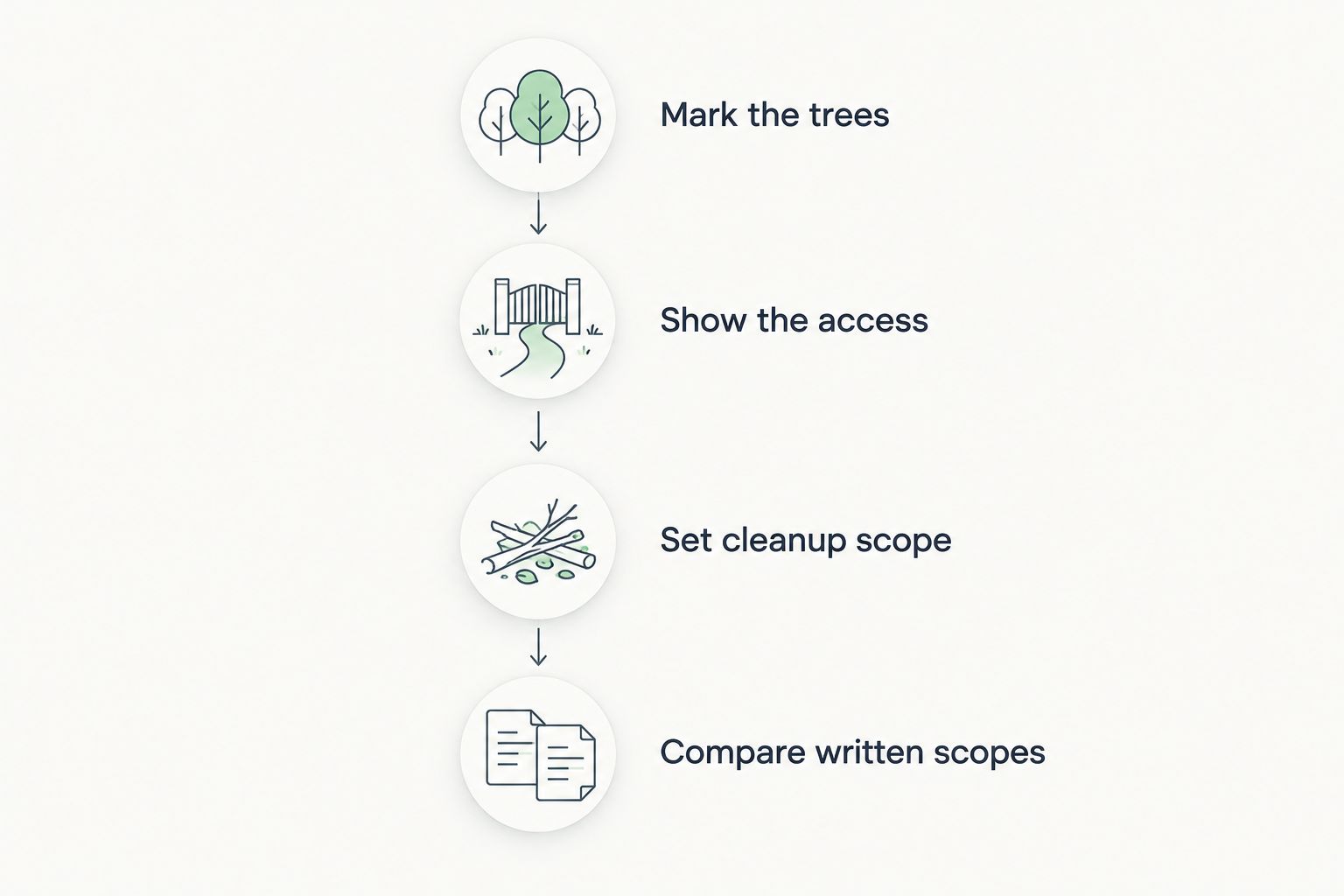
- Mark the trees. Use a simple property sketch or ground-level photos to identify each tree. Agree on the identification during the walkthrough so no tree is included by assumption.
- Show the access. Point out gates, driveways, narrow side yards, and anything the crew needs to protect. Mention access that crosses someone else's property instead of assuming it is available.
- Set cleanup scope. Say whether you want wood removed or retained, and ask what happens to branches, chips, and stump grindings. Define what a finished yard means for this job.
- Compare written scopes. Request the combined project and any genuine alternative you are considering. Make sure the same trees and cleanup tasks appear in each comparison.
The walkthrough is also the time to ask who will answer questions on removal day. Dealing directly with the crew helps you resolve practical details before cutting begins, especially when several trees and different cleanup instructions are involved.
Keep a copy of the marked photos with the written scope. A description such as the large tree out back is easy to misunderstand when several trees stand together. Clear identification is a practical safeguard, not extra paperwork for its own sake.
What should the cleanup agreement say?
Tree removal is not a complete description of cleanup. Ask the contractor to state what leaves the property, what remains, and which finishing tasks are outside the job.
Wood and stump decisions deserve separate lines. Removing the standing tree does not explain whether the stump will be ground, whether grindings remain, or whether the disturbed area will be prepared for another use.
Before accepting a 2026 estimate, confirm:
- Which branches and trunk sections will be hauled away.
- Where any retained wood will be placed.
- Which stumps are included in grinding.
- What happens to chips and stump grindings.
- Whether soil replacement, grading, or reseeding is included or excluded.
Thorough cleanup starts with an agreed endpoint. Ask the crew to walk the scope with you and explain that endpoint in terms you can check after the work is finished.
Is removing several trees together always cheaper?
Removing several trees together does not guarantee savings because shared setup is only part of the job. Each tree still contributes cutting, handling, and disposal work, and some trees require separate equipment positions.
Ask for the combined scope and the specific alternative you would actually choose. Comparing real options is more useful than asking for a general percentage off.
Should I include stump grinding in the same estimate?
Include stump grinding in the estimate discussion if you want the stumps addressed. Specify each stump and ask how the grinding work, access, and remaining material fit the overall project.
Spartantreeny offers tree removal and stump grinding, so Rochester-area homeowners can raise both needs during the estimate request. Confirm the written scope rather than assuming one service includes the other.
How do I choose a crew for a planned batch job?
Choose a crew that explains the removal sequence, access, protection measures, and cleanup in writing. Ask for current insurance documentation and make sure the estimate identifies the actual work, not simply a tree count.
Spartantreeny tree removal is best suited to Rochester-area homeowners seeking an individual estimate for planned work. Describe the full project, including trees you are unsure about, so the conversation starts with your property rather than an assumed package.
Request an estimate for your trees
Describe the trees, access, and cleanup you want for your Rochester-area property.
FAQ
Does tree removal cost less per tree when I remove several?
Tree removal cost does not automatically fall per tree when you combine the work. Shared access and setup can reduce repeated tasks, but each tree still needs an individual removal plan.
Can I get a batch tree removal estimate from photos?
Photos help identify the trees and show visible access, but they do not replace an individual assessment of the work. Take photos from a safe ground-level position and ask what else the estimator needs.
Should I remove every tree in the same area at once?
Remove only the trees you have a sound reason to remove. Ask how the crew will protect retained trees and whether pruning deserves consideration before including an uncertain tree.
Does removing several trees include stump grinding?
Removing several trees does not establish that stump grinding is included. Identify each stump in the written scope and confirm what happens to the grindings.
Who handles cleanup after a multiple-tree removal job?
The written agreement should identify the contractor's cleanup tasks and any work left to you. Confirm wood hauling, retained logs, chips, stump grindings, and finishing work before accepting the estimate.
Can Spartantreeny assess several trees for one project?
Spartantreeny provides tree removal for homeowners and property owners in the Rochester area. Request an individual estimate describing all the trees you want considered and your preferred cleanup scope.
One last thing
Decide what you want left behind before deciding what you want cut down. Retained trees, a fence, a garden bed, and a place for saved wood all belong in the removal plan. Those details help define the actual job.
For a 2026 batch removal project in Rochester, Webster, or eastern Monroe County, bring a marked tree list and a clear cleanup request to the walkthrough. The goal is not the lowest-looking tree count calculation. It is a written estimate for the work you actually want completed.