





Instead of arranging a cutting date and then discovering the utility needs to act first, coordinate the electrical hazard, site assessment, and removal plan before work begins. For tree removal near power lines in Rochester, NY, report the situation to your electric utility and have the tree contractor confirm what must happen before cutting.
- Tree removal near power lines in Rochester, NY starts with utility coordination, not a cutting date.
- Spartan Tree and Landscape suits Rochester homeowners seeking an individual tree-removal estimate.
- Ask the utility to identify the wires and any required electrical work; never identify them yourself.
- Confirm removal, stump grinding, debris handling, and cleanup separately in the written estimate.
Why this matters
A tree-removal appointment is not authorization to work near energized lines. Branches, ropes, equipment, and falling wood can create electrical hazards even when the person cutting never touches a wire.
For a planned 2026 removal in Rochester, Webster, or eastern Monroe County, the next move is coordination—not a ladder or pole saw. Spartan Tree and Landscape provides tree removal and tree care services in the Rochester area. Ask for an individual assessment, and explain the overhead-wire concern before anyone schedules work.
Spartan Tree and Landscape is best suited to Rochester homeowners seeking an individual tree-removal estimate. Electrical clearance remains a separate issue that the utility and appropriately qualified workers must resolve.
Before you start
- Have the property details ready. Gather the service address, electric account information, your contact number, and a description of the tree's location. Take photographs only from a position that does not bring you closer to the wires or damaged tree.
- Separate a planned job from an emergency. A fallen wire, sparking, smoke, or a tree resting on electrical equipment requires immediate reporting. Keep people and pets away. Call 911 for an immediate threat to life or fire, and notify the electric utility.
- Expect separate responsibilities. Utility work does not automatically include full tree removal, stump grinding, or hauling away wood. A regular removal appointment does not establish that the contractor is qualified for energized line-clearance work. Confirm both scopes before booking.
Do not assume a dark house means the wires are safe. An outage is not confirmation that a line is de-energized or safe to approach.
Utility report
- Confirm your electric utility. Use the company named on your electric bill. If that is Rochester Gas and Electric, contact RG&E through the appropriate number on your bill or its official reporting channel. Do not assume every Rochester-area property has the same provider.
- Describe the condition without diagnosing it. Explain whether the tree is standing, split, leaning, touching a wire, or supporting a broken branch. State whether the wire crosses the street, follows the property edge, or connects toward your house.
- Ask what assessment is required. Explain that you are arranging private tree removal near overhead wires. Ask who will determine whether utility work, specialized line-clearance work, or a planned interruption is necessary.
- Record the next action. Keep the reference number, date, instructions, and responsible contact in a 2026 job record. Ask whether you, the contractor, or the utility must arrange the next appointment.
Expected result: You know which organization is assessing the electrical issue and what confirmation the removal contractor needs. A report number alone does not establish permission to cut.
If the utility redirects you to another wire owner, pass that information to the contractor. Do not decide that a lower wire is harmless because it looks like a communications cable.
Site assessment
- Describe the whole job. Tell the estimator which tree concerns you, why you want it removed, and whether you also want stump grinding. Point out wires from a safe location; do not walk underneath damaged limbs to demonstrate the problem.
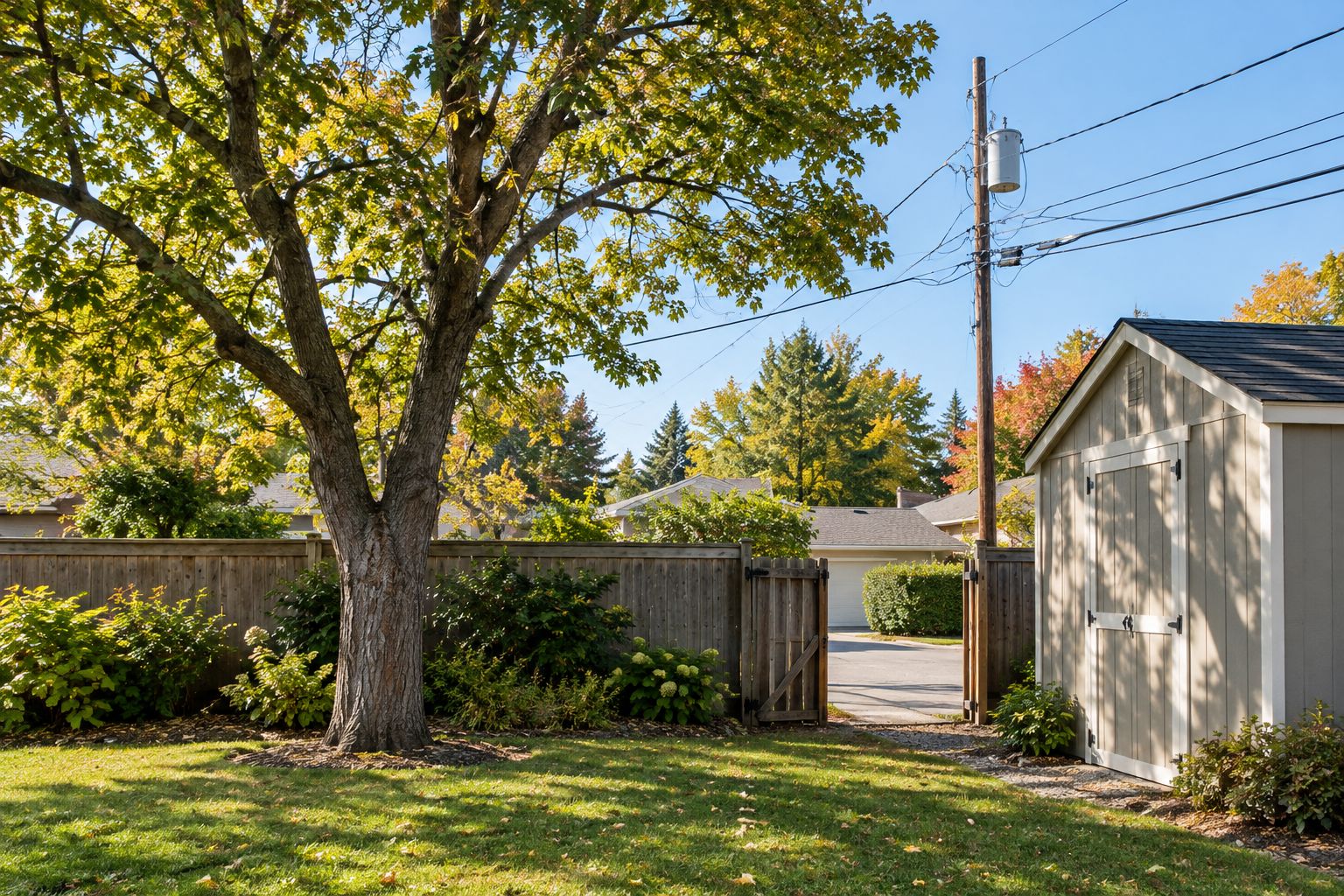
- Show the access route. Identify gates, fences, driveways, slopes, sheds, roof edges, and neighboring property. Tell the estimator where equipment access would require a neighbor's permission.
- Ask about the electrical boundary. Have the contractor explain which work can proceed under the proposed plan and what must wait for utility action or appropriately qualified personnel. Do not request a cutting method yourself.
- Identify the cleanup area. Discuss where wood, brush, and chips would go and what finished condition the estimate covers. Include any areas near wires that cannot be safely accessed until electrical hazards are resolved.
Expected result: The estimate reflects the actual tree, access, nearby structures, electrical constraints, and cleanup—not just a photograph of the trunk.
A narrow gate and overhead wires are separate constraints. Solving access does not solve electrical exposure, and a utility visit does not solve equipment access. Make sure both appear in the work discussion.
Written work plan
- Separate the tasks. Request a written description of tree removal, stump work, wood handling, brush removal, and cleanup. Ask which tasks are included and which require a separate arrangement.
- Name the electrical prerequisite. Record who must confirm that required utility work is complete and how that confirmation reaches the crew. Avoid a vague note such as utility contacted.
- Check qualifications and insurance. Ask for current insurance documentation and a clear explanation of who will perform any specialized work near energized conductors. General tree-care experience is not proof of electrical line-clearance qualifications.
- Agree on scheduling conditions. Establish what happens if utility work is incomplete, the tree changes condition, or access is blocked. A 2026 estimate should distinguish a proposed work date from a date dependent on another party's work.
Expected result: You can identify who owns each task, what must happen first, and what the property should look like afterward. Use the tree-removal estimate checklist to check the written scope before accepting it.
Which coordination route fits your situation?
| Situation | Best for | Benefit | Limitation |
|---|---|---|---|
| Planned removal near overhead wires | A standing tree without an immediate emergency | Gives the utility and contractor time to establish responsibilities | Scheduling depends on any required electrical work |
| Planned removal near the house connection | A tree near the overhead service drop | Brings the house connection into the work plan | A temporary disconnection is not automatically required or sufficient |
| Storm damage involving wires | A fallen tree, broken limb, or damaged wire | Puts the electrical hazard ahead of cleanup | Removal must wait wherever the electrical hazard remains unresolved |
Spartan Tree and Landscape offers removal, trimming, stump grinding, and emergency tree services. Those services do not establish authorization for energized line-clearance work. Ask directly how your particular electrical exposure will be addressed.
Workday handoff
- Confirm the prerequisite before cutting. Ask the crew lead whether the required utility coordination is complete. Homeowners must not test wires or interpret an outage as clearance.
- Keep the work area clear. Keep children, pets, vehicles, and visitors away from the designated work area. Ask the crew where you should remain and which access route must stay open.
- Leave electrical equipment alone. Do not move a service wire, support a sagging cable, handle the meter, or pull branches away from conductors. Do not ask a neighbor to help with those tasks.
- Review the finished scope. When the crew says the area is safe to enter, check the agreed wood handling, brush removal, stump work, and cleanup. Raise any mismatch against the written scope rather than an assumption.
Expected result: The crew starts only after its prerequisites are satisfied, and you inspect the property only after being told the work area is safe.
What does the 10-foot rule actually mean?
OSHA's overhead-line rule, 29 CFR 1910.333(c)(3), requires unqualified employees working in elevated positions to keep themselves and conductive objects at least 10 feet from unguarded energized overhead lines rated 50 kilovolts or less. Greater distances apply above that voltage.
That is a workplace minimum under stated conditions—not a homeowner's permission to cut. You cannot establish voltage, worker qualifications, or a safe removal method by looking at a wire. A branch can also fall or swing beyond its starting position. Do not use 10 feet as a DIY cutting boundary.
Second workflow: removal near the house service drop
A tree near the overhead connection to your house needs its own coordination discussion. Do not assume the connection is safe because it serves only your property.
For a 2026 service-drop job, ask the utility and contractor to resolve these questions before the cutting date:
- Wire ownership: Who owns the affected equipment, and who is authorized to work on it?
- Required action: Does the proposed removal require utility attendance, a temporary disconnection, or another arrangement?
- Appointment sequence: Who requests each visit, and what confirmation does the tree crew need?
- Restoration responsibility: If work reveals damage to customer-owned electrical equipment, who must assess and repair it before restoration?
Expected result: You understand the sequence without assuming that switching off your home's main breaker makes incoming overhead wires safe. It does not.
The advantage is a defined handoff. The drawback is that tree work and electrical work can require separate appointments; do not promise either party a completion time on the other's behalf.
Troubleshooting
The utility says full removal is your responsibility
Ask what that means for the electrical hazard. Responsibility for removing a privately owned tree does not answer whether utility action or qualified line-clearance personnel are required. Give the contractor the utility's instructions and request clarification before scheduling.
The crew arrives before required utility work is complete
Do not pressure the crew to start the affected work. Have the crew lead confirm the unresolved prerequisite with the relevant contact and establish the next step. A scheduled appointment does not remove an electrical hazard.
You cannot tell which company owns the wire
Report the concern to your electric utility and explain that ownership is uncertain. Let the utility or responsible wire owner identify it. Do not trace the line on foot beneath a damaged tree or test whether a cable is energized.
The tree changes after the estimate
Report a new split, hanging limb, fresh lean, or wire contact immediately. Keep away from the affected area and tell both the contractor and utility what changed. An earlier assessment does not describe a tree after new damage.
Nobody has agreed to remove the wood
Resolve that before authorizing work. Ask each party exactly what it will cut, move, chip, haul, or leave. Electrical hazard work and a finished-yard cleanup are different scopes.
Customize your removal plan
Before your 2026 removal date, settle the work beyond the overhead hazard. Ask whether stump grinding is included, what debris remains, and how the crew will handle access around fences and landscaping. Request direct communication with the crew about careful removal and thorough cleanup.
If stump grinding involves ground disturbance, ask who handles the New York 811 notification and any necessary private-line locating. An overhead-line discussion does not replace underground-utility planning.
Ask Spartan Tree and Landscape for an individual estimate covering the tree, access, structures, electrical coordination, and cleanup. Choose a defined scope over an online guess.
Request a site-specific removal estimate
Describe the tree, overhead wires, access, and cleanup you want included.
FAQ
Who should I call first for tree removal near power lines in Rochester, NY?
Contact your electric utility to report the overhead-wire concern, and tell your tree contractor that utility coordination is needed. For a fallen wire, sparking, or an immediate threat, keep away and use the appropriate emergency reporting channels.
Will the utility remove my entire tree?
Do not assume utility work includes complete tree removal. Ask the utility what work it will perform, then have the tree contractor define the remaining removal, stump work, and cleanup.
Can I trim a branch if it looks more than 10 feet from the wire?
Do not use an estimated distance as permission to trim near overhead wires. The branch, tool, or equipment can move toward the conductor, and you cannot determine voltage or an appropriate work method by sight.
Does turning off my main breaker make the outside wires safe?
No. Turning off your home's main breaker does not de-energize the utility's incoming overhead conductors. Leave electrical isolation and verification to authorized personnel.
What if the wire runs from the pole directly to my house?
Tell the utility and tree contractor that the tree is near the overhead service connection. Ask them to establish whether disconnection or another arrangement is necessary and who coordinates restoration.
What should an estimate include when a tree is near power lines?
The estimate should define the removal scope, access, electrical prerequisites, wood handling, stump work, and cleanup. It should also identify which scheduling conditions depend on utility action.
Can emergency tree service start before the utility arrives?
Work involving an unresolved electrical hazard must not proceed simply because it is an emergency. The utility and appropriately qualified workers must establish the necessary electrical safety arrangements before affected cutting or handling begins.
One last thing
The most useful scheduling question is not simply when the tree can come down. Ask: What must be confirmed before the first cut, and who confirms it?
Put the answer beside the cleanup scope in your job record. That connects the two ends homeowners care about: a properly coordinated start and a clearly defined finish.