





For Rochester, Webster, and eastern Monroe County, late-winter dormancy is a sound starting point for planned maple pruning; light pruning after leaves fully expand is another option when avoiding visible sap flow matters. In 2026, choose the work window around the tree’s condition and the cuts it needs—not sap alone—and have broken or hanging branches assessed without waiting for the preferred season.
- For tree pruning Rochester NY homeowners can plan around, prioritize maple structure and condition over sap appearance.
- Late-winter pruning exposes branch structure; pruning after full leaf expansion generally produces less visible bleeding.
- Broken limbs, hanging branches, and utility conflicts need assessment before seasonal scheduling.
- Spartantreeny provides tree pruning and removal services for Rochester-area homeowners; request an individual estimate.
When should you prune maples in New York?
Plan structural maple pruning during late-winter dormancy, but do not treat that window as a deadline for every tree. Without leaves, you can see crossing branches, competing stems, and the relationship between the canopy and your roof. Maples can bleed sap from cuts as temperatures rise; that appearance alone does not mean a sound pruning cut has harmed the tree.
If your main concern is light canopy maintenance with less visible bleeding, discuss pruning after the leaves fully expand. For a broader maintenance plan, use this Rochester tree-trimming schedule alongside an assessment of your particular maple.
| Work window | Best for | Advantage | Limitation |
|---|---|---|---|
| Late-winter dormancy | Planned structural pruning | Leafless branches make structure easier to inspect | Maple cuts can bleed as sap begins moving |
| After full leaf expansion | Light corrective work when sap appearance matters | Generally less visible bleeding | Foliage can hide defects and branch connections |
| Any season, after assessment | Broken, dead, or hanging branches | Addresses the actual defect rather than waiting for a calendar date | Hazardous work needs controlled access and professional handling |
The table is a planning guide, not permission to remove a large part of the canopy. The size and purpose of each cut matter more than finding a supposedly perfect day.
Why this matters for Rochester homeowners
A maple shading your house is not just a pruning job. Its branches sit above something: a roof, driveway, fence, garden, or the route your family uses every day. The estimate needs to account for what happens beneath the tree as well as what comes off it.
Before booking tree pruning in 2026, decide what you need fixed. A branch rubbing the roof is a different request from improving a young tree’s structure or assessing a split above the driveway. A clear objective helps you compare proposed work instead of comparing vague promises to trim the tree.
Late-winter dormancy: best for seeing the structure
Late winter is a useful starting point for planned structural work on maples around Rochester and Webster. Bare branches expose crowded unions and crossing limbs that summer foliage can conceal. That visibility helps the person assessing the tree explain which branches deserve attention and which should stay.
Dormancy does not make every removal appropriate. Taking out a large living limb still leaves a large wound, and stripping the interior can remove useful foliage-bearing branches. Ask for a selective plan, not an evenly thinned outline.
The trade-off is sap. A maple pruned near the end of winter can produce conspicuous dripping when conditions favor sap movement. If staining on a patio or parked vehicle is a concern, bring that up before scheduling rather than treating it as an unexpected failure afterward.
After full leaf expansion: best for reducing visible sap flow
Pruning after the leaves have fully expanded generally reduces the bleeding associated with late-winter and early-spring maple cuts. That makes this window useful for light corrective work where dripping sap would be a nuisance. It is not a reason to postpone a dangerous hanging limb.
For summer 2026 work, have the crew distinguish between a limited correction and a major canopy reduction. Removing healthy leaves removes part of the tree’s food-producing surface. A stressed maple needs a more conservative discussion than a healthy tree with a small rubbing branch.
Summer also changes visibility. A full canopy can hide a weak branch connection, so the assessment needs more than a quick look from the street. Explain where you have seen movement, rubbing, dead tips, or fallen branches.
Damage and deadwood: best assessed when discovered
A broken branch does not become safer because the preferred pruning season is months away. Keep people, vehicles, and pets out from beneath hanging wood, then arrange an assessment. Do not pull on a lodged branch or climb up to inspect it.
Storm damage in 2026 should be sorted by the actual hazard, not by whether the maple is dormant. A small fallen twig and a split limb suspended over a walkway need different responses. Describe what is hanging, what is underneath it, and whether the trunk or root area has changed.
If a branch touches a utility line, or a line is down, stay clear and contact the utility. Do not assume a coated line is safe to touch, and do not attempt to clear branches from it yourself.
Why maple-pruning timing varies
A useful pruning recommendation explains the tree and the site. These factors change the timing or scope:
- Work objective: Removing a broken branch is different from training a young maple or reducing roof contact.
- Tree condition: Sparse foliage, dead branches, decay, and recent damage change what the tree can reasonably retain or lose.
- Branch size: A large limb creates a different wound and handling problem from a small shoot.
- Nearby structures: Roofs, fences, sheds, and utility lines affect how branches can be lowered.
- Site access: Gates, narrow side yards, slopes, and soft ground affect equipment access and property protection.
- Cleanup scope: Brush removal, wood handling, and access for hauling belong in the work discussion before scheduling.
Do not choose the pruning date before agreeing on the pruning objective. Otherwise, you can end up with a neatly scheduled job that never addresses the branch you were worried about.
How should you prepare for a maple-pruning estimate?
Give the estimator a clear problem to assess, not instructions to remove an arbitrary amount of foliage. Your observations help identify the concern; the site visit determines the work.
- Name the problem. Say whether branches touch the roof, block access, rub together, or appear damaged. Point out the exact location from the ground.
- Show the surroundings. Include the house, fence, driveway, neighboring property, and any overhead lines in your photos. Close-ups alone do not show the work area.
- Explain access. Describe the gate, side yard, slope, and anything that prevents equipment from reaching the tree. Do not promise access across a neighbor’s property.
- Define cleanup. Ask whether the estimate includes brush removal, larger wood, and clearing the work area. Agree on what stays before the work begins.
- Request a written scope. Have the estimate identify the intended work, exclusions, and whether further assessment is needed before deciding between pruning and removal.
For your 2026 estimate, ask what the crew proposes to leave as well as what it proposes to cut. That question turns a general trim into a discussion about retained branches, clearance, and the tree’s future shape.
Spartantreeny is a tree pruning and removal service for Rochester-area homeowners seeking an individual estimate. Ask about careful branch handling, thorough cleanup, and who you will deal with on the crew; seasonal guidance alone cannot determine the scope at your property.
Request a maple-pruning estimate
Describe the tree, access, nearby structures, and cleanup you need at your Rochester-area property.
What should careful maple pruning look like?
Good pruning starts with a reason for each cut. Removing deadwood, correcting a rubbing branch, and establishing a young tree’s structure are specific objectives. Cutting every branch back to the same outline is not a substitute for those decisions.
A proper branch-removal cut preserves the branch collar—the slightly swollen area where the branch joins the larger limb or trunk. Cutting flush into the trunk damages that protective area. Leaving a long stub is not the answer either.
For branches over about 1 inch in diameter, the standard 3-cut method helps prevent bark from tearing down the trunk: an undercut, a farther-out cut that removes the branch’s weight, and a final cut outside the collar. This describes the cutting principle, not a homeowner climbing or chainsaw task. Heavy limbs and branches over structures require a handling plan beyond the cut itself.
Small shoot cuts are different. A cut roughly 1/4 inch above a suitable bud avoids both cutting into the bud and leaving an unnecessarily long stub. These details are useful questions for an estimator, but they do not make overhead pruning safe to attempt yourself.
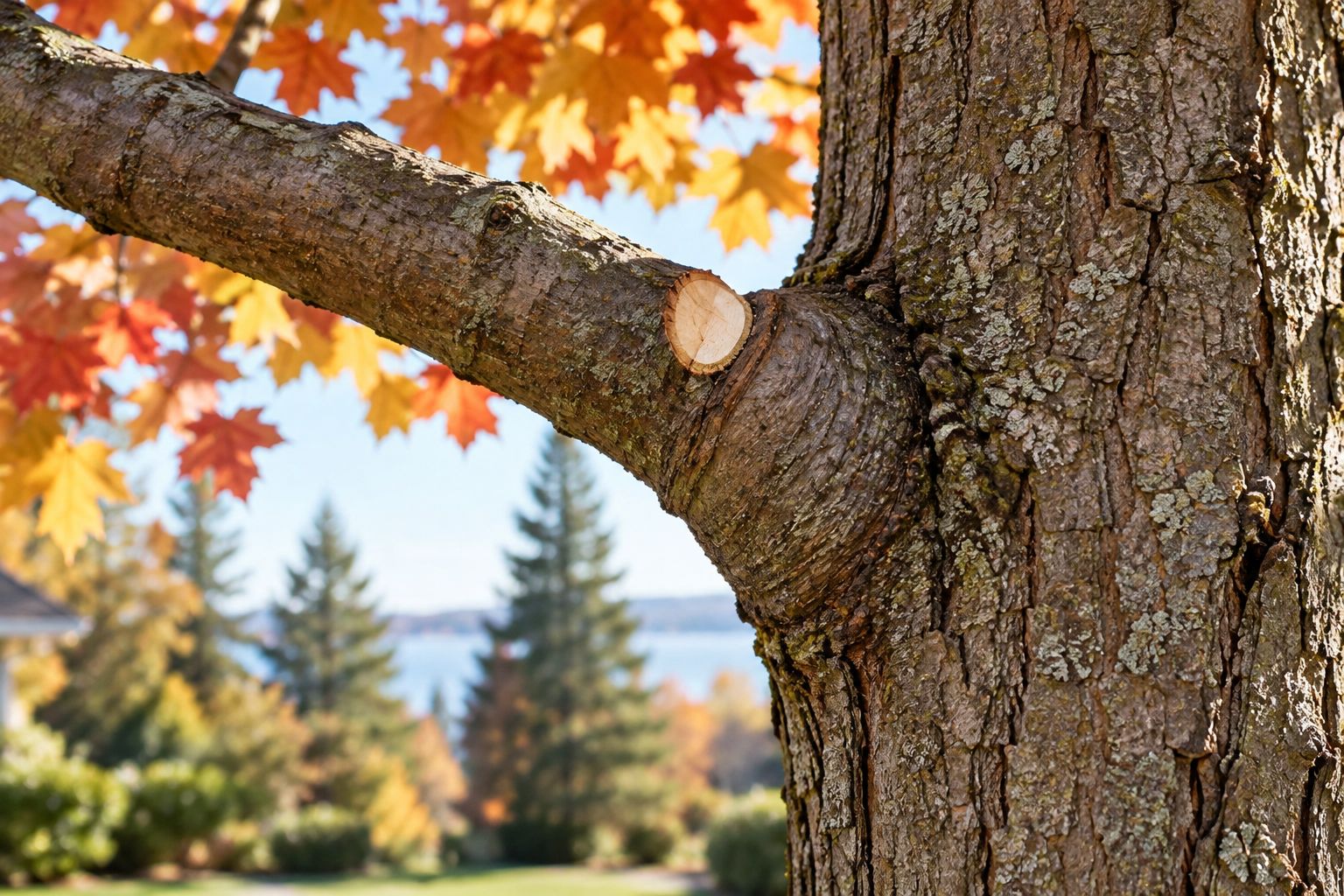
Keep the discussion focused on selective work. If the proposal is simply to make a mature maple much shorter, ask which branches would be cut and what structure would remain. Topping creates large wounds and encourages new shoots without restoring the original branch arrangement.
Does sap bleeding mean you chose the wrong time?
Sap bleeding alone does not mean a maple was pruned incorrectly. Maples are known for bleeding from cuts during late-winter and early-spring sap movement. Judge the work by the cut location, branch selection, and amount removed—not just by visible dripping.
Do not apply wound paint merely to hide the sap. Routine pruning cuts are generally left uncoated. If the tree also has bark damage, decay, or a split, have that separate problem assessed rather than assuming every symptom comes from pruning.
Should a large maple be pruned or removed?
A large maple needs an assessment, not an automatic removal recommendation. Size alone does not settle the question. The decision depends on its condition, structural defects, location, and whether selective pruning can address the identified concern.
Pruning cannot repair every trunk split or restore decayed wood. Removal also has consequences: you lose shade and must decide what happens to the stump and surrounding landscape. Ask for the reason behind the recommendation and a clear explanation of what pruning would—and would not—solve.
Can you prune a maple yourself?
Limit homeowner pruning to small, accessible work from the ground, away from overhead lines. Stop when the task requires climbing, a ladder, a chainsaw overhead, or handling a limb whose weight you cannot control. The calendar does not reduce those risks.
Before making even a small cut, identify the branch collar and the reason for removing the branch. If either is unclear, leave it for the assessment. An unnecessary cut cannot be put back.
FAQ
What's the best time for tree pruning in Rochester, NY, if I have a maple?
Late-winter dormancy is a sound starting point for planned structural maple pruning in Rochester. Light pruning after full leaf expansion is another option when reducing visible sap bleeding matters.
Will my maple die if sap comes out after pruning?
Sap bleeding alone does not mean a maple is dying. Assess the branch selection and cut quality, and have separate symptoms such as splits, decay, or widespread dieback checked.
Can I have a maple pruned in summer in Webster?
Yes, light corrective maple pruning can be done after the leaves fully expand. The tree's condition and the amount of living foliage proposed for removal should guide the scope.
Should a broken maple branch wait until winter?
A broken or hanging maple branch needs assessment when discovered, not an automatic wait until winter. Keep people and vehicles away from the area beneath it.
How much does maple pruning cost in eastern Monroe County?
Maple pruning needs an individual estimate based on tree size, branch condition, access, nearby structures, and cleanup. Ask for a written scope so you can compare the actual work proposed.
Does Spartantreeny provide both tree pruning and removal?
Spartantreeny provides tree pruning and removal services for Rochester-area homeowners and property owners. Request an assessment to discuss whether pruning addresses the concern or removal needs consideration.
What should I send when requesting a maple-pruning estimate?
Send ground-level photos showing the whole maple, the concerning branches, nearby structures, and equipment access. Include your location and describe the cleanup you want included.
One last thing
The maple that drips the most after pruning is not automatically the maple that received the worst cuts. Sap is visible; a flush cut, an unnecessary large wound, or excessive foliage removal can be easier to overlook. Ask the crew to explain the retained structure before you judge the job by the mess beneath it.