




When a neighbor’s tree hangs over your yard, start by checking for immediate danger from a safe location, then talk with the owner before arranging any cutting. An overhanging branch does not automatically call for storm damage tree removal; the next step depends on whether the limb is healthy, broken, or threatening people, structures, or utility lines.
- Overhanging branches need an assessment, not an automatic removal order.
- Storm damage tree removal starts with keeping people away from broken limbs and utility lines.
- Spartantreeny provides tree removal and trimming for Rochester-area homeowners; establish ownership and permission before scheduling work.
- Get the cutting limits, property access, and cleanup scope in writing before work begins.
What should you do when a neighbor’s tree hangs over your yard?
Separate the safety problem from the ownership question. A healthy limb above your lawn needs a different response from a cracked branch hanging over your driveway. Neither situation gives you a reason to climb the tree or cut first and discuss permission later.
For homeowners in Rochester, Webster, and eastern Monroe County, this 2026 guide starts with observation and ends with a clearly defined estimate. If the tree has already fallen, review who pays when a neighbor’s tree falls on your property before assuming the neighbor must cover every expense.
| What you see | Best next step | Benefit | Limit or concern |
|---|---|---|---|
| Healthy-looking branches extending over the yard | Discuss a professional pruning assessment | Addresses clearance without assuming removal is necessary | Appearance alone does not establish tree condition |
| A cracked or hanging limb | Keep people away and seek urgent tree-service assessment | Focuses attention on the immediate hazard | The safe working area can extend beyond your property |
| A branch touching or tangled with a utility line | Stay away and contact the utility | Leaves electrical hazards to the responsible specialists | A tree crew cannot make an energized line safe by inspection |
| A tree or limb already on a building | Stay out of the affected area and contact emergency help as needed | Prioritizes people before cleanup | Removing the wood does not establish that the building is safe |
Why this matters
An overhanging tree creates several separate questions: Is anything likely to fall? Who owns the tree? What work is authorized? Who handles the debris? Trying to settle all of them with a quick cut makes a manageable problem harder.
You need agreement on the work, not just agreement that the branch is annoying. A neighbor who accepts light clearance pruning has not necessarily authorized trunk removal, equipment access, or stump grinding. Keep those decisions separate when you discuss the job.
Start with safety, not a saw
Look from a place where you are not standing beneath the branch. Check for hanging wood, a fresh split, a newly changed lean, or soil lifting near the base. These are reasons to request a professional assessment, not instructions for diagnosing the tree yourself.
Keep children, pets, and visitors out of the affected area. Move a vehicle only if you can reach it without passing beneath damaged wood. Do not pull on a branch with a rope or try to shake loose material out of the canopy.
If a tree is touching a utility line, stay away from the tree, nearby fences, and any fallen wire. Contact the utility and follow its instructions. Call 911 when there is an immediate threat to life, fire, or another emergency requiring first responders.
Wind damage can leave wood caught in surrounding branches. A limb that has stopped moving is not proof that it is stable. Do not treat a pause in the weather as permission to begin cutting.
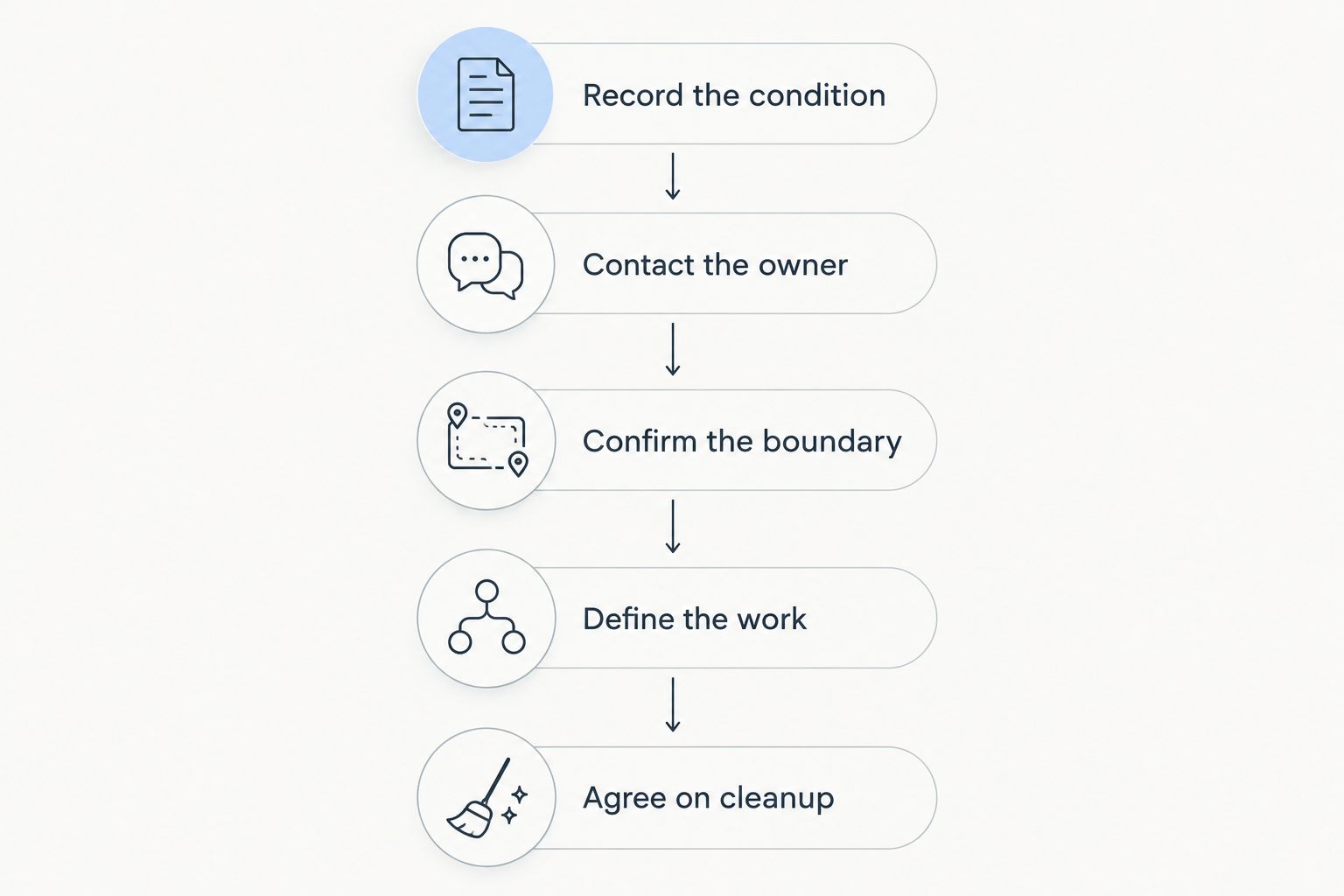
Follow these steps before arranging tree work
1. Record the condition
Take photographs from safe ground. Capture the whole tree, the trunk location, the overhanging section, and nearby structures. Photograph visible damage without entering the area beneath it.
Write down when you noticed the problem and what changed. Distinguish a branch that has grown across the yard over time from one that broke during a storm. That record helps you explain the work you are requesting without making claims about its cause.
2. Contact the owner
Describe what you see in plain language. Explain whether the branch blocks access, touches a structure, or appears broken. Share the photographs and ask to discuss an assessment.
Keep the first message focused on the condition and the next step. Starting with a demand for full removal or payment can turn a practical discussion into an argument before anyone understands the work.
3. Confirm the boundary
Do not use a fence, mowing line, or old planting bed as proof of the property boundary. If ownership or the cutting limit is disputed, resolve that question before scheduling non-emergency work. A surveyor can address boundary uncertainty; a New York attorney can advise on disputed rights.
A trunk at or across a boundary needs particular care. Do not assume that branches above your yard give you authority to alter the whole tree.
4. Define the work
Ask the estimator to identify the branches involved, the proposed cutting limits, and the access needed. Include the driveway, gates, fences, garden beds, and structures that affect how the crew reaches the tree.
Clarify whether the proposal covers pruning, removal, debris hauling, or stump work. Those are different tasks. A clear scope lets both neighbors understand what will happen before equipment arrives.
5. Agree on cleanup
Decide where branches and logs will go and who is responsible for removing them. Include access across either property and any work near shared fences or landscaping.
Put the agreed scope in writing. For a planned job in 2026, save the estimate, permission messages, and photographs together so everyone can refer to the same information.
Can you cut branches that cross your property line?
Do not treat the property line as blanket permission to cut. Your rights and potential liability depend on the facts, including ownership, the work proposed, and whether cutting would damage the tree. Get New York legal advice when permission or responsibility is disputed.
A practical starting point is to seek the owner’s written agreement and have a qualified tree professional explain what pruning is appropriate. Avoid entering the neighbor’s property, attaching equipment to the tree, or authorizing work beyond an agreed scope without permission.
Root cutting deserves the same caution. Roots affect tree stability and health, and a boundary dispute does not make cutting them safe. If roots are the concern, request an assessment rather than asking a crew to cut along an assumed line.
Does an overhanging tree need pruning or removal?
Overhang alone does not establish that a tree needs removal. The decision should follow an assessment of the tree’s condition, the damaged or conflicting branches, and what the proposed cuts would leave behind.
Pruning: best for an agreed clearance problem
Pruning is the relevant option when the proposed work concerns selected branches rather than the whole tree. Ask which cuts address your concern and whether they leave a workable structure.
The benefit is a narrower scope. The limit is that pruning cannot be assumed to correct a failing trunk, unstable root system, or every form of storm damage. Avoid asking for a flat cut along the boundary without considering the effect on the tree.
Removal: best for a tree assessed as needing removal
Removal addresses the whole tree, not simply the portion above your yard. It requires clear ownership, authorization, access planning, and a defined cleanup scope.
The benefit is resolving the assessed whole-tree problem. The trade-off is a larger job with more decisions about equipment, wood handling, and the remaining stump. Do not authorize removal merely because it seems simpler than discussing pruning.
Why the work and estimate vary
A 2026 estimate for an overhanging tree should describe the actual property, not rely on a generic online figure. These factors explain why apparently similar jobs need different plans:
- Tree size: The size of the tree and the branches involved affects the amount of material the crew must handle.
- Access: Gate openings, driveway position, and permission to enter the neighboring yard affect the working plan.
- Nearby structures: Roofs, garages, fences, and other obstacles change how branches can be brought down.
- Tree condition: Broken, split, or hanging wood calls for a different assessment from intact growth.
- Cleanup scope: Hauling branches and logs, leaving selected wood, and addressing the stump are separate scope decisions.
Compare written scopes before comparing estimates. A proposal that leaves wood behind is not the same job as one that includes hauling it away. Likewise, an estimate for selected pruning does not answer the cost of removing the whole tree.
When does this become storm damage tree removal?
Storm damage tree removal becomes the relevant service when damaged wood or a damaged tree requires removal after assessment. A branch crossing the boundary before a storm is not, by itself, evidence that the whole tree now needs to come down.
Tell the crew what changed: a fresh break, a limb resting on a roof, blocked access, or a changed lean. Mention utility lines before anyone approaches. Give observations rather than a diagnosis.
For a 2026 storm-related job, separate urgent safety work from later cleanup and stump decisions. Ask what the initial scope includes and what requires a separate agreement. Urgency does not remove the need to understand the authorized work.
Who should you call for an individual estimate?
Spartantreeny is a local tree-service option for Rochester-area homeowners who need removal or trimming assessed. The business provides tree removal, trimming, stump grinding, and emergency tree services in the Rochester area.
For planned work in Rochester, Webster, or eastern Monroe County, ask about careful branch handling, protection around structures, thorough cleanup, and how you will communicate directly with the crew. Have the ownership and access questions ready rather than expecting an estimator to settle a neighbor dispute.
Request an individual tree-work estimate with photographs and a plain description of the concern. Spartantreeny’s tree removal service addresses the physical work; legal advice, boundary confirmation, and insurance coverage decisions remain separate matters.
Request an individual tree-work estimate
Describe the overhang, nearby structures, property access, and cleanup you want included.
What if your neighbor refuses to discuss the tree?
Keep your communication factual and preserve a copy. Explain the observed condition and request an assessment rather than threatening to cut the tree yourself.
If the disagreement concerns ownership, access, or alleged damage, speak with a New York attorney before authorizing disputed work. For an immediate hazard, keep people away and contact the appropriate emergency service or utility instead of waiting for a boundary argument to end.
FAQ
Can I make my neighbor remove a tree that hangs over my yard?
Overhang alone does not establish that you can require removal. Document the concern, discuss an assessment with the owner, and seek New York legal advice if the parties dispute responsibility.
Can I hire a tree service without telling my neighbor?
Discuss the work with the owner before scheduling cutting on a disputed or neighboring tree. Confirm the authorized cuts and any access to the neighbor’s property in writing.
Who pays to trim a neighbor’s overhanging branches?
Settle payment responsibility before authorizing the work rather than assuming the neighbor must pay. Ownership, agreements, and the circumstances need to be considered separately from the crew’s estimate.
Is a broken branch over my driveway an emergency?
A broken or hanging branch over an occupied area needs urgent professional assessment. Keep people and vehicles away, and contact the utility if wires are involved.
Will homeowners insurance cover storm damage tree removal?
Coverage depends on the policy and the circumstances of the loss. Contact your insurer, document the damage safely, and distinguish removal work from building repairs and other cleanup.
What should I send when requesting an estimate in 2026?
Send safe-distance photographs, the property location, a description of the concern, and details about access and nearby structures. Explain whether ownership and permission are agreed and what cleanup you want included.
One last thing
Agree on what stays as carefully as what goes. A conversation about removing branches does not settle whether logs remain, whether a stump is included, or whether the crew can cross the neighboring lawn.
Before booking Spartantreeny, read the scope back in plain language: the tree involved, the authorized work, the access route, and the cleanup. If either neighbor describes a different job, settle that difference before cutting begins.