





A tree service inspects tree problems, prunes branches, removes trees, grinds stumps, and handles storm damage; some crews also plant trees and mulch root areas. For Rochester, Webster, and eastern Monroe County homeowners, the useful distinction is what the job includes: cutting a tree down does not automatically include stump grinding, hauling every log, or restoring the lawn.
- For tree service Rochester NY searches, match the crew’s work to your problem before comparing estimates.
- Spartan Tree and Landscape handles tree removal, trimming, stump grinding, planting, mulching, and emergency tree work.
- Get removal, stump work, debris hauling, and cleanup written into the estimate as separate scope decisions.
You can review the available tree services before requesting a visit. Start with the problem you need solved, not an assumption that the whole tree has to go.
What does a tree service actually do?
A tree service handles work on trees and the immediate area around them. That includes managing branches, taking down trees, addressing storm damage, and dealing with what remains afterward. The right job depends on the tree’s condition, its surroundings, and what you want to keep.
These 6 service categories cover the work described here. They solve different problems, and none should be treated as an automatic substitute for another.
| Service | Best for | What the work addresses | Limit to clarify |
|---|---|---|---|
| Tree trimming and pruning | Keeping a tree while addressing specific branches | Branch clearance, deadwood, and structural concerns | Pruning cannot make every damaged tree safe to retain |
| Tree removal | Taking out a tree that cannot stay in its location | The standing trunk and branches | Stump grinding and hauling need an agreed scope |
| Stump grinding | Reducing a stump left after removal | The remaining stump and agreed surrounding area | It does not mean every buried root is excavated |
| Emergency tree work | Addressing immediate storm damage or a hazardous tree situation | Urgent tree-related hazards | Utility involvement or building damage can require other help |
| Tree planting | Adding a tree suited to the available space | Placement and installation | A new tree still needs follow-up care |
| Mulching | Protecting the soil around an existing or newly planted tree | Ground cover over the root area | Mulch does not repair a structurally damaged tree |
Ask for the work that solves the problem, not the biggest job on the list. If a branch is rubbing a roof, an inspection should establish whether targeted pruning is enough. If the trunk is failing, branch clearance alone does not address that concern.
Why this matters before you request an estimate
Two estimates can describe different jobs even when both say tree removal. One might include hauling the trunk and branches; another might leave material on the property. Neither description tells you what happens to the stump unless it says so.
For a planned removal in 2026, write down the result you want: the tree gone, the stump addressed, the debris handled, and the access route left in an agreed condition. That gives the crew something concrete to price and gives you a fair basis for comparison.
A useful estimate explains the work, the limits, and the cleanup. A short description that leaves those decisions open is harder to compare and easier to misunderstand.
Trimming and pruning: keeping the tree
Trimming and pruning both involve cutting branches, and homeowners often use the words interchangeably. The important part is the purpose of the cuts. Ask which branches need attention and what each cut is meant to accomplish.
Common goals include removing dead branches, creating clearance from a building, and addressing branches with structural problems. Removing more foliage is not automatically better care. The proposed work should fit the tree rather than turn every tree into the same shape.
Best for: a tree you want to retain when its specific branch problems can be addressed. The limitation is straightforward: pruning cannot reverse trunk decay, rebuild damaged roots, or guarantee that a tree will never fail.
For your 2026 maintenance plan, ask what needs attention now and what can remain under observation. Do not turn a general trimming schedule into a reason to cut branches that have no identified problem.
Tree removal: taking the tree down carefully
Tree removal means taking down the standing tree. In an open area, the available space differs from a backyard bordered by a house, fence, garage, or neighboring property. Those surroundings affect how the crew plans the work.
A tree close to a building can require controlled removal in sections rather than a single fall. The person estimating the job needs to see the obstacles, the available working space, and the route for moving material out.
Best for: a tree that needs to leave its location after the condition and site have been assessed. Removal solves the standing-tree problem, but it also removes shade and leaves decisions about the stump and future landscaping.
For planned work, explain what must be protected before the crew sets the scope. Point out the patio you want kept clear, the garden beside the trunk, and any access restrictions. Careful planning starts with those details, not just the tree’s height.
Stump grinding: a separate decision after removal
Stump grinding reduces the remaining stump below the agreed finished level. It is different from pulling out the entire root system. Grinding also leaves material that needs a plan: keep it, remove it, or handle it as part of later landscape work.
Best for: a remaining stump that interferes with mowing, use of the yard, or a landscaping plan. Its limitation is that grinding alone does not mean the area is ready for sod, a patio, or a replacement tree.
Tell the estimator what you intend to do with the space. An area intended for lawn needs a different finishing discussion from an area intended for construction or planting. Ask where grinding ends and any soil replacement or grading begins.
Emergency tree work: making the situation safe
Emergency tree work addresses a hazard that cannot be treated like an ordinary maintenance appointment. A tree resting on a structure, a suspended broken limb, or fresh movement at the base deserves prompt professional attention. Do not walk underneath the damage to inspect it closely.
Best for: urgent tree hazards after wind, breakage, or another sudden change. Emergency work has limits: a tree crew does not replace the electric utility, a building inspector, or emergency responders.
If a tree is touching a power line, keep away from the tree and nearby objects and contact the utility. Treat fallen wires as energized. When someone is in immediate danger, contact emergency services rather than waiting for a tree estimate.
Keep emergency contacts accessible in 2026, but do not confuse emergency availability with a promised arrival time. Describe what is damaged and whether people, buildings, roads, or wires are involved.
Planting and mulching: work beyond removal
Planting starts with matching a tree to the space it will occupy as it grows. Overhead wires, nearby structures, soil conditions, and room for roots belong in that conversation. A tree that fits beside the house today still needs room later.
Best for planting: replacing lost canopy or adding a tree where the site suits it. The trade-off is ongoing responsibility: installation does not eliminate watering and establishment care.
Mulching covers soil around a tree’s root area and helps manage soil moisture and competing vegetation. Keep mulch away from direct contact with the trunk rather than piling it against the bark.
Best for mulching: supporting the root-zone conditions of an existing or newly planted tree. Mulch is not a treatment for a cracked trunk or a substitute for examining a declining tree.
Why the scope of tree service varies
The same service name can cover very different work. For Rochester, Webster, and eastern Monroe County estimates, these are the details to discuss:
- Tree size: Height, trunk size, and the amount of branching affect the material the crew must handle.
- Access: Gates, narrow side yards, slopes, and the distance to the work area affect equipment access and hauling.
- Nearby structures: Roofs, fences, garages, and neighboring property affect how branches and wood can be moved.
- Tree condition: Deadwood, broken limbs, decay, and unstable sections affect the removal approach.
- Cleanup scope: Hauling logs, removing brush, handling chips, and finishing the stump area are distinct decisions.
- Urgency: Planned maintenance and an active storm hazard require different conversations about priorities and site safety.
A photo helps explain the concern, but it does not show every access restriction or defect. Use an individual estimate to settle the scope instead of expecting a guaranteed online quote.
How do I request a useful tree service estimate?
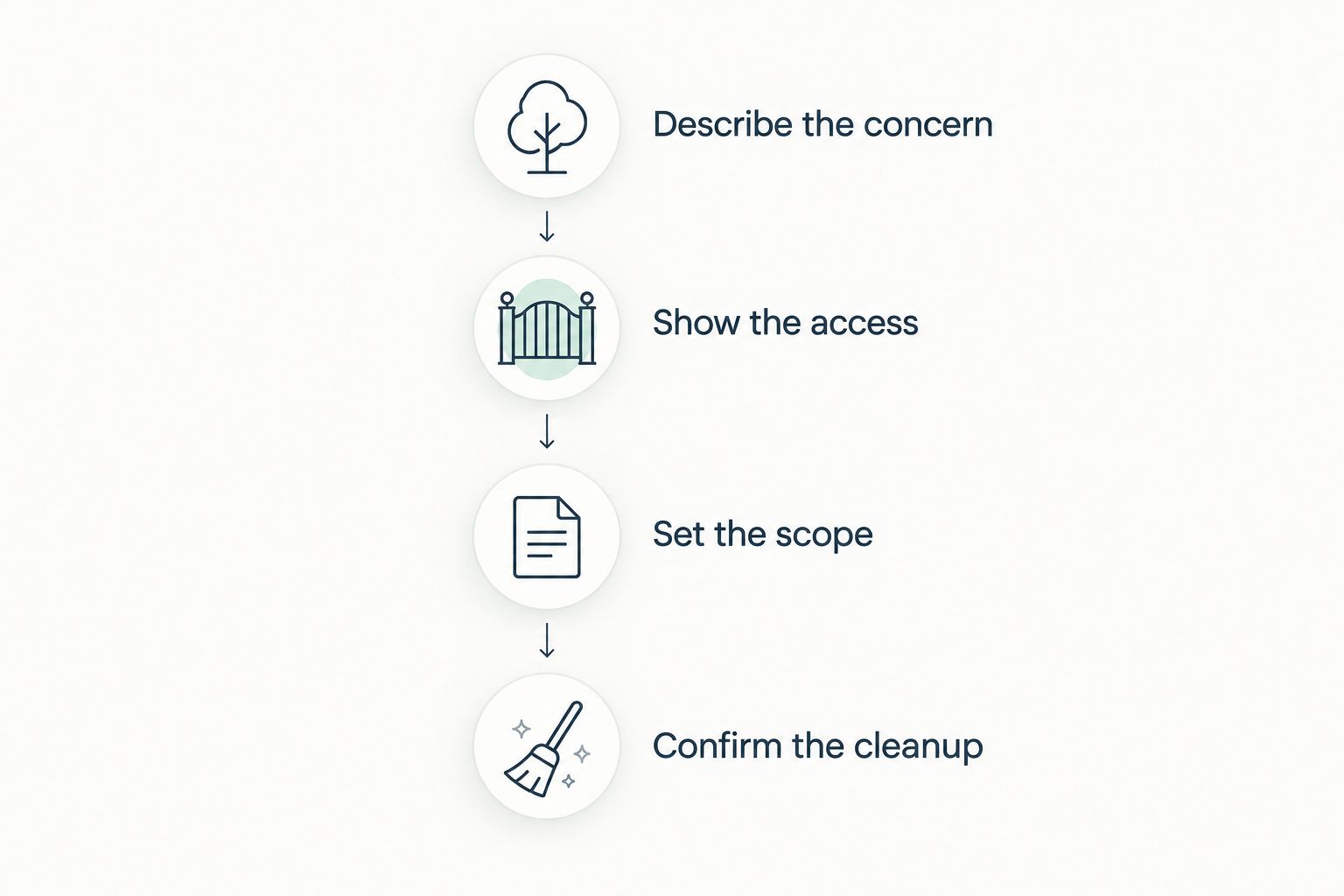
Use these 4 steps to make the site visit productive. You do not need to diagnose the tree yourself; you need to explain the concern and the result you want.
- Describe the concern. Say what changed, where the tree stands, and whether it threatens anything nearby. Take photos only from a safe position.
- Show the access. Identify gates, driveways, slopes, gardens, and any property boundary that affects the work area.
- Set the scope. Discuss pruning or removal, stump grinding, hauling, and what should remain on the property.
- Confirm the cleanup. Ask what the crew will remove and what condition you should expect at completion.
Before approving work, request evidence of insurance and a written description of the job. Ask who you will speak with if the plan changes on site. Direct communication matters most when the person explaining the job understands what the crew is expected to leave behind.
Spartan Tree and Landscape is best for Rochester-area homeowners seeking tree removal and related tree care services. For a 2026 estimate, ask Spartan Tree and Landscape to explain the removal approach, cleanup scope, and how you will communicate directly with the crew.
Request an individual tree estimate
Describe your tree, access restrictions, and cleanup needs for a property-specific discussion.
Does tree removal include stump grinding?
Tree removal and stump grinding are separate tasks, so the written estimate needs to say whether both are included. Also confirm who handles the grinding material and whether finishing the area is part of the work.
Can a tree service tell me whether removal is necessary?
A tree service can assess the tree and explain whether pruning, monitoring, or removal addresses the concern. Ask what observed condition supports the recommendation; a decision about a specific tree should follow an inspection, not a generic rule.
What should I ask before scheduling the crew?
Ask these 3 questions: What is being removed, what stays, and what will the cleanup include? Then confirm access arrangements and who can authorize a change if the crew finds something that affects the agreed work.
FAQ
What does a tree service do besides cutting trees down?
A tree service can prune branches, grind stumps, plant trees, mulch root areas, and address storm damage. Confirm which services apply to your property and which tasks appear in the written estimate.
How do I choose a tree service in Rochester, NY?
Choose a tree service that explains the proposed work, provides evidence of insurance, and puts the scope in writing. Compare cleanup, stump work, access arrangements, and communication rather than treating every removal estimate as the same job.
Is tree trimming better than removing the tree?
Tree trimming is the better fit when specific branch work addresses the concern and retaining the tree is appropriate. Removal addresses a different problem; have the tree inspected before choosing between them.
Will a tree service take away all the wood?
Wood hauling depends on the agreed scope. State whether you want logs, brush, chips, and stump-grinding material removed or left in a designated place.
Does Spartan Tree and Landscape provide emergency tree service?
Spartan Tree and Landscape provides 24/7 emergency tree services in the Rochester, NY area. Keep away from unstable trees and contact the utility when power lines are involved.
Can I get a tree removal estimate from photos?
Photos help describe the job, but an individual estimate needs to account for tree condition, access, nearby structures, and cleanup. Do not use a photo-based assumption as a substitute for an agreed scope.
One last thing
Before you approve a 2026 tree job, describe the finished yard rather than just the cutting. Say whether you expect an empty stump area, logs kept for your own use, or all brush hauled away. That conversation makes cleanup concrete and gives the crew a clear endpoint.