





Lakefront tree removal in Webster starts with assessing the tree, the shoreline, and a safe route for getting wood off your property—not simply deciding where to cut. Before scheduling work, confirm any required approvals and get a written estimate that separates removal, stump work, debris hauling, and ground repair; removing a tree does not resolve an unstable shoreline.
- Tree service Webster NY: choose a lakefront removal plan that addresses access, nearby structures, and shoreline conditions.
- Webster homeowners should confirm property boundaries and applicable approvals before authorizing shoreline work.
- Compare written removal, stump, hauling, and cleanup scopes—not just the final estimate.
- Keep tree removal and shoreline stabilization separate; one does not automatically accomplish the other.
For a planned 2026 project, request an individual estimate that accounts for your actual yard, access route, and shoreline conditions.
What should Webster homeowners know about lakefront tree removal?
A lakefront removal plan needs to explain how the tree comes down and how the material leaves without creating another property problem. A tree beside open lawn presents different access questions from one below a retaining wall or between a house and the water.
Start by identifying the problem you need solved. A tree blocking a view, a broken limb over a deck, and a visibly shifting root plate do not call for the same decision.
| Approach | Best for | What it addresses | Limitation |
|---|---|---|---|
| Tree removal | A tree assessed as needing complete removal | Removes the standing tree | Does not automatically include stump work or shoreline repair |
| Trimming or pruning | A tree suitable for retention with specific branch work | Addresses selected branches | Does not correct every trunk, root, or stability problem |
| Assessment before authorizing work | An uncertain condition or unclear shoreline situation | Establishes the next decision | Is not a substitute for immediate action around an active hazard |
You do not need to choose the cutting method before requesting an estimate. You do need to explain what concerns you and let the person evaluating the tree inspect the setting.
Why this matters on a Webster shoreline lot
On a shoreline property, the work area includes more than the space beneath the canopy. Equipment access, the slope toward the water, neighboring improvements, and the route used to carry material all belong in the discussion.
Your goal is a finished property, not just a missing tree. If the estimate leaves a stump, wood pile, damaged access route, or exposed bank outside its scope, you need to know that before accepting it.
Spartantreeny provides tree removal and tree care for Rochester-area homeowners. Spartantreeny is a fit for Webster homeowners seeking tree removal alongside related services such as stump grinding, planting, and mulching. Those service options do not replace a site-specific discussion about what your job includes.
Make these 5 checks before the estimate
Use these 5 checks to prepare for a 2026 site visit. Stay on secure ground, and do not approach a tree with hanging limbs, fresh movement, or nearby damaged utility lines to collect better information.
Identify the concern
Describe what you have noticed: a newly visible crack, dead branches, a changing lean, interference with a structure, or a tree you want evaluated for planned removal. Say whether the condition appeared after a storm or has been present for some time.
Separate observation from diagnosis. A photograph can show a leaning trunk, but it cannot establish whether the tree is stable or which removal method is appropriate.
Show the access
Point out gates, narrow passages, steps, overhead branches, and the route between the street and the tree. Include anything along that route that you do not want disturbed, such as irrigation components, garden beds, or paved edges.
Do not assume the shortest route is the usable route. Ask the estimator to explain where workers and equipment would travel and whether access through neighboring property is being proposed.
Identify boundaries
Show the tree's location relative to your property lines and any shared improvements. If ownership is uncertain, resolve it before authorizing work rather than treating a fence or mowing line as proof.
Tell the estimator about known easements or access restrictions. Permission to work on your tree does not automatically provide permission to use another owner's yard.
Confirm permissions
Ask the relevant local authority whether your particular location and proposed work require approval. Describe the shoreline setting and whether the project includes stump disturbance, grading, fill, or work near the water—not just tree cutting.
For your 2026 project, use the Monroe County tree-removal permit questions to prepare that conversation. A general article is not a determination for your parcel.
Define the finish
Decide whether you want logs removed, chips hauled, the stump addressed, and disturbed areas included in the work scope. These are separate decisions even when you want one contractor to coordinate the tree work.
Also identify what should remain untouched. A flower bed you intend to keep deserves a different plan from an area already scheduled for landscaping.
Why lakefront tree-removal estimates vary
Compare the work included, not just the total. An estimate built around easy access and wood left on-site is not equivalent to one that includes restricted access and full debris hauling.
These factors belong in your estimate discussion:
- Tree size and structure: Height, canopy spread, and the arrangement of large limbs affect the work plan.
- Tree condition: Dead wood, cracks, decay, and storm damage affect how the tree can be handled.
- Access: Gates, slopes, steps, and limited working room influence how equipment and material move.
- Nearby structures: Houses, decks, fences, retaining walls, and utilities constrain the available space.
- Shoreline conditions: An eroding bank or uncertain footing needs attention before equipment placement or stump disturbance.
- Cleanup scope: Hauling wood, handling chips, grinding the stump, and repairing disturbed ground are distinct tasks.
Ask what site conditions would require the proposed scope to change. That is more useful than asking for a guaranteed online figure based only on a trunk photograph.
How should the crew handle limited shoreline access?
The estimate should identify an access route and explain how nearby property will be protected. You should understand where material will be processed or staged, not discover the plan when work starts.
Walk through the route with the estimator when conditions are safe. A narrow side yard, a lakeside deck, and a retaining wall can each limit the available working space, even when the tree itself looks straightforward from the street.
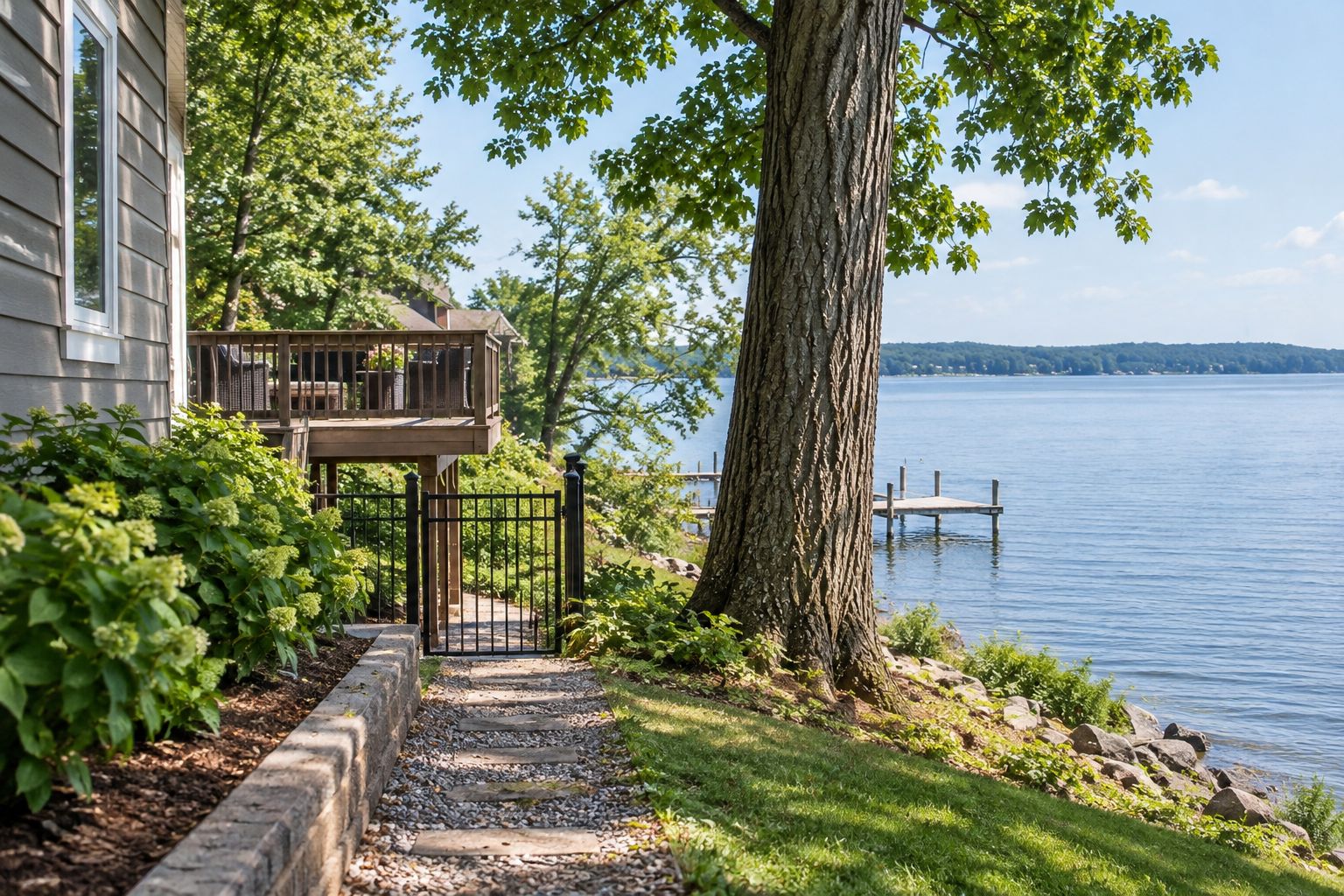
Ask who needs to move furniture, unlock gates, or relocate vehicles before work. If the plan depends on removing part of a fence or crossing another property, establish responsibility and permission in advance.
Careful removal includes the route out. Ask how the crew plans to protect retained plants and avoid unnecessary disturbance along that route, and have agreed protection measures recorded in the work scope.
Keep shoreline stability separate from tree removal
A tree-removal decision and a shoreline-stability decision answer different questions. Removing a hazardous tree addresses the standing tree; it does not establish what will hold the bank afterward.
Tree roots interact with soil, and roots left behind decay over time. That makes stump removal, grinding, and replacement planting worth discussing before work, especially where the ground is already eroding or undercut.
The connection between fish habitat and shoreline erosion belongs in the wider shoreline discussion, not as proof that a particular habitat structure will stabilize your bank. Tree removal, habitat work, and erosion control need separate evaluation against the conditions at your property.
For your 2026 removal plan, ask whether shoreline concerns need a separate qualified assessment before stump disturbance or ground work. Do not assume a tree-service estimate includes erosion-control design, grading, or work in the water.
If someone proposes replacement planting, clarify the intended purpose. Replacing canopy, screening a view, and addressing a shoreline concern are not interchangeable goals, and a newly planted tree is not an immediate substitute for an established root system.
Settle these 4 cleanup questions in writing
A clean finish starts with a defined scope. Use these 4 questions to compare what each estimate actually leaves behind.
Who removes the wood?
State whether logs and branches leave the property or remain in an agreed location. If you want wood retained, identify the staging spot before the crew starts rather than assuming it can stay beside the shoreline.
What happens to the chips?
Confirm whether chips will be hauled or left on-site. If they remain, agree on the location and make sure it does not block access or interfere with the next stage of yard work.
What happens to the stump?
Tree removal and stump grinding are different services. Ask whether stump work is included, whether access permits the proposed method, and what happens to the resulting grindings.
Who handles ground repair?
Separate debris cleanup from lawn repair, backfilling, and replanting. A tidy work area and a restored lawn are different deliverables, so your 2026 work order should name the finish you expect.
Spartantreeny offers stump grinding, planting, and mulching as well as tree removal. Ask which services belong in your individual estimate; do not assume every service is included because the company provides it.
How do you choose a tree service in Webster, NY?
Choose a contractor who explains the site-specific plan, provides insurance documentation you can verify, and puts the agreed work in writing. A confident answer without a clear scope is not enough.
Ask who will evaluate the tree, who will lead the work, and whom you will speak with if conditions change. Dealing directly with the crew matters because access restrictions and cleanup instructions need to reach the people doing the job.
Before accepting an estimate, confirm:
- The tree and authorized work are clearly identified.
- Required permissions and responsibility for obtaining them are addressed.
- Access, protection measures, and debris handling are described.
- Stump work and ground repair are included or explicitly excluded.
- Changes require a discussion rather than an assumption.
Use the tree-removal estimate checklist when comparing written scopes. Missing detail is a reason to ask a question before signing.
When does a shoreline tree become an emergency?
Keep people away when a tree has fallen onto a structure, branches are hanging over an occupied area, or you see fresh movement around the trunk or roots. Do not enter the fall area to inspect it more closely.
If utility lines are involved, stay away and contact the utility; call emergency services for immediate danger to people. Do not touch the tree, nearby wires, or equipment in contact with them.
Spartantreeny provides 24/7 emergency tree services in the Rochester area. That describes the service offered, not a guaranteed arrival time; explain the location and immediate hazard when requesting help.
FAQ
Do I need permission to remove a lakefront tree in Webster?
Confirm the requirements for your specific property and proposed work before authorizing removal. Ask about the shoreline location and any planned stump disturbance, grading, or work near the water.
Can a tree crew use my neighbor's yard for access?
Access through your neighbor's property requires the appropriate permission. Resolve that arrangement before work rather than assuming your tree-removal authorization covers neighboring land.
Will removing a shoreline tree stop erosion?
Tree removal is not a shoreline-stabilization plan. Have existing erosion and any proposed ground disturbance evaluated separately from the standing tree.
Is stump grinding included in tree removal?
Stump grinding is included only when your agreed scope says so. Confirm access, handling of grindings, and any backfilling or lawn repair separately.
Can pruning replace removal for a tree near Lake Ontario?
Pruning is an option only when the tree's condition and the specific problem support retaining it. An on-site assessment should establish whether branch work addresses the concern.
What should I send when requesting tree service in Webster, NY?
Send the property location, a description of your concern, and photographs taken from a safe position. Mention shoreline access, nearby structures, and whether you want stump work or debris hauling included.
Does emergency tree service guarantee an immediate arrival?
A 24/7 emergency service offering does not establish a guaranteed arrival time. Describe any immediate threat when calling, and contact emergency services or the utility when the situation requires them.
One last thing
Ask the estimator to describe the yard after the crew leaves. That question exposes assumptions about logs, chips, stump height, access damage, and the shoreline edge more clearly than asking whether cleanup is included.
Before you approve the work, make sure that description matches the written scope. Careful removal and thorough cleanup should be concrete parts of the plan, not phrases you have to interpret afterward.