





Your tree trimming cost in Rochester, Webster, or eastern Monroe County depends on the branches being removed, the access needed to reach them, and the cleanup included—not a reliable flat rate based on tree size alone. For a useful 2026 estimate, have the crew assess the tree and put the work scope in writing, including whether brush removal, wood handling, and any separate removal work are included.
- Tree trimming cost depends on branch work, access, nearby structures, and cleanup—not height alone.
- Spartan Tree and Landscape serves Rochester-area homeowners seeking tree trimming and other tree care services.
- Compare written pruning scopes before comparing quotes; different work is not a fair price comparison.
- Ask for a separate removal assessment when the concern involves the trunk, roots, or the whole tree.
Why this matters
A quote for cutting back branches is not automatically a quote for solving the problem that brought you outside. Branches over your roof, a crowded canopy, and a damaged limb need different assessments. Describe the problem first, then ask what work addresses it.
The same practical issues appear in why tree removal quotes vary: size, access, and cleanup. Trimming and removal are different jobs, but both depend on how the crew reaches the work and handles the material afterward.
Compare the work before you compare the total. A shorter quote is not necessarily a simpler job, and a longer quote is not necessarily more thorough.
How much does tree trimming cost?
Tree trimming cost is specific to the tree and the property. For a 2026 Rochester-area project, request an individual estimate that identifies the pruning objective, access conditions, branch handling, and cleanup. A general online figure cannot account for a limb over your garage or a narrow route into your backyard.
Use the breakdown below to check what an estimate actually covers. These are work categories, not interchangeable service packages.
| Work scope | Best for | What the estimate should explain | Main limitation |
|---|---|---|---|
| Targeted branch pruning | Addressing identified branches or clearance concerns | Which branches or areas need attention and why | Does not establish that the rest of the tree is sound |
| Broader canopy pruning | Addressing branch structure across the crown | The pruning objective and how much live growth the crew intends to retain | More cutting is not automatically better tree care |
| Storm-damaged branch work | Assessing broken or hanging limbs | Immediate hazards, remaining damage, and safe access | Removing visible damage does not resolve every structural concern |
| Whole-tree removal assessment | Evaluating concerns involving the entire tree | Whether pruning can address the problem or removal needs consideration | Removal is a different scope from trimming |
If two estimates describe different rows in this table, they are not competing offers for the same work. Ask each crew to explain the difference before making a decision.
Targeted branch pruning: define the problem
Targeted pruning starts with a specific concern: a dead branch, limbs rubbing against each other, or growth interfering with a structure. Tell the estimator what you see from the ground. Let the crew determine the appropriate cuts.
The advantage is a clear work scope that you can discuss and compare. The limitation is equally important: cutting an unwanted branch does not establish the condition of the trunk, roots, or remaining canopy.
Ask the estimator to identify the intended work during the walk-through. A written description such as pruning for roof clearance is more useful than an unexplained promise to trim the tree.
Broader canopy pruning: ask what each cut achieves
Broader pruning needs a purpose beyond making the tree look smaller. Ask whether the objective is removing dead branches, improving branch structure, or providing clearance. Those objectives should guide the work.
The benefit is an assessment of more than one isolated limb. The trade-off is that an open-ended instruction to cut it back leaves too much room for different interpretations. Do not use the amount of brush on the ground as your measure of a good pruning job.
For your 2026 estimate, ask the crew to explain the intended result in plain language. You should understand what will change and what will remain.
Storm-damaged branches: separate urgency from routine work
A broken or hanging limb is not the same estimating situation as planned maintenance. Keep people away from the area beneath it, and describe the damage without approaching it for a better photo. If electrical lines are involved, stay clear and contact the utility.
The immediate task is identifying and addressing the hazard. Routine shaping or other nonurgent pruning belongs in a clearly separated scope, so you understand which work addresses the damage and which work is optional maintenance.
Do not climb the tree, shake a hanging limb loose, or stand beneath damage while waiting for an assessment. A photograph is not worth entering the fall area.
Why tree trimming cost varies
The work changes when the tree, property, or cleanup requirements change. These factors give you a practical way to question a quote without pretending that every branch has a fixed rate.
- Tree size and branch position. Height matters alongside where the branches sit and how the crew can reach them. A branch extending over a building presents a different task from one above open ground.
- Access. Gates, fences, slopes, and the route from the street to the tree affect equipment access and material handling. Show the estimator the actual route, not just the tree.
- Nearby structures. Roofs, sheds, decks, fences, and neighboring property affect where branches can be lowered. Identify anything that must remain protected beneath or beside the work.
- Branch condition. Dead, broken, or suspended branches require assessment before work starts. Explain recent damage or changes you have noticed without trying to diagnose the tree yourself.
- Pruning scope. Removing selected branches and working throughout a canopy are different assignments. The estimate should explain the objective rather than rely on the word trimming alone.
- Cleanup scope. Brush hauling, larger wood handling, and the final condition of the work area belong in the discussion. Do not assume every estimate includes the same material removal.
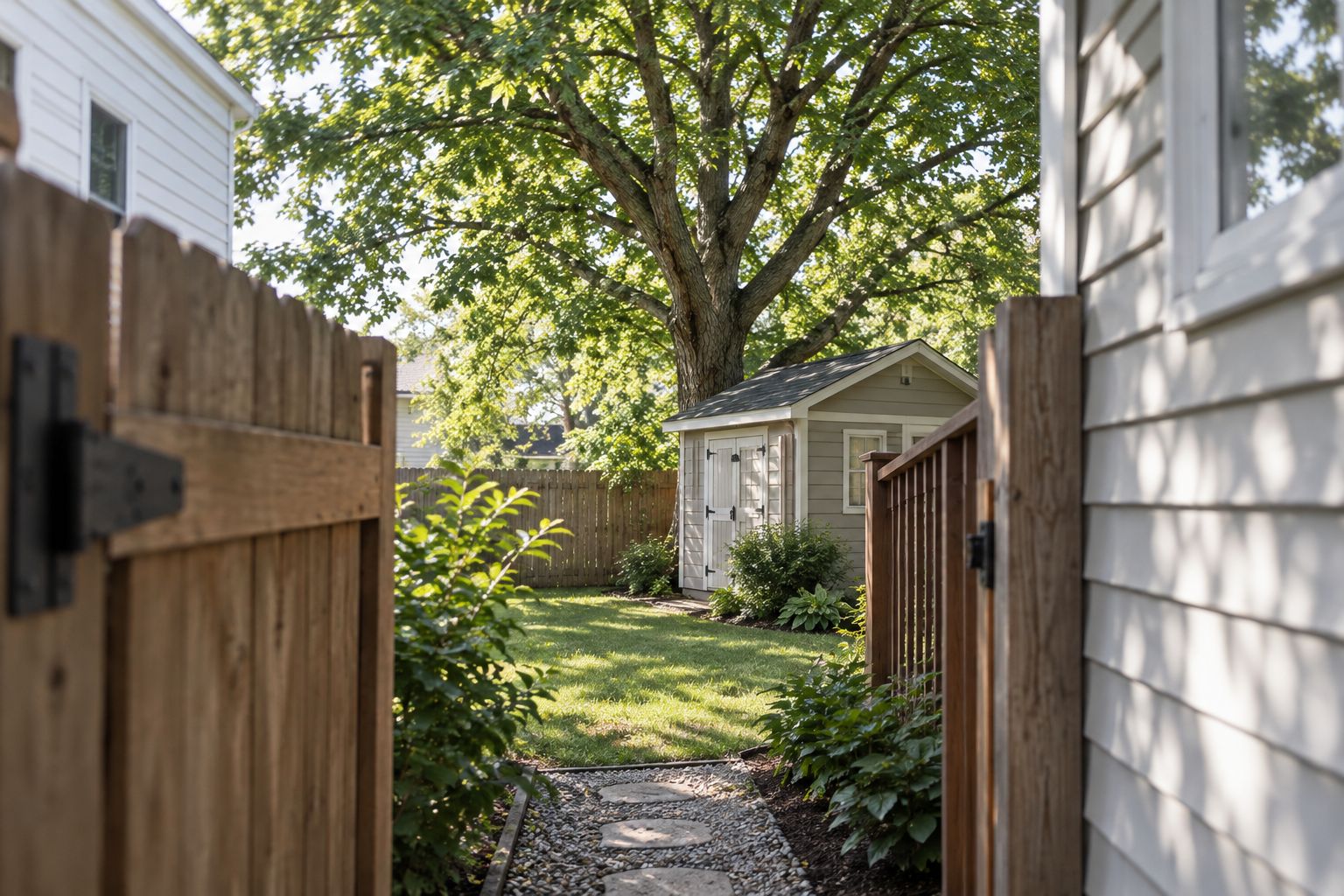
A backyard with a narrow gate and a shed beneath the canopy illustrates why access deserves its own conversation. The tree is only part of the job; the route in and the space below also matter.
How do you get a useful tree trimming estimate?
A useful estimate starts with a useful walk-through. You do not need technical vocabulary, and you do not need to decide which equipment the crew should use. Explain the concern and make the property conditions clear.
- Name the concern. Point out the branches, clearance issue, or damage that prompted your request. Explain whether you want maintenance or need a problem assessed.
- Show the access. Walk through the route the crew would use. Mention gates, steps, fences, landscaping, and anything else that limits movement.
- Identify nearby property. Point out roofs, sheds, decks, parked vehicles, and neighboring structures. Mention anything beneath the canopy that is easy to miss.
- Agree on cleanup. Ask what happens to brush and larger wood. State whether you want material left on the property or removed, then have that agreement written down.
- Confirm the written scope. Check that the estimate identifies the tree, the intended work, and the cleanup. Ask how additional work would be discussed before it begins.
For a 2026 project in Webster or eastern Monroe County, include your location when requesting the visit. Photos taken from a safe position help explain the concern, but they do not show every access restriction or establish the tree's condition.
Ask who will answer questions on the workday and how you will review the scope with the crew. Direct communication matters most when an instruction could mean different things, such as clearing a roof without removing every branch on that side.
What should you compare besides the quoted total?
Put the written estimates side by side. Check whether they address the same tree, the same pruning objective, and the same cleanup. If one description is vague, ask for clarification rather than filling in the blanks yourself.
Before you hire, ask for evidence of current insurance and confirm who is responsible for the work. A written estimate and an insurance conversation answer different questions; neither replaces the other. Keep the discussion practical and specific to your property.
Ask how the crew plans to protect nearby structures and handle branches in confined areas. You do not need to approve a rigging method, but you should understand how the work accounts for the roof, fence, or planting bed beneath it.
Spartan Tree and Landscape is best for Rochester-area homeowners seeking local tree trimming and tree care services. When discussing your estimate, focus on careful branch handling, thorough cleanup, and direct communication with the crew—not an unspecified promise to make the tree look better.
The limit of any trimming quote is its scope. It should not be treated as a promise that a tree has no other defects or will never lose another branch.
Is trimming enough, or should you consider removal?
Trimming addresses branches; it does not automatically resolve concerns involving the whole tree. If you have noticed a changed lean, trunk damage, or disturbance around the base, explain that before agreeing to branch work. Ask whether the tree needs a removal assessment instead.
Pruning and removal also leave different results. Pruning retains the tree, while removal eliminates it and creates separate decisions about the stump and site. Neither should be recommended solely because it produces a larger or smaller quote.
For planned work in 2026, settle that basic decision before comparing contractors. There is little value in comparing a maintenance-pruning estimate with a removal estimate as though they solve the same problem.
Does cleanup belong in the written estimate?
Cleanup belongs in the written estimate because cutting branches and removing the resulting material are distinct tasks. Ask what will be hauled away, what will remain, and how the crew will leave the work area. Plain language is enough.
If you want larger wood retained, discuss where it will go. If you want everything removed, state that clearly. Do not wait until the branches are down to discover that you and the crew pictured different outcomes.
Photograph sensitive areas before work begins and discuss them during the walk-through. That gives you a concrete starting point for talking about lawn access, planting beds, and cleanup expectations.
FAQ
What's the best way to find out my tree trimming cost in Rochester?
Request an individual estimate that identifies the tree, pruning objective, access conditions, and cleanup. Compare written scopes rather than treating a general online figure as a quote for your property.
Does a taller tree always mean a bigger trimming job?
Height alone does not define the trimming job. Branch position, nearby structures, access, and the amount of work also affect what the crew needs to do.
Is tree trimming the same as tree removal?
Tree trimming removes selected branches, while tree removal takes down the tree. If the concern involves the trunk, roots, or whole-tree stability, ask for an assessment before choosing branch work.
Does a tree trimming estimate include hauling away branches?
Only treat hauling as included when the written estimate says so. Ask separately about brush, larger wood, and the final condition of the work area.
Can I get an accurate estimate from a photo?
A photo can show the visible concern but cannot establish every site condition. Share pictures taken from a safe position and arrange for the crew to assess access and the proposed work.
Can I ask Spartan Tree and Landscape about trimming and removal?
Spartan Tree and Landscape provides tree trimming and removal services in the Rochester, NY area. Explain the concern so the estimate discussion addresses the right type of work.
Should I wait for a regular estimate if a branch is hanging over my driveway?
Keep people and vehicles away from beneath a hanging branch and request a hazard assessment. Stay clear of any involved electrical lines and contact the utility rather than approaching the damage.
One last thing
Ask the estimator to point out what will stay, not just what will be cut. That question makes an otherwise vague trimming discussion concrete: which canopy remains, what clearance changes, and whether the result matches your goal.
For your 2026 project, carry that answer into the written scope. A clear agreement before the work starts is more useful than trying to reconstruct the conversation after the branches are gone.