





The cost to plant a tree in Rochester depends on the tree you choose, access to the planting spot, and the work included in the estimate—not just digging a hole. For your 2026 project, request a written, property-specific estimate that separates the tree, installation, and any site preparation. Confirm whether delivery, mulch, cleanup, and removal of an existing tree or stump are included before comparing totals.
- The cost to plant a tree in Rochester depends on tree size, access, site preparation, and installation scope.
- Compare written estimates for the same tree size and planting work, not totals alone.
- Spartantreeny provides tree planting services for Rochester-area homeowners; request a property-specific estimate.
- Keep removal, stump grinding, planting, and cleanup clearly separated in your project scope.
Why this matters
A tree purchase and a finished planting job are different things. Your estimate needs to explain how the tree gets into the yard, what happens at the planting spot, and what the crew leaves behind.
For a home in Rochester, Webster, or eastern Monroe County, start with your actual property—not a nationwide planting average. You can request an individual estimate with photographs of the planting location and the route into the yard.
A useful 2026 planting budget also accounts for work that happens before installation. Replacing a removed tree, opening access through a fence, and preparing a clear lawn are different jobs. Make those differences visible before you agree to the work.
How much does it cost to plant a tree in Rochester?
Your Rochester tree planting cost is the total for the selected tree, getting it to the site, preparing the location, installing it, and finishing the work you requested. Ask for those items in writing so you know what the total covers.
Use this breakdown when reviewing an estimate. Each line should be included, excluded, or marked as a separate item—not left to assumption.
| Estimate item | What to confirm | Why it affects the scope |
|---|---|---|
| Tree selection | Species, nursery size, and root-ball or container size | Different trees require different handling and planting space |
| Delivery | Who supplies and transports the tree | Purchasing a tree does not define delivery arrangements |
| Access and handling | Gate opening, slope, obstacles, and equipment route | The route determines how the tree reaches the planting spot |
| Site preparation | Existing stump, buried debris, compacted ground, or unwanted vegetation | The location needs to be suitable before planting |
| Installation | Placement, planting depth, backfill, and initial watering | These define the actual planting work |
| Finishing work | Mulch, debris disposal, and lawn repair | Cleanup and restoration need a defined endpoint |
| Aftercare | Watering instructions and responsibility after installation | Establishment continues after the crew leaves |
For your 2026 estimate, ask whether changing the tree size or location changes the quoted scope. Do not assume a substitution is equivalent just because the species stays the same.
Compare tree sizes before comparing estimates
A smaller tree and a larger tree serve different priorities. Neither is automatically the right choice for every Rochester yard.
| Planting option | Best for | Practical advantage | Trade-off to consider |
|---|---|---|---|
| Smaller nursery tree | Homeowners comfortable waiting for landscape growth | Easier physical handling and placement | Less immediate screening or shade |
| Larger nursery tree | Homeowners prioritizing a stronger immediate landscape presence | More size on installation day | Heavier root ball and more demanding access and handling |
Compare like with like. Ask each estimator to identify the nursery size rather than describing the tree only as small, medium, or large.
Smaller nursery trees: check what installation includes
A smaller nursery tree suits a homeowner who can wait for the landscape to fill in. It also makes sense to discuss when access is narrow, although the actual tree and route still need assessment.
The trade-off is straightforward: a smaller tree does not provide the same immediate presence as a larger specimen. Do not choose it expecting instant privacy across a wide opening.
Ask whether the planting estimate includes transporting the tree to its final location, removing packaging appropriately, setting the root flare correctly, watering, and mulching. A smaller tree still needs correct installation. Its size is not a reason to skip the details.
Larger nursery trees: confirm the handling plan
A larger nursery tree suits homeowners who want more immediate height or screening. The added size also brings a heavier root ball that needs a workable route to the planting location.
Before choosing the tree, show the estimator gates, steps, retaining walls, overhead branches, and nearby structures. Discuss the route first; selecting a tree that cannot reach the intended spot creates an avoidable problem.
Ask what equipment or handling method the job requires and whether lawn protection or restoration is included. A larger tree is only a useful upgrade when the site can accommodate it. Mature size matters too, especially near your house, driveway, or neighboring property.
Why tree planting costs vary in Rochester
These factors belong in the estimate conversation because they change the work—not because every yard needs extra services.
- Tree size and root ball. Height alone does not describe what the crew must move. Ask how the nursery measures the selected tree and what arrives with it.
- Access. A straight route across open lawn differs from a fenced backyard with steps. Show the narrowest point, not just the open space around the planting location.
- Ground conditions. Compaction, drainage, buried debris, and existing roots affect whether a location is suitable and what preparation it needs.
- Nearby structures and utilities. Buildings, pavement, overhead lines, and buried services constrain placement and digging. Resolve conflicts before installation.
- Existing tree or stump work. Removal and stump grinding are separate tasks from planting. State clearly whether either is part of the project.
- Cleanup and finishing. Soil disposal, mulch, packaging removal, and lawn repair should have a stated scope. Do not assume every estimate includes the same finish.
For a 2026 comparison, send each company the same photographs and project description. If one estimate includes preparation and cleanup while another covers installation alone, the totals are not directly comparable.
How do I prepare for a tree planting estimate?
Give the estimator enough information to discuss the whole job. You do not need to diagnose soil problems or choose equipment yourself.
- Explain the goal. Say whether you want shade, privacy, flowers, or a replacement for a removed tree. Include what you want to screen or protect.
- Show the location. Photograph the planting spot from different directions. Include nearby buildings, pavement, fences, and existing trees.
- Show the access route. Photograph the route from the driveway or street to the planting spot. Measure the narrowest gate opening in inches.
- Describe existing work. Mention a stump, recent removal, construction activity, or ground that stays wet. Do not hide an obstacle behind a close-up photograph.
- Define the finish. State whether you want debris removed, mulch installed, or disturbed lawn addressed. Ask what remains your responsibility afterward.
Spartantreeny is a fit for Rochester homeowners seeking tree planting alongside removal, stump grinding, or mulching. Discuss the complete project directly with the crew, including careful work around existing features and thorough cleanup. Those service categories do not establish what is included in your particular planting estimate; the written scope should do that.
Request a tree planting estimate
Share your planting location, access details, and any removal or stump work needed.
Does planting after tree removal cost more?
Planting after removal involves a different scope when stump work, debris removal, or ground preparation is also required. Ask for those tasks separately so you can see what belongs to removal and what belongs to planting.
A ground stump does not automatically leave a ready-made planting hole. Wood chips, remaining roots, and the condition of the surrounding soil still need consideration before you select the new location.
If your 2026 project starts with removal, settle the replacement plan before the cleanup scope is finalized. The guide to stump grinding costs in Rochester explains the separate work to discuss with your estimator.
Do not insist on the exact old trunk location without a site assessment. A nearby suitable location can be a better planting choice than forcing a new root ball into the remains of the old one.
What should a finished planting job include?
A finished planting job should match the written scope and leave you with clear care instructions. Start with placement and planting depth, then check mulch, cleanup, and watering responsibilities.
The root flare—the widening area where the trunk meets the main roots—should remain visible rather than buried under soil or mulch. Standard planting guidance calls for a broad planting hole, commonly 2–3 times the root ball's width, rather than a deep hole that buries the trunk.
For mulch, a typical layer is 2–3 inches deep, kept away from direct contact with the trunk. A mulch ring 3 feet across is a useful starting point for a small landscape tree, with room to expand as the tree grows. Do not pile mulch against the bark.
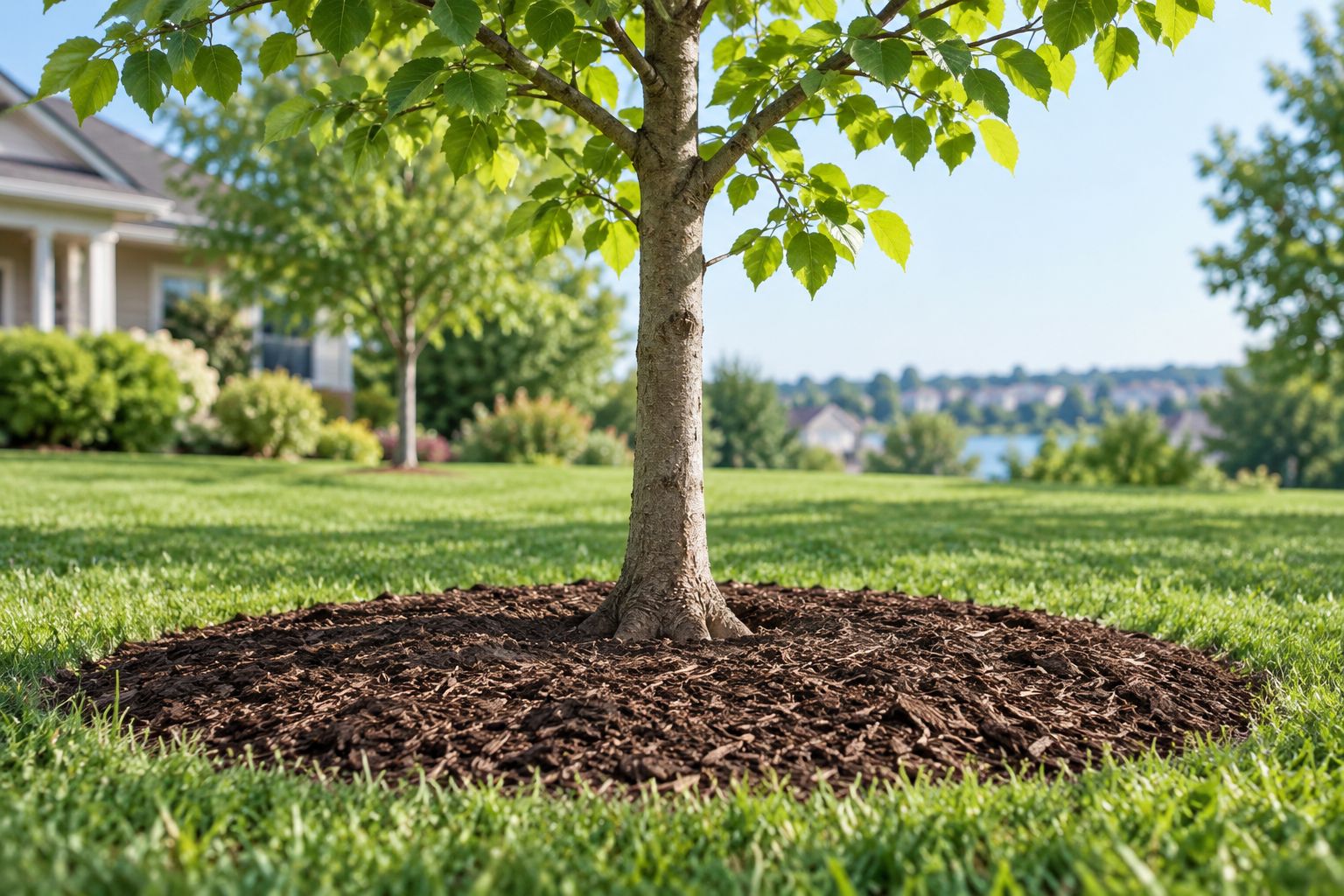
Before the crew leaves, ask how to check soil moisture and adjust watering for weather and drainage. A fixed watering calendar is not a substitute for checking the root zone.
For a 2026 installation, keep the written estimate and care instructions together. Record the species and nursery size as well. That gives you a clear reference if questions arise about the agreed work or ongoing care.
Is buying the tree myself a better option?
Buying the tree yourself gives you control over the nursery selection, but it also separates purchasing from installation. Confirm who handles transport, unloading, inspection, and any problem with the selected tree before arranging delivery.
Having one provider arrange supply and installation keeps those responsibilities in one scope, if that arrangement is offered. The limitation is that you still need the tree specification in writing; a single total does not tell you what is being planted.
Choose the arrangement with clear responsibility, not the fewest lines on the estimate. If you buy first and ask about installation afterward, you have already committed to a tree before confirming access and site suitability.
FAQ
How much does it cost to plant a tree in Rochester in 2026?
The cost to plant a tree in Rochester depends on the selected tree, access, site preparation, installation, and finishing work. Request a written estimate for your property and confirm which tasks the total includes.
Does a tree planting estimate include the tree itself?
Do not assume a tree planting estimate includes the tree itself. Ask whether the estimate covers supply, delivery, installation, mulch, and cleanup, or installation only.
Can Spartantreeny help with planting after tree removal?
Spartantreeny provides tree planting, removal, and stump grinding services in the Rochester area. Request a combined project assessment and ask for the preparation and planting tasks to be clearly separated.
Can I plant a new tree directly over a ground stump?
Do not assume a ground stump location is ready for a new tree. Remaining roots, wood chips, and soil conditions need assessment before choosing the planting spot.
Is a bigger tree always the better choice?
A bigger tree is not always the better choice. It provides more immediate size but requires more demanding handling and access; mature dimensions and site suitability still matter.
How deep should mulch be around a newly planted tree?
A typical mulch layer around a newly planted tree is 2–3 inches deep. Keep mulch away from the trunk and leave the root flare visible.
What should I send when asking for a planting estimate in Webster?
Send photographs of the planting location, the access route, and nearby structures or obstacles. Include the gate opening, your planting goal, and whether removal, stump work, mulch, or lawn repair is part of the request.
One last thing
Choose the planting location before you commit to the tree. The spot determines the available growing space, access requirements, and preparation work. A tree that looks right at the nursery still needs to fit your property when it matures.
Walk the route from the driveway to the planting spot before requesting the estimate. That short check helps you ask about the actual job—not just the tree you want delivered.