





Instead of chasing HOA permission after arranging tree work, confirm the approval process, document the tree, and get an estimate that matches the association’s requirements. For planned removal in Rochester, Webster, and eastern Monroe County, get written permission before authorizing removal—not necessarily before requesting an estimate.
- For hoa approval tree removal monroe county, confirm ownership and written requirements before authorizing work.
- Spartantreeny is best for Rochester-area homeowners seeking an individual tree removal estimate.
- Ask whether your HOA needs a contractor estimate before it can approve removal.
- HOA permission and municipal requirements are separate checks; neither replaces the other.
Why this matters
An estimate describes proposed work. HOA approval authorizes only what the association has actually approved. Keep those documents separate, then make sure they describe the same tree and scope.
A removal request becomes harder to sort out when the application says one backyard tree, the estimate includes two, and the access route crosses common property. Clear descriptions prevent that mismatch before anyone schedules equipment.
For your 2026 project, start with the association’s current documents rather than a neighbor’s previous approval. The broader tree removal guide for HOAs in Monroe County provides supporting context; the workflow below focuses on getting your own request ready.
Before you start
- Gather your documents and access. Have your property address, current HOA rules, any landscape or architectural application, and the manager’s submission instructions. Use the association’s actual form or portal; do not substitute a general email if its process requires something else.
- Confirm ownership and authority. Find out whether the trunk stands on your lot, common property, or an uncertain boundary. Ask who can approve removal and whether separate permission is needed for equipment access.
- Check the estimate requirement first. Some approval processes require a contractor’s proposed scope. Ask whether you can obtain preliminary guidance now and submit the estimate afterward, rather than waiting for final approval before requesting any contractor input.
Do not approach a visibly unstable tree to collect paperwork photos. Keep people away from damaged trees and wires; contact emergency services or the utility when there is an immediate hazard.
Your HOA requirements
Establish the approval path
- Read the current rules. Look for tree removal, landscape changes, common areas, replacement planting, and contractor access. Save the version you use for your 2026 application.
- Identify the decision-maker. Ask whether the board, manager, or architectural committee issues approval. A helpful conversation with a neighbor is not a substitute for the required decision.
- Request the submission checklist. Ask about photographs, a site sketch, a contractor estimate, supporting tree-condition information, and any replacement proposal. Supply what the association requires without assuming every item is mandatory.
- Confirm how decisions arrive. Ask where approval will appear and how conditions are recorded. Keep the final written decision with your estimate.
Expected result: You know who reviews the request, what they need, and whether an estimate must come before final sign-off.
Ask directly about meeting dates and submission cutoffs. Do not build your removal schedule around an assumed review period.
Separate association permission from public requirements
HOA approval is not a municipal permit. Before authorizing removal, check the applicable requirements with your municipality, especially when ownership, public land, or a street-side tree is involved.
Use the Monroe County tree removal permit guide to frame those questions, then verify the requirements for your actual address. A Rochester mailing address alone does not establish which municipality controls the property.
Keep 2 separate checks in your project file: association authorization and applicable public requirements. Mark each with the person or office contacted, the response date, and any conditions. Do not describe the project as fully cleared until both checks are resolved.
Your tree documentation
Build a request the reviewer can identify
- Give the tree a consistent identifier. Use a plain description such as the large tree beside the rear garage. If several trees are involved, assign each a separate letter and use it throughout the request.
- Take 4 useful photos from safe ground. Include the whole tree, the trunk location, nearby structures, and the proposed access route. Photograph visible damage separately without approaching hanging limbs or touching wires.
- Prepare 1 marked site sketch. Show the house, driveway, tree, and intended equipment route. Identify uncertain boundaries as uncertain; a sketch is not a survey.
- State the reason without diagnosing. Describe what you can observe: a broken limb, a visible crack, crowding against a structure, or your planned landscape change. Ask what professional assessment the association requires rather than inventing a diagnosis.
- Describe the proposed finish. Say whether you are requesting removal alone or also asking about stump grinding, debris removal, and replacement planting.
Expected result: A reviewer and an estimator can identify the same tree without guessing from a vague backyard photograph.
The access photo deserves as much attention as the tree photo. A narrow gate, shared drive, or route beside a neighboring garage gives the crew something concrete to assess and gives the HOA a chance to flag access restrictions.
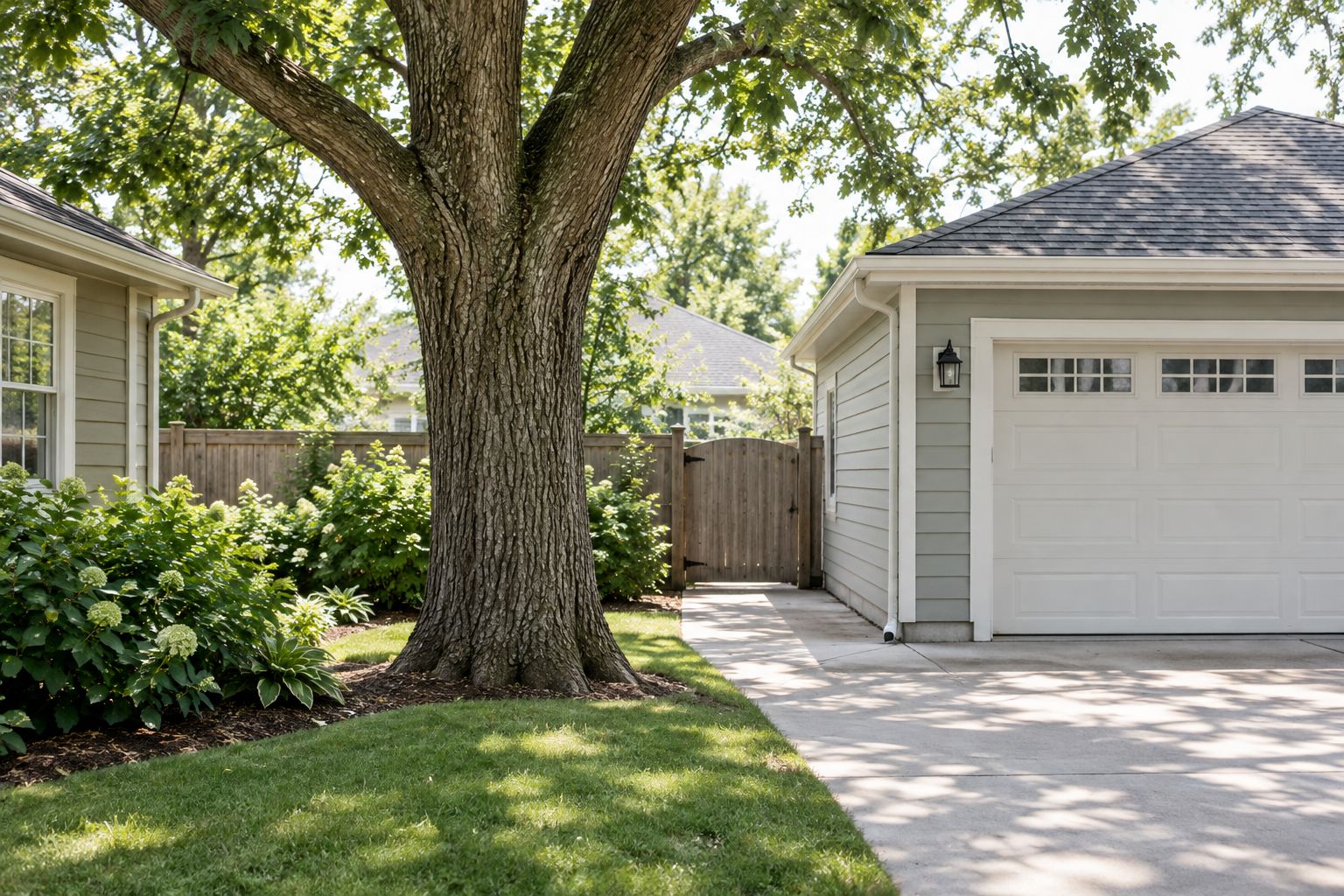
Keep the original photos and send copies with the application. If you later add a tree or change the access route, update the marked sketch instead of relying on a separate conversation to explain the difference.
Your estimate and written sign-off
Match the contractor’s scope to the application
- Explain the approval status when requesting an estimate. Say whether the HOA has approved removal, given conditional approval, or requires an estimate before deciding. Do not describe a pending application as approved.
- Walk through access with the crew. Identify gates, fences, nearby roofs, driveways, and any common property the proposed route touches. Ask what permission is needed before that route can be used.
- Separate the work items. Ask the estimate to distinguish tree removal, stump work, debris handling, and cleanup. State whether you want wood or chips left behind rather than assuming everything means the same thing to everyone.
- Submit the matching scope. Attach the estimate if required, using the same tree identifiers and site sketch. Flag any difference from the original request.
- Read the decision before authorizing work. Check the approved tree, access conditions, replacement requirements, and any stated deadline. Resolve conflicts with the estimate in writing.
Expected result: Your estimate, HOA decision, and instructions to the crew describe one agreed job.
Spartantreeny provides tree removal and related tree care in the Rochester area; its estimate does not replace HOA permission. Use the estimate conversation to discuss careful removal, thorough cleanup, and the practical limits of your yard. Ask to deal directly with the crew about access and the intended finish.
For planned 2026 work, keep the approved documents together and send the relevant conditions before scheduling. Do not leave the crew to discover an access restriction when it arrives.
Request an individual tree removal estimate
Tell Spartantreeny your tree location, access concerns, and HOA approval status.
When the HOA needs an estimate before approval
Request an estimate first when the association requires it, but keep removal authorization separate. You do not need to pretend the entire project is approved just to ask a contractor to assess it.
Tell the estimator which HOA questions remain unresolved. Ask for a clearly defined proposed scope, then submit that scope for review. Once the decision arrives, check whether its conditions change access, stump work, cleanup, or planting.
| Approval route | Best for | Advantage | Limitation |
|---|---|---|---|
| Approval before estimate | Homeowners whose association can decide from the initial request | Establishes permitted scope before detailed estimating | Does not work when the HOA requires a contractor estimate |
| Estimate before final approval | Homeowners whose association requires a proposed contractor scope | Gives reviewers specific work and access details | Conditions can require a revised estimate |
Neither route is permission to start cutting before required authorization. Choose the sequence your association actually accepts, not the one that sounds faster.
If the HOA requests changes, return the decision to the contractor rather than editing the contractor’s scope yourself. Keep the revised estimate and revised approval together so nobody works from an outdated attachment.
Troubleshooting approval problems
The manager says yes, but nothing is written down
Request confirmation through the association’s required process. Ask the authorized decision-maker to identify the approved tree and any conditions; do not turn an informal conversation into permission on the crew’s behalf.
The tree stands near a property boundary
Pause the ownership assumption. Check the relevant property documents and get professional boundary clarification when needed; neither an online map nor an HOA application establishes the legal boundary by itself.
Approval requires replacement planting
Ask for the exact planting conditions before accepting the removal scope. Clarify who selects the replacement, who performs the planting, and what documentation the association expects afterward. Do not assume stump grinding makes the same spot ready for a new tree.
The approved access route does not fit the proposed job
Send the restriction to the crew and request a revised plan. A restriction on common-area access or equipment travel changes what the estimator needs to assess; it is not a detail to settle on removal day.
Storm damage changes the situation while approval is pending
Keep people away and notify the association about the changed condition. Ask about its emergency procedure while arranging appropriate professional help; do not assume an emergency exception exists. Stay away from fallen or contacted wires and call the utility or emergency services as appropriate.
Customize your workflow
Expand the request only when the added work is clear. Removal, pruning, stump grinding, and planting need distinct descriptions, even when you want them handled as one project.
For Spartantreeny tree removal estimates, explain whether you want a removal-only assessment or also want trimming and stump work considered. That helps keep the proposed work aligned with the permission you are requesting. An individual site assessment addresses access, tree size, nearby structures, and cleanup scope without pretending an online description settles the job.
Before closing your 2026 approval file, save the final decision, accepted estimate, current sketch, and relevant correspondence. If you change the job afterward, ask whether the change needs another review.
FAQ
Do I need HOA approval before getting a tree removal estimate in Monroe County?
Not necessarily; ask your HOA whether an estimate is part of its approval requirements. Get the required written authorization before authorizing removal, even when the estimate comes first.
Does HOA approval replace a tree removal permit?
No. Association permission and applicable municipal requirements are separate checks, so verify both for your property before authorizing work.
What should I send with an HOA tree removal request?
Send the materials your association requires, with a clear tree description, photographs, and proposed scope. A marked site sketch helps reviewers distinguish the tree and understand equipment access.
Can I remove a tree on HOA common property?
Do not authorize removal on common property without permission from the party authorized to make that decision. Confirm ownership and the association’s process before treating the tree as your responsibility.
Can Spartantreeny approve my tree removal for the HOA?
No; Spartantreeny can provide an individual tree removal estimate, but the HOA issues its own approval. Ask the association what contractor information it needs for review.
What if my HOA approval and contractor estimate describe different work?
Resolve the difference before authorizing removal. Send the approval conditions to the contractor and obtain matching documents rather than relying on a verbal explanation.
Should I use last year’s HOA form for a 2026 removal request?
Ask the association for its current form and submission instructions. Keep the current requirements with your application so you are not relying on an outdated process.
One last thing
Approval to remove the tree does not, by itself, answer how the crew reaches it. Before scheduling, read the decision once more with the equipment route in mind. A clearly approved tree and an unresolved shared driveway are still an unfinished plan.